They Called Him Crazy for a Double Stone Wall Cabin — It Stayed 62°F Warmer Than His Neighbors
The Heart of Stone
But insulation, Elias knew, was only half of the equation. A thermos will keep coffee hot, but it cannot generate the heat itself. To survive the brutal winter, Elias also needed a way to generate and store heat efficiently.
In the exact center of the cabin, tied seamlessly into the inner limestone wall, he constructed a massive masonry heater.
It was a complex, winding chimney system made of brick and stone that completely defied the logic of the traditional, straight-piped iron stoves used by his neighbors.
An iron stove, Elias knew, was a reactive device. It provided intense, localized, blistering heat only as long as it was actively consuming fuel. The absolute moment the fire died, the thin iron cooled rapidly. Within minutes, the drafty timber cabins would plummet back into freezing temperatures.
Elias’s masonry heater, however, was a proactive system. It was a massive thermal battery designed to capture and hold energy.
The flue of his heater did not go straight up and out the roof. Instead, it snaked back and forth through a massive block of thick limestone in a series of horizontal baffles.
When a fire was lit in the firebox, the intensely hot exhaust gases were forced to travel slowly through this long, winding labyrinth of stone before finally escaping outside. As the hot smoke traveled through the baffles, the dense limestone absorbed the thermal energy, soaking up the heat exactly like a dry sponge soaking up water.
A relatively small, brief fire—burning incredibly hot and fast with twisted sagebrush or scrap wood for just two hours—was enough to fully “charge” the entire central mass of the heater.
Once the fire burned down to coals, Elias would close the damper, sealing the heat inside the labyrinth. The massive inner limestone walls of the heater—protected from the outside cold by the envelope of dead air in the walls—would then slowly, gently radiate that stored heat back into the living space over the course of twelve to eighteen hours.
The stone would remain warm to the touch long after the fire was entirely gone, providing a constant, stable, and deeply penetrating radiant warmth that no thin iron stove could ever hope to replicate.
The heat would gently rise, creating slow, comforting convection currents that circulated the warm air evenly throughout the small cabin, ensuring that there were no freezing corners, and no drafty floorboards.
As the golden days of August gave way to the crisp, fading light of September, the physical toll of the massive construction project became agonizingly apparent on Elias’s body. He had lost significant weight. His face was gaunt beneath a thick, untrimmed dark beard. His hands were permanently stained white with lime and deeply fissured from hauling the abrasive stone.
Yet, his pace never slackened. He worked with a rhythmic, mechanical efficiency, driven by a quiet determination that bordered on the fanatical. He knew what was coming.
He was entirely isolated in his endeavor. The community had largely written him off as a doomed eccentric, a cautionary tale in the making. They ignored him.
The only person in Blackwood Creek who showed even a flicker of genuine interest in his strange, double-walled construction was an elderly widow named Clara Miller, who lived alone on a neighboring claim.
Clara had survived two harsh winters on the plains. She had lost her husband to a brutal case of pneumonia during the first one. She understood the deadly reality of the cold far better than the arrogant Silas Thorne did.
She would occasionally walk over to Elias’s site, bringing him a loaf of heavy, dark rye bread or a small pail of fresh milk. She would stand in silence, watching him carefully align the inner and outer stones, mixing his mortar.
“They say you are building your own grave, Mr. Vane,” Clara said quietly one brisk October afternoon. She wrapped her woolen shawl tightly around her thin shoulders as the first sharp, biting wind of autumn swept across the plains.
She looked up at the heavy timber roof Elias was currently framing, which he was preparing to cover with a thick, insulating layer of earth and prairie sod. “They say when the deep cold sets in, this stone will freeze you solid in your sleep.”
Elias paused. He took the bread she offered with a slight, respectful nod of his head. He looked at the old woman, recognizing in her tired eyes the weary, haunted look of someone who had fought the winter and lost something precious to it.
“The wood they build with,” Elias said, his voice a low rumble, gesturing vaguely toward the distant settlement. “It fights the wind. But it loses. The wind pushes through the cracks. The heat runs away out the roof.”
He turned and patted the rough surface of the inner limestone wall, which was currently soaking up the weak autumn sunlight.
“This stone,” Elias said. “It does not fight. It holds. It keeps the warmth close, like a mother holds a child. When the great cold comes, Mrs. Miller, you will see. The empty air between the stones is the magic.”
Clara did not fully understand the complex science he described, but she recognized the quiet, absolute confidence in his voice. It was a profound, deeply rooted confidence that was entirely absent in the frantic, fearful, rushing preparations of the other settlers.
By late November, the cabin was finally complete.
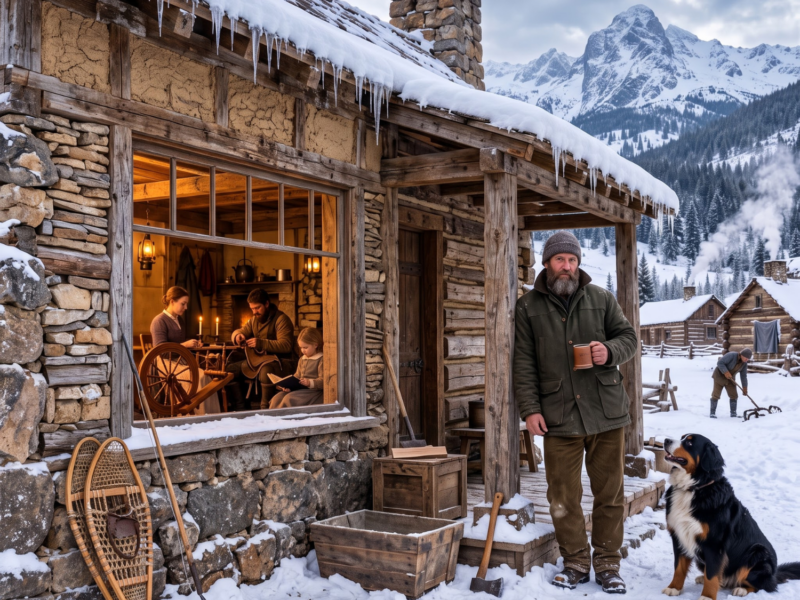
From the outside, it was a low, squat, heavily fortified structure. It looked far more like a military bunker or a natural outcropping of granite than a human dwelling. It completely lacked the tall, proud gables and the large, welcoming glass windows of Silas Thorne’s home.
Elias’s windows were very small. They were deeply recessed into the thick double walls, creating deep sills, and they faced strictly south to capture the low winter sun. The door was incredibly heavy, built of double-layered oak planks, and fitted snugly into a frame lined with felted sheep’s wool to prevent even the slightest draft from entering.
As the first light snows began to fall, dusting the sagebrush with white powder and signaling the definitive end of the building season, Elias retreated inside.
He gathered a modest pile of fuel—dried buffalo chips, twisted roots, and scraps of discarded lumber. It was a pile so incredibly small that Silas Thorne, passing by on his wagon on the way to town, loudly declared to his son that the immigrant would be completely out of firewood and frozen stiff before Christmas.









