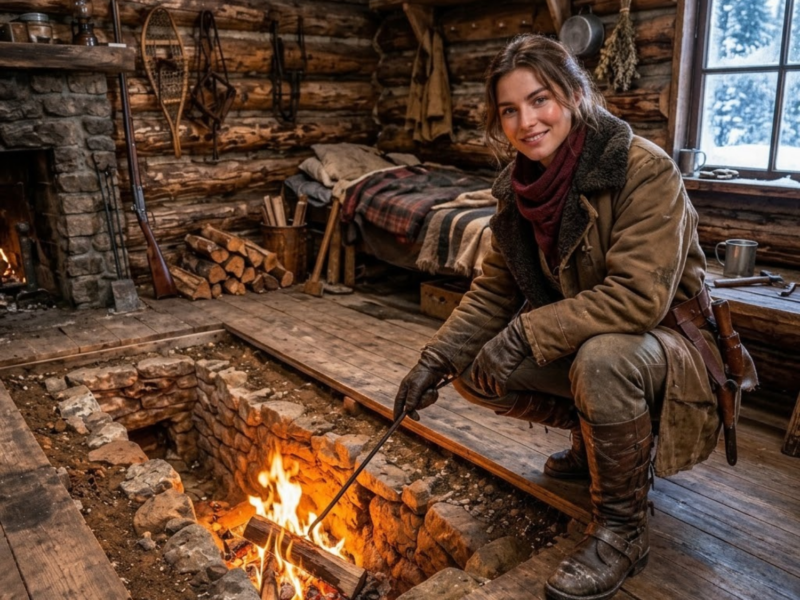
They Called His Floor Stupid — Until It Kept His Cabin Warm for 6 Days
The Making of a Mason
Marcus Webb wasn’t anyone special. Born in a cramped farmhouse in Ohio in 1803, he’d worked as a stonemason’s apprentice from the age of twelve, hauling mortar, squaring limestone blocks, and learning the stubborn language of mineral and weight. By 1828, at twenty-five years old and unmarried, he possessed a quiet, relentless streak of stubbornness that would serve him well when he looked west.
That year, he joined a trapping brigade heading for the Rockies—part of that restless generation of young men who saw opportunity in beaver pelts and untamed mountain streams. He spent his first three years trapping in various parts of the Rockies, learning the trade, learning the land, and learning what it took to survive the brutal high-altitude winters.
By 1831, he’d saved enough money from his pelts to file a land claim and build his own permanent place. He chose the Teton Valley in what would later become the Idaho territory. The valley offered everything a trapper could possibly need: rushing water, abundant timber, heavy game, and relative protection from the worst of the northern gales.
His first cabin was standard frontier construction: round logs, mud-and-moss chinking, a fieldstone fireplace, and a bare dirt floor. He built it in three weeks during the summer of 1831 and moved in before the first frost could catch him unawares.
That first winter taught him the same harsh lessons every mountain man learned the hard way. A standard cabin was barely adequate. The cold found every microscopic gap. The open fire devoured wood at an alarming, terrifying rate. The dirt floor was always cold, greedily conducting heat away from his body even when the stone fireplace roared with flames.
He burned six cords of wood that first winter. His hands were permanently raw and bleeding from splitting frozen logs. His back ached from hauling timber through deep drifts, and still, the cabin never felt truly warm. It felt survivable, and nothing more.
When spring finally arrived, washing the valleys in muddy brown runoff, Webb didn’t immediately start trapping. Instead, he spent days sitting on his porch, thinking about heat—about how it moved, where it went, and why his cabin was so utterly incapable of holding it.
He’d been trained as a stonemason. He understood how different materials behaved under thermal stress. Wood was an insulator of sorts, but it was thin, porous, and prone to drafts. Stone held heat. Wood did not. Air moved heat away rapidly through convection. Mass stored it.
He’d also read more than most mountain men. During his apprenticeship in Cincinnati, his master had owned a small, dusty library, and Webb had spent his quiet winter evenings reading whatever he could lay his hands on. One specific book—an aging translation of classical architecture—had described ancient Roman heating systems.
Hypocausts, they were called. Systems where hot air and exhaust from a subterranean fire traveled under raised floors and through hollow walls, heating an entire Roman villa from the bottom up. The Romans had heated massive public baths and noble estates this way. They’d understood a fundamental truth that frontier settlers had forgotten: You didn’t need to heat the air directly. You needed to heat the mass. The mass would then heat the air slowly, steadily, and efficiently.
Webb spent that entire summer thinking about how to adapt that classical principle to a log cabin in the Teton Valley.
He couldn’t build a true Roman hypocaust; that required specialized brickwork, slave labor, and Roman cement. But he could build something simpler, something rugged: a massive core of stone hidden beneath his wooden floor that would absorb heat during a fierce burn and release it slowly over the days that followed.
The challenge was twofold: he needed to heat that mass effectively without burning the cabin down, and he needed to build a floor that would allow the heat to radiate upward without blocking it entirely.









