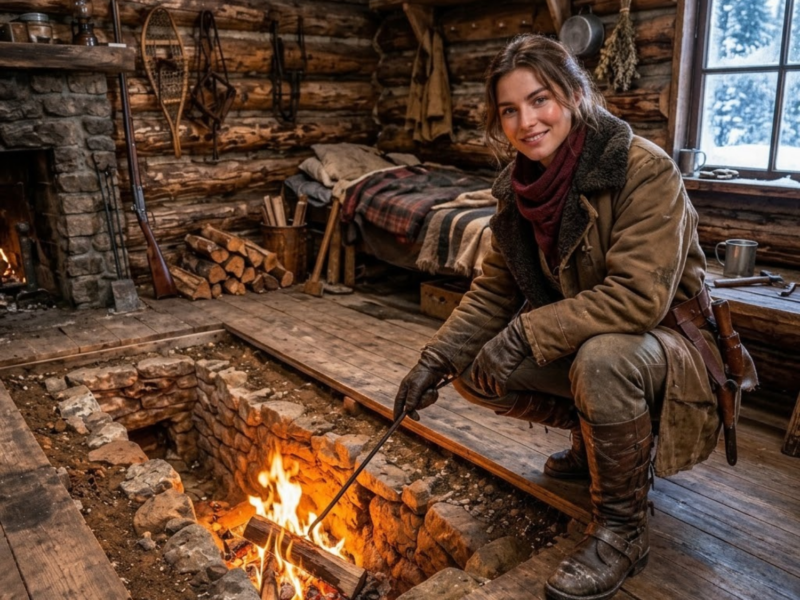
They Called His Floor Stupid — Until It Kept His Cabin Warm for 6 Days
The First Test of Fire
Webb’s neighbors remained intensely skeptical. They’d watched him slave all summer, hauling wet rocks until his mules nearly dropped. They’d seen the massive pile vanish beneath the floorboards. Most of them thought he was touched in the head—that he’d spent too much time alone in the high country breathing pine smoke.
Why go through all that backbreaking effort when a simple stone fireplace worked just fine for their fathers and grandfathers?
The answer arrived with the first real cold snap of October 1831.
The temperature dropped precipitously to ten below zero, frosting the window glass into intricate, fern-like patterns. Across the valley, other trappers and homesteaders immediately began stoking their fireplaces, burning wood steadily day and night just to keep ice from forming inside their water buckets.
Webb decided it was time. He built a fire in his hearth—not a towering bonfire, but a hot, intense fire using seasoned oak and dry birch that burned at a ferocious temperature.
He fed the fire steadily for about four hours, keeping the flames roaring and bright. The heat from the hearth was drawn down into the heating chamber by the draft, exactly as he had planned.
Standing in the cabin, Webb could feel the system working. The stones immediately surrounding the fireplace grew hot to the touch. As the hours ticked past, that warmth crept outward. He tracked its progress by walking across the cabin and touching the floorboards in different spots.
The section nearest the fireplace heated first, turning pleasantly warm. Then the warmth crept outward, moving methodically through the stone mass like warm water soaking through a dry woolen blanket.
After four hours of intense firing, Webb did something his neighbors would have thought absolute madness: He let the fire die.
He didn’t add more wood. He pulled the iron damper closed to trap the heat inside the system, let the remaining wood burn down to glowing coals, and eventually watched them turn to cold gray ash.
By evening, there was no fire burning in the cabin at all. Just four tons of hidden river stone, charged with thermal energy, and the fading light of a winter day.
The cabin stayed warm.
The floor continued radiating a steady, comforting heat upward. Webb slept that night in absolute comfort, the warmth rising from below making him feel as though he were sleeping on a heated brick in a German bakery.
When he woke the next morning, the cabin was still comfortable. Not as hot as when the fire had been actively roaring, but warm enough that he didn’t need to shiver while pulling on his boots.
On the second day, the cabin began to cool, but with agonizing slowness. The stone mass was so immense, having absorbed so much thermal energy, that it was releasing it back into the room at a fraction of a degree per hour. By the evening of the second day, the cabin was still noticeably warmer than the freezing world outside.
On the third day, the warmth persisted. The floor was no longer hot, but it was pleasantly warm to the touch—warmer than the surrounding air—and that ambient heat kept the interior temperature above freezing without a single stick of wood being burned.
On the fourth day, Webb built another fire.
The cycle repeated: four hours of hot, aggressive burning to charge the battery, followed by days of slow, steady, effortless warmth.
Webb kept meticulous notes in a small leather ledger that first winter. He recorded how long his fires burned, how much wood he used, and how long the warmth lasted after each ignition.
The results were nothing short of miraculous.
In the dead of winter, with outside temperatures consistently plunging below zero, he only needed to heat his cabin once every six or seven days. During milder autumn or spring periods, he could easily go eight or nine days between fires.
His total wood consumption for that entire winter was less than three cords.
The previous winter, working himself to the bone in his standard cabin, he’d burned six full cords of wood. He had cut his firewood needs by more than half, and his cabin had never once felt drafty or miserable.









