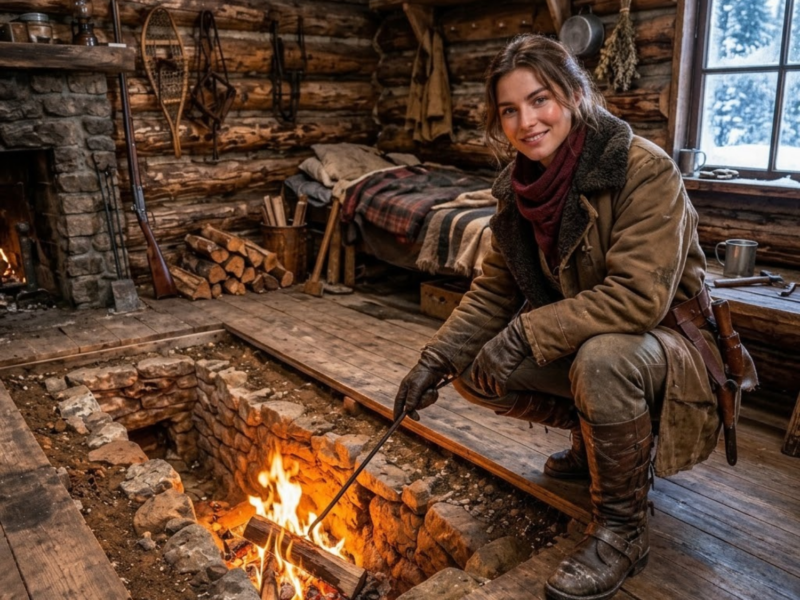
They Called His Floor Stupid — Until It Kept His Cabin Warm for 6 Days
The Winter of '37 and the Enduring Physics
The ultimate trial of Webb’s invention arrived with the winter of 1836–1837.
That winter went down in western lore as one of the most vicious on record. Temperatures in the high valleys stayed below zero for weeks on end, plunging past thirty and forty below during the polar surges. Snow piled twelve feet deep against the cabin eaves, trapping men indoors for days.
Across the region, standard cabins failed catastrophically. Trappers burned through their winter wood supplies by January, forced to tear down outbuildings, sacrifice furniture, or make perilous treks through blinding whiteouts just to find enough damp scrub oak to keep from freezing in their beds.
In Teton Valley, Marcus Webb’s cabin stood like an impregnable fortress of comfort.
Even when outside temperatures bottomed out at thirty-five below zero, the interior of his cabin hovered comfortably around forty-five to fifty degrees without a fire burning—and when he charged his stone mass every six days, the room rose to a cozy sixty-five degrees.
He didn’t run out of wood. He didn’t suffer frostbitten toes. He sat by his table, sipping hot coffee, reading his old books, while the gale tore the shingles off neighboring roofs.
When spring finally arrived, washing the valleys in a flood of muddy gray water, the local settlement looked like a disaster zone of broken chimneys and exhausted men. But Marcus Webb walked out of his front door looking rested, healthy, and entirely unbothered.
The mockery that had greeted him in the summer of 1831 was long dead and buried. By the late 1830s, Webb was no longer viewed as a stubborn eccentric; he was revered as a pioneer of survival, a man who had looked at the raw physics of the wilderness and mastered them with stone and brainpower.
His original cabin stood for over sixty years, weathering the decades until 1892, when his grandson finally dismantled it to build a larger modern farmhouse. When the old floorboards were pried up, the stone mass beneath was found to be entirely intact, soot-stained but structurally sound, as pristine as the day Webb had laid the final river stone sixty-one years prior.
Several of those original river stones were rescued and are preserved today in the Museum of the Mountain Man in Jackson, Wyoming, where visitors can press their hands against the cold basalt and imagine the invisible fires that once heated them in the deep, silent heart of the frontier.
The physical principles that Marcus Webb harnessed with a shovel and a collection of creek rocks are ones modern engineers and architects understand intimately today.
What Webb engineered by intuition and classical reading was a flawless application of thermal mass storage and radiant floor heating.
Stone has a high volumetric heat capacity; it can absorb vast quantities of thermal energy without spiking wildly in temperature, and it releases that energy with agonizing, beautiful slowness. By placing that mass inside the insulated envelope of the cabin—and isolating it from the damp earth below with a gravel bed—he ensured that every BTU generated by his hearth stayed inside the living space.
Modern passive solar homes, earth-sheltered dwellings, and advanced hydronic radiant floor systems all operate on the exact same thermodynamic truth that Marcus Webb discovered in an old book in Ohio and hammered into reality in Idaho:
You do not fight the cold by burning more fuel. You capture the heat you make, you anchor it in the earth, and you let the stone do the work.
Marcus Webb lived to eighty years old, passing away quietly in 1883. He lived to see the frontier transform, to see wagon trains turn into railroads, and to see the rough trapping camps settle into permanent towns and territories.
He never grew rich. He never sought fame, patents, or public acclaim. He lived out his days tending his traps, reading his books, and walking softly across a warm wooden floor that rested upon four silent tons of river stone.
If you had asked him late in his life what kept him alive through all those bitter Teton winters, he wouldn’t have pointed to his Sharps rifle, his steel traps, or even the iron stove in the corner.
He would have looked down at the floorboards beneath his boots, smiled that quiet, knowing smile of his, and told you to feel the warmth rising from the earth.
Because long after the wood turns to ash and the fire fades into the dark, the stone remembers.









