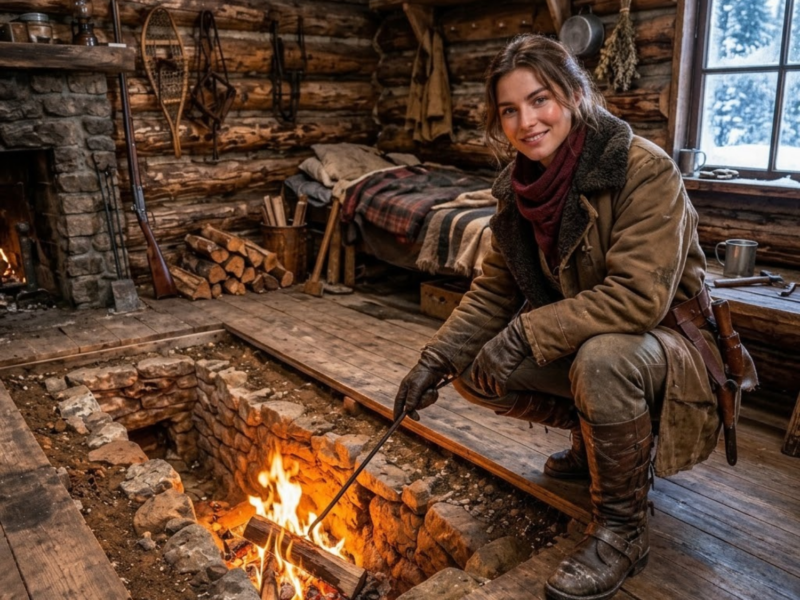
They Called His Floor Stupid — Until It Kept His Cabin Warm for 6 Days
The Conversion of the Valley
Word of Webb’s floor heating system spread through the mountains, slowly at first, then with the irresistible momentum of a proven truth.
That first winter, most trappers were too busy fighting for their own survival to pay attention to what the quiet Ohio stonemason was doing. But when spring unlocked the mountain passes and trappers gathered at the trading posts to swap pelts and stories, Webb’s cabin became the most talked-about topic from Fort Hall to Jackson Hole.
Some dismissed it still, clinging to their stubborn pride. But others were deeply intrigued.
The first person to visit and verify the rumor was Coleman, the grizzled trapper who had arrived during that freezing January snap of ’89. After seeing the dead fireplace and feeling the hot floorboards with his own hands, Coleman returned to his own claim the following summer and spent a grueling week hauling stones from the creek.
He built a rougher, simpler version of Webb’s system under his cabin floor. It didn’t perform quite as brilliantly as Webb’s masterwork—Coleman lacked the precise stonemasonry skills required for tight joints—but it worked well enough to cut his wood consumption by forty percent.
Coleman became an evangelist for the technique. Whenever he shared a bottle of whiskey with fellow trappers, he’d lean in close and preach the gospel of the thermal mass floor.
Over the next few years, variations of Webb’s design began popping up in trapping camps and homesteads throughout the Teton and Bitterroot ranges. Each builder adapted the core concept to their unique circumstances.
A trapper named Harrison built his cabin with two separate stone masses, one beneath the north half and one beneath the south half, allowing him to alternate which side he charged, keeping a perpetual thermal balance. A pair of inventive brothers from Pennsylvania built their underground heating chamber large enough to double as a primitive baking oven, using the residual stone heat to bake heavy rye loaves while keeping their living quarters snug.
The systems weren’t without flaws. They required monumental, back-breaking labor to install. They required access to the right kind of river stones. If a builder got lazy and left gaps in the channel design, soot and ash could clog the system, requiring a messy excavation to clear.
Yet, for those willing to pay the price in sweat during the summer, the reward was a winter of unprecedented comfort and freedom.
For Marcus Webb, the greatest gift wasn’t just the warmth—it was time.
In a standard cabin, winter was an endless, grueling cycle of slavery to the hearth: chopping, hauling, splitting, feeding, waking up shivering in the dark to shove another log into the jaws of a greedy iron stove.
With his four-ton thermal battery beneath the floor, Webb broke those chains. He could stoke his mass once a week and spend his days hunting elk, checking his trap lines, or reading by candlelight without the constant, nagging anxiety of a dying fire.
The stone mass was a faithful servant. It held what he gave it, and it gave it back when he needed it most.









