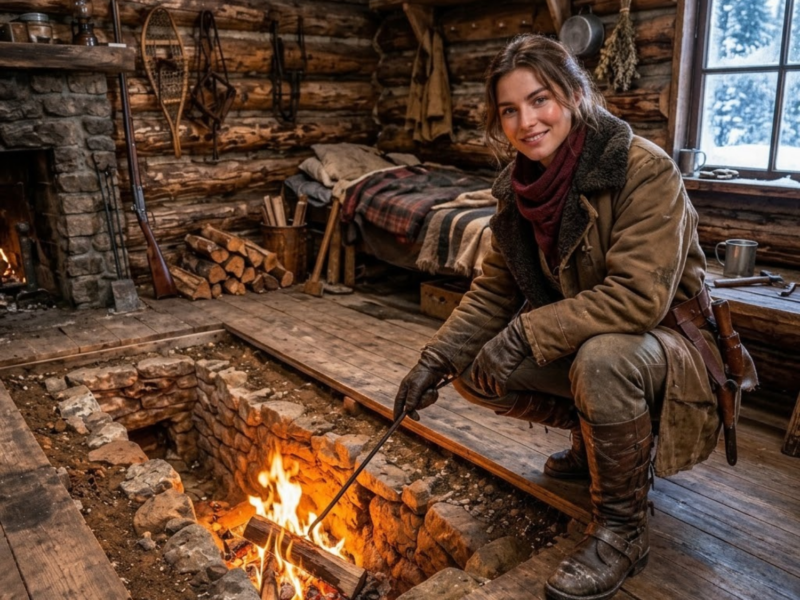
They Called His Floor Stupid — Until It Kept His Cabin Warm for 6 Days
Four Tons of River Stone
He started by hauling stones—hundreds of them.
He pulled them from the creek bed half a mile from his cabin, selecting them with the eye of a master mason. He wanted large stones, fifty to one hundred pounds each. Smooth river stones were best; they’d been shaped by rushing water over centuries, and they fit together more efficiently in tight spaces than jagged, quarried blocks.
Every day that summer, he made multiple trips to the creek. He’d load his rickety wooden wagon with as many stones as his two mules could pull, the axles groaning under the strain. He’d haul them to his cabin site, unload them into a massive pile, and then go back for more.
His neighbors thought he’d completely lost his mind.
One trapper, a French-Canadian named Dubois who ran lines near the foothills, stopped his horse one afternoon to watch Webb heave a massive basalt boulder off the wagon.
“What are you building, Webb?” Dubois asked, wiping sweat from his forehead.
“Building a floor,” Webb said, breathing heavily.
“With rocks? Why not just pack earth like everyone else? It’s what the good Lord gave us.”
“These stones are going under the floor. They’ll hold heat.”
Dubois frowned, spitting a stream of tobacco juice into the dust. “Hold heat from what? The ground is cold.”
“From the fire. I’m going to heat them with the fire, and they’ll keep the cabin warm.”
Dubois shook his head slowly, clucking to his horse. “That’s not how heat works, boy. Heat goes up. Always up. Your stones under the floor won’t do a damn thing.”
“We’ll see,” Webb said.
“You’re wasting your summer,” Dubois called out as he rode away. “Beavers are still bringing good money. You’re gonna freeze to death while you’re playing with pebbles.”
Webb ignored the talk. He kept hauling stones. By midsummer, he had enough. He figured the pile weighed close to four tons, maybe more.
Then he began the real, agonizing work.
First, he had to dig. He excavated the entire area inside his planned cabin footprint to a depth of two feet. This was brutal, back-breaking labor: cutting through stubborn pine roots, prying out buried boulders, and creating a perfectly level subterranean surface. The excavation alone took him two solid weeks of blisters and sore muscles.
Then he created a base layer. He spread a thick, uniform bed of coarse gravel over the excavated area, creating essential drainage and a stable foundation that would prevent the stones from shifting or sinking into the damp earth. Over the gravel, he placed a layer of flat stones fitted together as tightly as humanly possible. This was the floor of his thermal mass.
Then came the critical, engineering part.
He began building up layers of stone, but not in a solid, monolithic pile. He created channels—deliberate, arched gaps between certain stones that would allow heated air to flow through the mass. These channels started near where his fireplace would be and spread outward through the stone mass like the branches of a tree or the vascular system of an animal.
The pattern was entirely intentional. Heat from the fire would be drawn down and through these channels, warming every single stone it passed along the way. He built the stone mass in deliberate courses, each one carefully shimmed and fitted. The stones had to be tight enough to transfer heat efficiently to one another through direct conduction, but the channels had to remain unobstructed so air could move. It was like building a massive, three-dimensional puzzle where every single piece had to relate harmoniously to all the others.
As the stone mass rose, Webb checked it constantly with a long, straight board and a spirit level he’d carried all the way from Ohio. Every few courses, he’d shim, adjust, and tap stones into place with his mallet. Everything had to be level to support the floor evenly later.
By late summer, the stone mass stood about eighteen inches high, filling the entire floor area of the cabin. The channels threaded through it like veins in a living body. The whole monolithic structure weighed somewhere between four and five tons. It was, without question, the most unusual cabin foundation anyone in the Idaho territory had ever seen.









