They Called The Widow “Poor” and Took Her Seat—Five Minutes Later,They Learned Whose Railroad It Was
They Called The Widow "Poor" and Took Her Seat—Fiv…
They Called The Widow “Poor” and Took Her Seat—Five Minutes Later,They Learned Whose Railroad It Was
PROLOGUE: THE STUB AND THE SEAT
The Elkhorn and Northern Railway did not run on iron alone; it ran on arithmetic, deference, and the quiet, heavy knowledge of who owned the mortgage.
On an October Tuesday in 1888, inside the stale, wood-smoke-choked air of a second-hand parlor car, a ticket stub was worth precisely as much as the man whose name was written on it. Or, more precisely, as much as the man who was willing to shout the loudest.
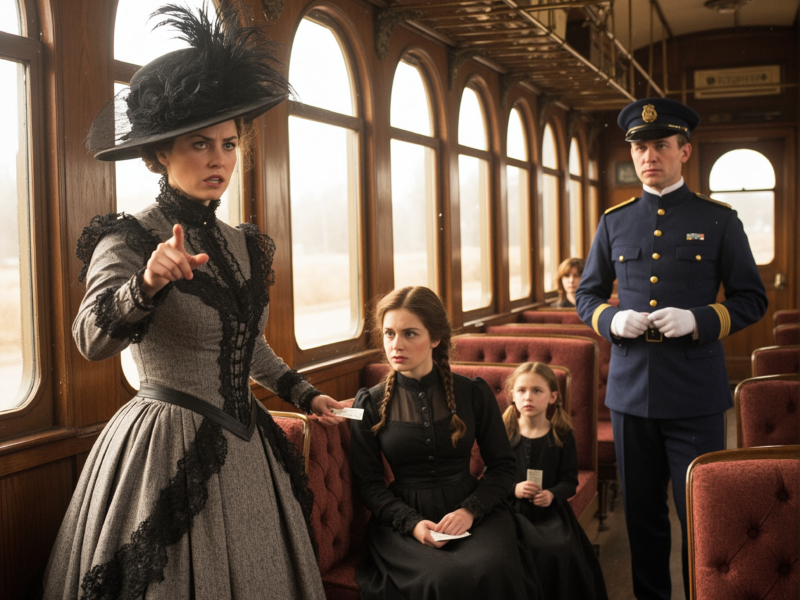
Mrs. Pauline Fields, draped in a gray traveling suit cut in Chicago and wearing a hat that had cost more than a year’s flour for a homesteader’s family, did not shout. She did not need to. Her husband’s cattle grazed on sixty thousand acres of grass north of Ainsworth, and in October, those sixty thousand acres were the only reason the Elkhorn and Northern didn’t roll its engines into the ditch and rust away into the sand hills.
So when Pauline wanted seat one—the padded velvet chair by the forward window, right where the stove drew properly and the view of the bluffs was unbroken—she simply looked at the conductor, and the conductor looked at her ticket stub, and the arithmetic took care of the rest.
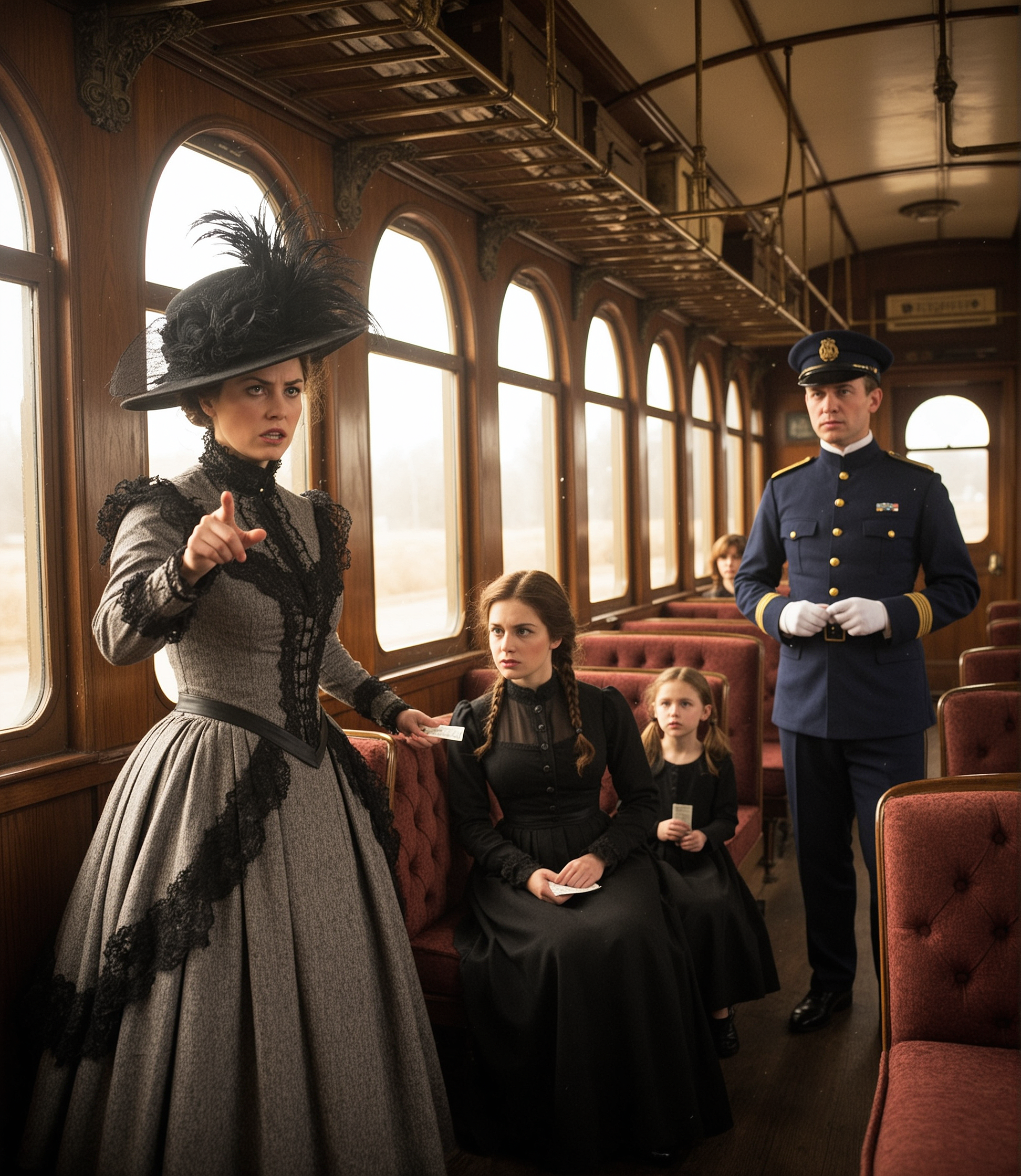
“Get that poor woman out of my chair,” Pauline had said, her voice dropping into the hushed, carrying register of the truly wealthy. “Women dressed like that ride in the day car, not across from me.”
The woman she referred to was thirty-four years old. Her black coat had been black for a year, and the black had gone thin and brown at the elbows, the way cloth does when a woman owns one good thing and wears it to everything. Her boots were mended across the toe with awkward, thick stitches. Beside her stood her daughter, Rose, ten years old, clutching a bunch of crushed prairie asters wrapped in newspaper against her chest.
The conductor, Philip Craig, had Jane Newman’s ticket stub in his pocket, already punched. He had seen with his own eyes that the number on it was one.
He had looked at it. Then he looked at Pauline Fields’s hatbox, and he did the arithmetic that men in his position do in about a second and a half.
He told Jane Newman there had been a mistake in the assignments. He told her she would be more comfortable in the day car. And when she refused—quietly, without raising her voice, simply stating that she had bought the seat and paid the extra fare out of a tin box on her kitchen shelf—Philip Craig took out his stiff, folded car diagram, drew a neat line through the name in seat one, wrote another name above it, and added four small, clean words beside the change: At passenger’s request.
Jane Newman stood close enough to read them upside down. She did not point at them. She did not scream. She read the words, and the reading changed her face in a way nobody in that car was watching closely enough to notice.
She took her daughter, her mended boots, her black coat, and her crushed asters, and she walked out of the parlor car.
Neither Philip Craig, nor Pauline Fields, nor the division superintendent who later threatened her with the sheriff, nor the general manager sitting warm in his Grand Island office had the faintest, darkest inkling of the truth. They thought they were displacing a widow with frayed cuffs.
They were standing on the neck of the woman who owned every spike, tie, rail, and piston of the 96 miles of iron beneath them.
Related Articles

They Mocked the Widow’s Dirt Cellar—Then the Freeze Left Every Cabin Cold but Hers Warm
They Mocked the Widow’s Dirt Cellar—Then the Freeze Left Every Cabin Cold but Hers Warm…

A Homeless Veteran and His German Shepherd Inherited a Ridge No One Wanted — 35 Feet In, They Found
Chapter 1 / 7 A Homeless Veteran and His German Shepherd Inherit… A Homeless Veteran…

Neighbors Laughed When He Built A Cabin Inside An Old Barn—Until It Kept His Home 35 Degrees Warmer
Chapter 1 / 8 Neighbors Laughed When He Built A Cabin Inside An… Neighbors Laughed…

His Sod House Had No Woodpile in January – Until the Trains Stopped and the Town Came Begging
Chapter 1 / 10 His Sod House Had No Woodpile in January – Until t……

She Built Her Cabin Over the Woodshed and Never Burned Wet Wood Again
Chapter 1 / 8 She Built Her Cabin Over the Woodshed and Never Bu… She…

The Duke Abandoned Her on Their Wedding Day—Years Later, He Discovered What He Had Lost
Chapter 1 / 7 The Duke Abandoned Her on Their Wedding Day—Years… The Duke Abandoned…

He Wedged a Tiny A Frame Into a Crevice Before Winter and His Family Slept at 75°F While Town Hit
Chapter 1 / 7 He Wedged a Tiny A Frame Into a Crevice Before Win……

He Was Too Old to Ride—So He Bought the Ruined Ranch and Found the Room Behind the Fireplac
Chapter 1 / 5 He Was Too Old to Ride—So He Bought the Ruined Ran……

Settlers Laughed at His Underground Heat Recovery Duct — Until It Kept His Cabin 71°F Warmer
Chapter 1 / 9 Settlers Laughed at His Underground Heat Recovery… Settlers Laughed at His…

A Navy SEAL Built a Home Inside a Mountain—Then His Dog Warned Him Before the Storm
Chapter 1 / 5 A Navy SEAL Built a Home Inside a Mountain—Then Hi… A…