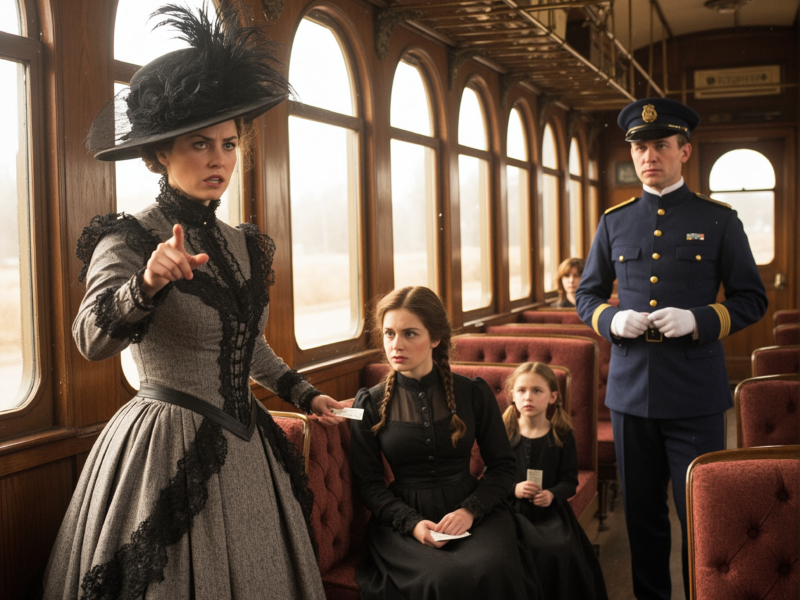
They Called The Widow “Poor” and Took Her Seat—Five Minutes Later,They Learned Whose Railroad It Was
THE RATE BOOK AND THE MOURNING VEIL
To understand how Jane Newman came to be standing on the windswept, creosote-smelling platform of Elm Creek with a carpet bag and a dead man’s watch, one had to go back to a bedroom in Grand Island that smelled of camphor and cold tea.
Clarence Newman had built the Elkhorn and Northern with his bare hands, a borrowed surveyor’s transit, and a stubbornness that outlasted two panics and a grasshopper plague. He had walked the grade himself in 1880 alongside a man named Hubert Wade. By the time his lungs failed him in October of 1886, Clarence had laid 96 miles of track from the junction at Grand Island to the stock pens at Ainsworth, putting together three wheezing locomotives, two combination cars, and a single second-hand parlor car with buttons tufted into the velvet.
He had left it all to his wife.
The controlling stock of the railroad came to Jane along with the house and the tin box on the kitchen shelf. But Clarence, dying and half-delirious in the autumn of ’85, had signed the voting power of his stock over to the road’s general manager—a careful, pleasant, well-spoken man named Roland Warner—with the understanding that Warner would manage the property until the paper was formally revoked in writing at a meeting of the stockholders.
There had not been a meeting of the stockholders in two years.
Every letter Jane wrote to Grand Island came back inside a week in Roland Warner’s elegant, Spencerian hand, full of regret and figures. The road was in delicate condition. The Fields contract was the only thing keeping it alive. A woman in mourning should not be troubling herself with tariffs and ties.
For a year in a house with nobody in it, Jane Newman had spent her evenings reading her husband’s rate book. Not because she meant to run a railroad—though the thought had flickered like a distant prairie fire—but because it was his handwriting, and it was the only part of him left that was still speaking to her. She learned every schedule, every tariff, and every hidden cost. She learned that the printed tariff for hauling a car of steers from Ainsworth to Grand Island was thirty-one dollars. She learned that it cost the road nineteen dollars and some cents to move it.
And she learned, through a series of freight manifests she had quietly copied when the local station agent wasn’t looking, that the Fields cattle outfit—Pauline Fields’s husband—was paying fourteen dollars a car.
For three years, the Elkhorn and Northern had been hauling 60,000 acres of beef at a five-dollar loss per car, bleeding slowly and quietly while Roland Warner smiled from his carpeted office in Grand Island and told her a widow had no business looking at books.
Eleven days ago, Jane had walked into the Grand Island ticket window in her old black coat, laid down her own money, and bought two seats in her maiden name—a name no clerk on that road had ever seen written down.
She wanted to see the ties. She wanted to see the water tanks. She wanted to see what her husband had died building.
What she had seen so far was a conductor draw a line through her name, and a division superintendent named Dwight Hopkins tell her that a railroad was not a court, and she could take the pass or take the platform.
She took the platform.









