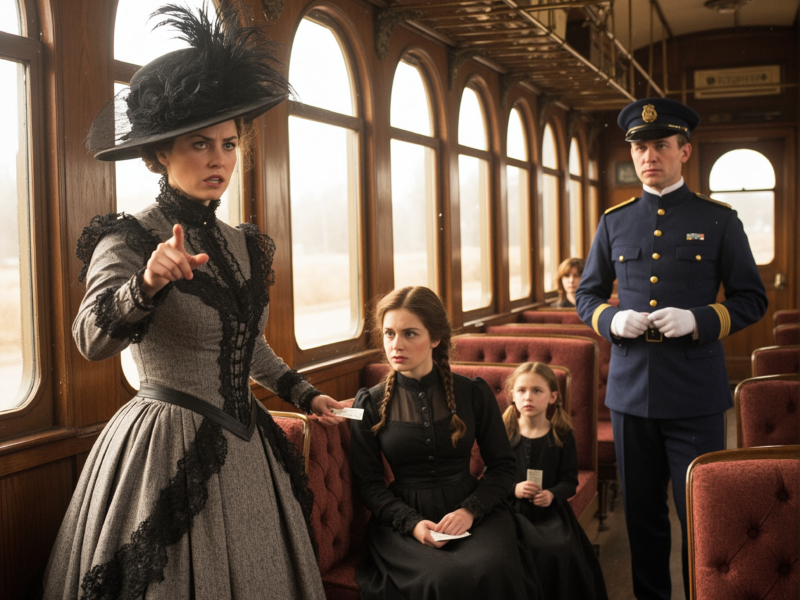
They Called The Widow “Poor” and Took Her Seat—Five Minutes Later,They Learned Whose Railroad It Was
THE WAITING ROOM INQUISITION
They went into the waiting room—one cast-iron stove, four hard oak benches, and a barred ticket grill. Within three minutes, it was packed shoulder-to-shoulder.
Passengers came down from the day cars. The section gang crowded in behind Hubert. Marvin Riley stood by the door with his way-bill satchel. Up in the parlor car, Pauline Fields remained seated, but the silence from the station echoed through the open windows like a gathering storm.
Jane did not ask for her seat back. When Philip Craig hurriedly sent the porter forward to clear Pauline’s things out of seat one, Jane told him to leave them right where they were.
Instead, she asked for the car diagram.
Philip brought it to her with trembling fingers. Jane carried the stiff cardboard card to the ticket shelf beneath the window where the afternoon light was sharpest, and she read it out loud to the room.
“Seat one,” Jane read, her voice ringing clear against the ticking stove. “The name struck through in pencil. A new name written above it. And beside the change, four small, clean words in a small, clean hand: At passenger’s request.”
She paused, letting the silence settle like lead shot.
“Whose request?” Jane asked.
Philip Craig did not answer. He stared at a knot in the pine flooring.
“I am the passenger,” Jane said, turning slowly to face him. “Did I request it?”
“No, Mrs.”
“Then who wrote those words?”
“I did,” Philip whispered.
Jane laid the card down on the counter. “Mr. Craig, you were rude to me in front of a car full of people. I have been rude to people myself and lived through it. That is not what this is. You wrote down a thing that did not happen on a company record so that a wrong would look lawful. Do you understand that those are not the same offense?”
Dwight Hopkins stepped forward, shouldering his way through the farmers. He was done being polite; he was back to being the superintendent.
“I take full responsibility for the operating decision,” Dwight barked, his voice booming in the small room. “We’ll look into the rest of it privately at Grand Island—”
“You have looked into it privately eleven times this year, Mr. Hopkins,” Jane said.
Dwight’s face didn’t twitch, but the air went out of him. “I don’t know what you’re implying, Mrs. Newman.”
“The complaints book in that office drawer,” Jane nodded toward the inner door. “How many entries are in it since January?”
“I could not say offhand.”
“How many of them are marked SETTLED?”
Dwight swallowed. “It’s a busy road.”
It was the closest thing to an admission anyone would get out of him, and the room heard it. The spell was broken. A farmer from Burwell—a man named Galt whose family had lost two carloads of hogs to unexplained shipping delays the previous spring—stepped out of the crowd.
“I was in the day car in August,” Galt said loudly. “There was a woman put back out of the front car with two children, and everybody knew it, and nobody said anything.”
A traveling man with a sample case raised a hand. “The seats behind the stove have been empty the whole way up. I had my coat on one of them, and the conductor told me it was reserved for ‘special transit.'”
An elderly woman in a neat bonnet spoke up from the bench. “I was moved out of seat four in September,” she said quietly, not looking at anyone. “I didn’t make trouble. I’m seventy-one. I travel alone, and I don’t care to be the sort of person who makes trouble.”
That one landed like a heavy iron rail dropped on stone. You could feel the room turn. The collective shame of a hundred small indifferences rose up and choked the air.
At the back, Marvin Riley placed his satchel on the bench, stood up straight, and raised his chin.
“Mr. Hopkins,” Marvin’s voice cracked slightly, but he didn’t back down. “I carried that August complaint to the agent myself, and I wrote the date on it. It was the ninth. And the September one was the twenty-sixth. I know because I copied them both into the daybook before I handed them over.”
Dwight glared at him with murderous hatred. “Sit down, Riley.”
“No, sir.”
“You are nineteen years old and you are a clerk at a flag stop,” Dwight snarled. “You might want to give some thought to how long you intend to be either of those things.”
Marvin’s hands were shaking—everyone could see them trembling—but he stayed on his feet. And in that second, half the people in the waiting room quietly crossed an invisible line and stood beside a nineteen-year-old clerk.
Before the argument could turn to shouting, the heavy oak door swung open, bringing a gust of cold prairie air and a fresh figure into the room.
It was Pauline Fields. She had grown tired of waiting in her parlor car while her servants watched from the windows. She came two steps into the room, her gloves clutched in one hand, her chin tilted at an angle that had cowed half the county commissioners in Nebraska.
“I know who you are, Mrs. Newman,” Pauline said, her voice dripping with aristocratic irritation. “Mr. Wade made your name loud enough for the county. But I also know who pays for this road, and it is not you.”
She gestured toward the tracks outside with her gloved finger.
“We ship a thousand head before the fifteenth, and it will be nine hundred more in the spring. And if I take them south to the Burlington, the men standing in this room lose their places inside of a year. That is not a threat. That is arithmetic. So by all means, have your little inquiry about a chair.”
She looked around the room, not with a sneer, but with the terrifying, sincere conviction of a capitalist who believes her ledger is the voice of God.
“Every man here knows which of us this road cannot do without.”
Nobody contradicted her. Hubert Wade looked at the floorboards. Philip Craig looked at his boots. The farmer from Burwell looked at his hat.
And Jane Newman said nothing at all. Which several people in that room took for defeat, and which was the most dangerous thing she could possibly have done.









