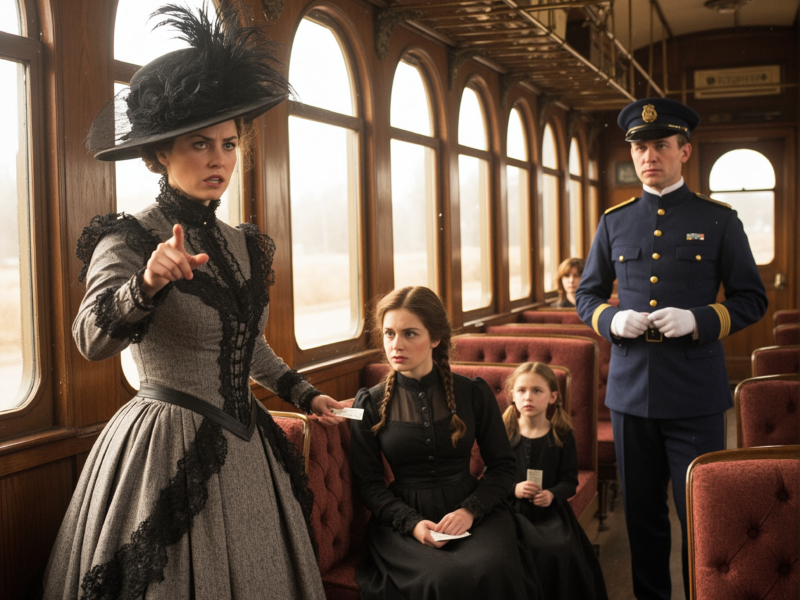
They Called The Widow “Poor” and Took Her Seat—Five Minutes Later,They Learned Whose Railroad It Was
THE ROADMASTER OF THE NORTH END
Five minutes after Jane Newman stepped down off the parlor car of her own railroad, a handcar came rattling down from the north with four section men pumping the levers in rhythm. It stopped at the water tank, and an old man got off it stiff-legged, slapped the alkali dust off his thighs, and started up the platform toward the freight room.
He was sixty-four years old. He had a gray mustache, a steel tape measure clipped to his belt, and a face carved out of harness leather and oak burl. He had been roadmaster of the Elkhorn and Northern since the day there was an Elkhorn and Northern to be master of.
His name was Hubert Wade.
Hubert got about halfway down the platform, his boots thudding heavily against the pine planks. Then he stopped. He stopped dead in his tracks, his weathered hand hovering over his belt.
He looked at a woman in a worn black coat standing by the depot wall with a little girl and a handful of smashed asters.
The whole of his face dissolved. The hard, suspicious lines of a man who spent his life fighting washouts and frozen spikes melted away. He took off his wide-brimmed hat, holding it against his belt buckle.
“Mrs. Newman,” Hubert said.
It was not loud. It did not have to be. The platform of a country depot in a lull is about as quiet as a church, and there were twenty-two people standing on it. The name went across those boards like a stone skipped across glassy water.
Philip Craig froze six feet away with his silver pocket watch dangling from its chain. Dwight Hopkins turned around from the stock chute with his mouth still open on the last word of instructions he was giving a drover. Up in the parlor car, Pauline Fields set her coffee down so hard the china chipped against the tray.
Hubert Wade came the rest of the way. He walked up to Jane, looked down at her mended boots, and then looked into her eyes.
“I haven’t seen you since the funeral, ma’am,” Hubert said, his voice cracking slightly on the consonants. “Clarence… Clarence walked me up this very creek in ’81 and showed me where the tank was going to stand.”
He put his hat back on, pulling it low. “How’s the north end holding up, Mr. Wade?” Jane asked.
Hubert opened his mouth to answer, but Philip Craig pushed through the crowd, his uniform jacket buttoned tight, his face flushed with the sudden, panicky blood of a man who realizes he has kicked a sleeping dog and found out it has iron teeth.
“If the lady wishes,” Philip stammered, “the road can certainly find her something more suitable up front—”
“How long before the steers are loaded?” Jane asked, cutting him dead.
“Twenty minutes,” Philip said.
“Hold the train,” Jane said.
Philip stared at her. He looked at Dwight Hopkins, who had hurried up, his face gray beneath the coal dust. Dwight looked at Hubert Wade.
And Hubert Wade, who had built ninety-six miles of railroad for Clarence Newman, and didn’t give a single, solitary damn about Philip Craig’s hat or Pauline Fields’s cattle, spat a stream of amber tobacco juice into the cinders and said:
“You heard her.”









