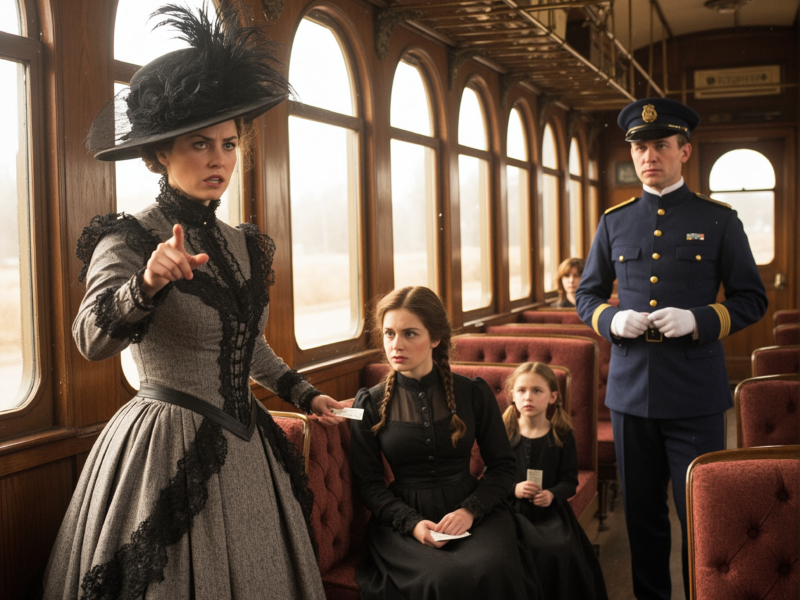
They Called The Widow “Poor” and Took Her Seat—Five Minutes Later,They Learned Whose Railroad It Was
THE STATION CLERK OF ELM CREEK
The Elm Creek platform was forty feet of splintered pine planking with a water tank at one end and a stock chute at the other. October wind blew down from the sand hills, carrying the raw scent of cattle dung and wet coal smoke.
Rose stood with her back against the depot wall, clutching her newspaper-wrapped asters. She didn’t cry. She didn’t ask her mother why they didn’t just turn around. She simply watched the parlor car windows where Pauline Fields was being brought coffee by a sweating porter.
“Why didn’t you tell them who you are?” Rose asked softly.
Jane crouched down so their faces were level. Her knees ached from the damp, but she kept her spine straight.
“Because if they are decent to us only after they find out what I am,” Jane said, her voice steady against the howling wind, “then they were never being decent to us at all. They were being careful. Those are two different things, and only one of them is worth having.”
“But they made everybody think we were lying.”
“The truth doesn’t get any smaller because a room full of people didn’t recognize it,” Jane said, smoothing a strand of hair back under the girl’s hat. “It just has to wait.”
While the train sat panting at the water column, taking on three cars of stock, a young man came out of the freight room with a leather way-bill satchel strapped across his chest. He was nineteen, thin, with ink stains permanently etched into the skin of his right index and middle fingers.
His name was Marvin Riley, the station clerk at Elm Creek. He had ridden down to the junction that morning, and he had seen the car diagram on Philip Craig’s knee.
Marvin stopped a few feet from Jane, shifting his weight from one boot to the other with the agonizing hesitation peculiar to nineteen-year-olds who know they are about to ruin their prospects for a woman they barely know.
“The day car is full, Mrs.,” Marvin said, looking at the gravel between his boots.
“There are two seats together behind the stove,” Jane replied calmly. “And there have been two seats together behind the stove since Grand Island.”
Marvin looked up sharply. “I sat in one of them for eleven miles this morning. Mr. Craig walked past them twice. He looked at the boards. He knew.”
“Why are you telling me this?”
“Because it’s the third time this season,” Marvin said, the words tumbling out of him now like grain from a torn sack. “A woman and two children put back in August for a man who bought cattle. An old fellow from Bassett moved out of seat four in September so a land agent could sit by the window. And now this.”
He swallowed hard, his Adam’s apple bobbing in his thin throat. “I went to the agent both times, and the agent went to Dwight Hopkins, and both times word came back that the matter was settled. I’ll say it out loud if somebody asks me.”
Jane looked at the boy. She saw the ink on his fingers, knew his mother lived in a sod house two miles up the creek, and knew that his forty-dollar-a-month job was the only thing keeping his family from the poor farm.
“Don’t,” Jane said.
“Mrs.—”
“Don’t, Marvin,” Jane repeated, her tone dropping into a quiet, absolute register. “Unless somebody with authority asks you in front of witnesses. Promise me that.”
Marvin promised. As he shifted his satchel, the flap fell open. For precisely four seconds, Jane’s eyes caught the top way-bill in the stack—the Fields consignment out of Ainsworth, written out in a clerk’s careful hand. Down at the bottom, in the rate column, was a single number: 14.
She didn’t say a word. She looked at it the way a sailor looks at a reef he has mapped out in his dreams.
Inside the depot office, Dwight Hopkins was at the agent’s desk writing a wire message. He was division superintendent, a man who had spent nineteen years deciding that his primary duty was to keep the big shipper content and the complaints off the general manager’s desk. In his second drawer was a black clothbound book with COMPLAINTS stamped in gold. Inside it, in Dwight’s hand, were eleven entries for that year, every single one of them marked SETTLED.
Unsettled, there was nothing. No interview, no name, no reason. Dwight had learned long ago that a complaint written down is a complaint that can be asked about later, and a complaint marked SETTLED is a complaint that is over.
He finished his message—Passenger disturbance Elm Creek resolved, no delay reportable—and stepped out onto the platform to check his steers.
He had five minutes. That was all.









