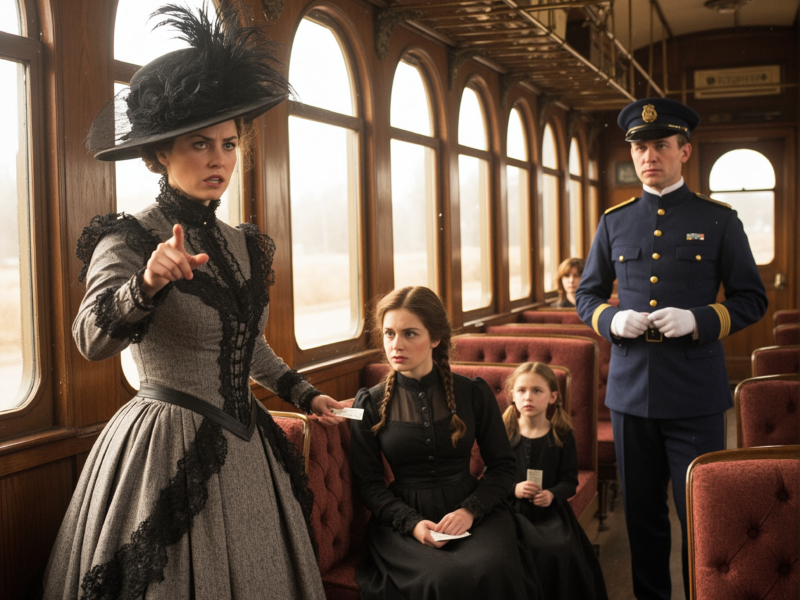
They Called The Widow “Poor” and Took Her Seat—Five Minutes Later,They Learned Whose Railroad It Was
THE GHOST OF THE RICE-FIELD
It took Roland Warner three hours and ten minutes to steam up the line.
When he came through the waiting room door at Elm Creek, he didn’t look like a thief; he looked like a grieving friend. He wore his overcoat open, his hat in his hand, and a mask of profound, executive sorrow carefully arranged across his features.
He took Jane’s hand in both of his. He said Clarence’s name with just the right catch in his throat. He told her it had been unforgivable of him not to come up himself a year ago.
And it sounded so damnably like the truth that two people in the room actually reached for their handkerchiefs.
Then Roland sat down on the bench beside her, placed his hat on his knee, and began to explain how the world worked.
“The road’s trouble, my dear Jane,” he said softly, pitching his voice for the room to hear, “is that it has one shipper and no margin. The Fields business is the difference between running and not running. I’ve spent two years keeping that woman’s freight moving so men like Hubert Wade would have bread on their tables. I’d do it again tomorrow. And if a widow’s chair was the price of it… well, I am sorry, but it is a cheap price to pay for a living railroad.”
He looked around the room, gathering their nods. He had won. He had framed the debate so that anyone who opposed him was voting to starve the section gangs.
Jane waited until he was entirely finished. She didn’t raise her voice. She simply reached into her carpet bag and pulled out a small, leather-bound notebook.
“Mr. Warner,” she said, her voice cutting through the hiss of the stove. “What does the printed tariff say a car of steers costs from Ainsworth to Grand Island?”
Roland blinked, thrown off rhythm for the first time. “Thirty-one dollars, ma’am. The same as it has since ’82.”
“And what does it cost this road to move one?”
“Nineteen dollars and… well, operating costs fluctuate—”
“What does the Fields outfit pay?” Jane asked, her gray eyes locking onto his.
Roland’s mouth stayed open for a fraction of a second too long. “That is a confidential commercial contract—”
“It is fourteen dollars,” Jane supplied smoothly. “It has been fourteen dollars since the spring of 1885. Mr. Warner, would you care to tell these men what happens when you haul ninety-six miles of cattle for five dollars less than the coal and grease costs to pull them?”
The waiting room went dead. Not a cough, not a shuffle of a boot.
Roland Warner stood up slowly, the sorrow completely gone from his face, replaced by the hard, glittering calculation of a man who realized his knife had just been turned against his own ribs.
“Rates are an operating matter,” Roland said, his voice dropping its warm paternal cadence, turning thin and sharp. “And operating matters are mine. Under the paper in my safe, the management of this property rests with me until January. You are an owner of stock, Mrs. Newman, nothing more. You have no operational authority.”
“Then let’s talk about the operation,” Jane said. She stood up, smoothing the front of her worn black coat. She turned to the crowd of farmers, section hands, and clerks.
“My husband never signed that Fields contract,” she announced, her voice ringing off the rafters. “Mr. Warner signed it. He signed it the exact same spring he sat in Clarence’s sickroom and had him sign away the voting stock.”
Hubert Wade stepped out of the shadows, his face dark with a rage older than the railroad.
“Roland,” the old roadmaster whispered, stepping right up to the general manager’s chest. “I’ve known you nine years. Tell her she’s lying. Tell me she’s wrong about the north twenty miles not seeing a new tie since ’86. Tell me why my reports came back from your office with the figures shaved down.”
Roland didn’t look at Hubert. He looked at Dwight Hopkins.
“Get her out of this office,” Roland ordered.
Dwight Hopkins looked at the black clothbound complaints book still resting on the ticket shelf. He looked at young Marvin Riley, whose hands were no longer shaking. And then Dwight did something that surprised everyone, most of all himself.
He walked over to the desk, picked up his hat, and laid his set of station keys down on the wood.
“I can’t do that, Mr. Warner,” Dwight said quietly. “Because for eleven months out of the year, I’ve been the man who wrote SETTLED over things that were rotting right under my boots.”
EPILOGUE: THE DAY CAR RIDE
The sun went down behind the sand hills, turning the sky the color of a fresh bruise—purple and orange along the western rim.
The special car waiting on the siding took Roland Warner south that night, alone except for his ledgers and the cold realization that January was coming, and with it, a stockholders’ meeting where three years of forged tariffs and suppressed maintenance reports would be laid out on a table before men who knew how to use a rope as well as a pen.
Before the train pulled out, Pauline Fields came across the platform. She didn’t offer her hand—she was too proud for that—but she looked Jane Newman straight in the eye.
“I would have paid the thirty-one dollars from the start,” Pauline said stiffly. “Nobody ever asked me to.”
“I believe you,” Jane said.
Both statements were entirely true, and neither made the evening any less bitter, but the two women understood one another with the crystal clarity only money and power can forge.
On the northbound local that followed twenty minutes later, the parlor car was dark and empty. Philip Craig had been dismissed before the switch was thrown; his four clean words on the car diagram had cost him nineteen years of seniority.
In the day car behind the engine, where the stove radiated a dry, roaring heat that smelled of scorched iron and damp wool, two new passengers climbed aboard.
It was a woman named Delia and her eight-year-old boy, Ben, whose legs were splinted from ankle to hip, traveling down to Ainsworth to see the bone-setter. They had day-car tickets and forty miles of hard wooden bench ahead of them.
Jane didn’t ask. She simply stood up, took the boy by his good shoulder, and led them both forward into the empty, velvet-upholstered splendor of the parlor car, settling them into seat one and seat two right by the forward window.
When Rose asked her mother why she was giving the good seats away after all the trouble it took to claim them, Jane adjusted the girl’s collar and looked out through the glass at the dark, rushing prairie.
“I never wanted the chair, Rosie,” Jane said softly. “I just wanted to know who was sitting in it.”
The train rolled north through the dark, its iron wheels singing against the spikes that Clarence had laid down eight years before. In the baggage car up front, Marvin Riley sat on a folding stool with his way-bill satchel between his knees, a sixty-dollar-a-month clerk on his way to Grand Island to keep the rate books honest.
And back in the day car, behind the roaring stove, Jane Newman sat with her daughter, riding the 96 miles of her own ground, watching the sparks fly out into the Nebraska night like tiny, burning stars.









