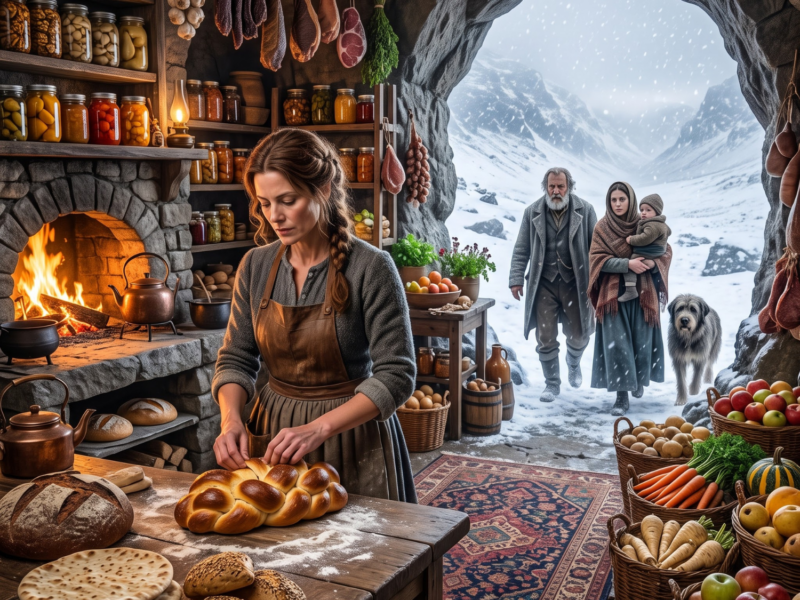
They Expected a Frozen Widow in a Savage Blizzard—Instead They Found Fresh Bread and a Warm Shelter
The Map of Memory
The Bitterroot Cut
The road out of Ashen Creek narrowed drastically as it climbed toward the jagged elevation of Bitterroot Cut. Juniper the mule pulled steadily through the fresh snow, his head bowed against the driving wind. Bramble ranged ahead, his brown coat stark against the blinding white, disappearing now and then among the deep sagebrush drifts before returning to the trail to check on the girl.
Elsie walked beside the mule, her head tucked down, both hands still desperately shielding the stoneware jar beneath her coat.
Mara walked in front, breaking the trail. She said little, conserving her breath, her calories, and her heat. Her eyes scanned the white horizon, but her mind was fixed entirely on a memory.
Years earlier, before the sickness took him, her husband had spent several long winter evenings hunched over the kitchen table, studying a weathered, canvas-backed geological survey he had bartered from a passing railroad crew. The map itself had been ordinary—topographic lines, elevation markers, proposed rail routes. But what had stayed burned in Mara’s mind was a single, hurried note scribbled in the margin near a jagged depression called Black Furnace Ravine.
Ground remains warmer than surrounding terrain. Possible geothermal influence.
At the time, nobody in Ashen Creek cared. The railroad had chosen a different route. The remark never became a town discussion; it never appeared in the local paper. It was simply a line of faded graphite on an old sheet of paper. Yet, Mara remembered exactly where that pencil mark had been made. She had traced it with her finger while her husband slept.
Ahead of them, the sky darkened another shade, shifting from bruised purple to the charcoal black of an impending whiteout. The wind swept loose snow across the trail in mesmerizing, serpentine waves, erasing their tracks almost as quickly as they made them. Somewhere beyond the pine-covered ridges, the true heart of the storm was gathering its catastrophic strength.
Instead of searching for a road back to civilization, Mara kept her head down and moved toward a place most people had forgotten existed.
The storm caught them two miles before they reached the coordinates.
The wind shifted violently, howling through the mountain passes like a wounded animal. The temperature plummeted so fast Mara could feel the moisture freezing on her eyelashes. Juniper slipped twice on hidden plates of ice beneath the powder, braying in panic. Elsie stumbled, her small legs exhausted, and eventually fell hard into a deep drift.
When Mara rushed back and hauled her daughter to her feet, she pulled off the girl’s mitten. Elsie’s fingers were ghostly pale, stiffening with the first terrifying signs of frostbite.
“Keep your hands on the jar,” Mara ordered, her voice cutting through the wind. “The starter is still alive. It has warmth. Hold it.”
Ahead of them, Bramble suddenly stopped. The dog barked—a sharp, flat sound absorbed by the snow—and darted off the trail. He moved toward a steep, rocky slope and began frantically sniffing along the ground, digging his paws into the powder. Something there had caught his ancient, wolfish instincts.
Mara tied Juniper’s lead to a dead pine and waded through the waist-deep snow to follow the dog. As she crested the small rise, she noticed an odd detail. Snow covered the hillside, yes, but not as deeply. Thin patches exposed strips of dark, wet stone beneath the white surface.
And there, rising from the exposed rock, a faint, ghostly ribbon of vapor drifted upward, dancing for a moment before disappearing into the freezing air.
Mara dropped to her knees. She pulled off her worn leather glove and pressed her bare palm flat against the exposed stone. It was cold—but it was not freezing. It held the faint, lingering temperature of a body just left.
She looked from the slope to the darkening, apocalyptic sky. For the first time since leaving the loading dock of Crowther’s mill, she saw something that looked less like blind luck, and more like a possibility.
The rocky slope narrowed sharply into a vertical crack between two towering limestone walls. At first glance, from the trail, it seemed too small to matter, nothing more than a shadow in the rock. But Mara squeezed through, dragging the mule and her daughter behind her.
They stepped inside.
The wind weakened almost immediately, blocked by the towering architecture of the earth. The snow became thinner, turning to slush, and then disappearing entirely. Bare, dark ground appeared in scattered patches along the ravine floor. The passage twisted once to the left, tight and claustrophobic, and then opened magnificently into Black Furnace Ravine.
Silence settled around them. It was not complete silence—the blizzard still raged, shrieking and tearing at the pines beyond the cliffs. Yet its voice seemed miles away, muffled by thousands of tons of ancient rock.
Mara walked to the center of the ravine and knelt beside an exposed section of dark, loamy soil. She pressed her bare fingers deep into the earth. It was cold, the deep chill of winter, but it was not frozen solid. The soil crumbled beautifully between her fingers instead of ringing hard like iron beneath her touch.
Behind her, Elsie waited quietly, her breath barely visible in this new, sheltered microclimate.
Mara dug a little deeper, feeling the profound, impossible softness of the unfrozen dirt. The old, faded note on her husband’s map suddenly seemed far less forgotten than it had that morning.









