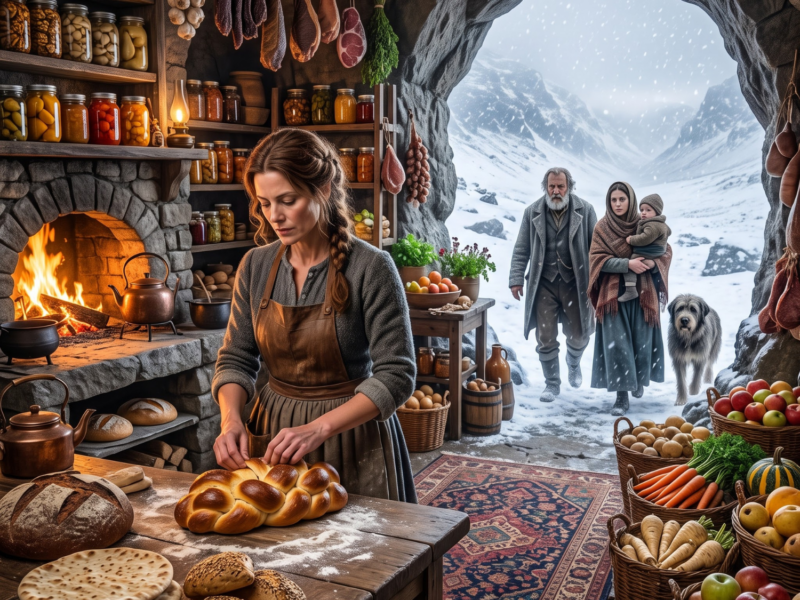
They Expected a Frozen Widow in a Savage Blizzard—Instead They Found Fresh Bread and a Warm Shelter
The Breath of the Earth
Days 1-2
Black Furnace Ravine stretched farther and deeper into the mountain than Mara had anticipated. The impulse was to rush, to immediately throw up a tent and hide, but survival required observation before action. Instead of rushing deeper into the dark, she spent the remaining hour of daylight studying the anatomy of her new world.
The northern side of the ravine drew her attention first. Snow melted significantly faster there. She walked the perimeter, laying her hands on the rock face. Several patches of exposed ground felt slightly warmer than the rest. It was nothing dramatic, nothing that would impress a crowd in a warm parlor. Yet in the brutal calculus of winter, a difference of ten degrees was the difference between life and death.
A massive sandstone wall at the rear of the ravine seemed to conceal something behind it. Working her way around the jagged outcrop, brushing aside hanging vines of dead ivy, she discovered it: a broad, deep rock alcove recessed into the hillside.
The floor here remained mostly dry dirt and crushed stone. Above, thin beads of moisture clung to sections of the limestone ceiling, suggesting that warmth was actively moving through hidden, subterranean fractures deep below their feet.
One terrifying question still remained. The alcove had a roof and three walls, but could the place breathe? If they built a fire, would they suffocate in their sleep?
As dusk rapidly approached, painting the ravine in shades of blue and black, Mara gathered dry sagebrush twigs and built a small, experimental fire near the alcove’s entrance. She struck a match, the sulfur hissing, and fed the flame. Both she and Elsie crouched in the dirt, watching the smoke with unblinking intensity.
At first, the smoke rose straight upward, hitting the ceiling and pooling. Mara’s heart sank. But then, the cave exhaled. The gray ribbon of smoke bent gracefully. Instead of drifting back into their faces and filling the alcove, it slid deeper into the darkness at the rear of the cave, caught an invisible updraft, and disappeared into a high, unseen fissure.
The draft was steady. Perfect. The cave was naturally pulling air through itself, a geological chimney.
Mara continued watching for another minute before adding thick, heavy wood to the fire. Outside, the blizzard was beginning to close over the mountains, sealing the passes. Inside, the smoke had already delivered its verdict. For the first time since leaving Ashen Creek, Mara allowed herself to believe they might actually open their eyes when morning came.
The first forty-eight hours disappeared into a blur of agonizing, mechanical work. Black Furnace Ravine offered incredible possibilities, but possibilities did not stop a crosswind. They did not keep flour dry. They did not create a place where a child could sleep off the frozen ground. Everything still had to be built from nothing.
Mara started with the most ancient building material on earth: stone.
The alcove sat beneath a heavy sandstone overhang, which meant the roof and the rear wall already existed. That saved days of labor. Juniper, hitched to a makeshift sled of pine boughs, hauled smaller rocks from the ravine floor. Mara rolled the larger, hundred-pound boulders into position by hand. Some weighed enough to tear the skin from her palms and leave her shoulders aching with a deep, nauseating fire long after sunset. Slowly, rock by rock, a rough, curving windbreak took shape along the exposed, western side of the alcove.
Meanwhile, Elsie walked the perimeter of the ravine. She gathered dead branches trapped beneath ledges, pulled dry sage, and dug up dead juniper roots. Every armful mattered. Dry wood was becoming exponentially harder to find as the fresh snow buried the valley floor outside their sanctuary.
Bramble settled near the entrance whenever they worked, the dog serving as their sentinel. He rarely slept deeply; any unfamiliar sound—the crack of a freezing branch, the distant howl of wind—brought his head up at once, his ears swiveling.
By the second afternoon, the shelter finally began to resemble something intentional.
Mara constructed a raised sleeping platform. The ground, though unfrozen, would still leach the body heat from a sleeping child and kill her by morning. Using sturdy pine poles, flat stone supports, and a thick mattress of salvaged, dried brush and pine needles, she built a bed two feet off the dirt. Keeping the bedding elevated reduced convective heat loss and protected it from any subterranean moisture.
Nearby, she lashed together a simple hanging rack from forked branches and hemp cordage. The tragic flour sack, the dried potatoes, and their meager supplies were hoisted into the air, stored above the reach of rodents and away from the damp pockets near the floor.
None of it looked impressive. The stone walls were uneven. The pine platform creaked under their weight. The storage rack leaned slightly to one side. Yet each crude piece solved a specific, lethal problem that winter would gladly exploit.
That night, the true fury of the storm arrived.
Wind struck the exterior cliffs hard enough to send violently swirling eddies of snow past the ravine entrance. Somewhere beyond the limestone walls, the world was being erased. The trails disappeared beneath ten-foot drifts. Any route back to Ashen Creek vanished, one layer of ice at a time.
Inside the alcove, the small fire burned steadily, feeding off the dry juniper wood. The stone windbreak held, deflecting the stray gusts. The raised bed stayed dry. The warm air generated by the fire lingered against the sandstone ceiling far longer than it had the night before, trapped by the thermal mass of the rock.
Long after Mara had fallen into a state of exhausted unconsciousness, Elsie remained awake. She was curled beneath a heavy wool blanket, the stoneware jar of sourdough starter tucked securely against her stomach, sharing her body heat. Eventually, the steady crackle of the fire lulled her into the dark.
Morning came before the little girl opened her eyes again. It was the first uninterrupted night of sleep she had experienced since the day they were forced out of the mill.









