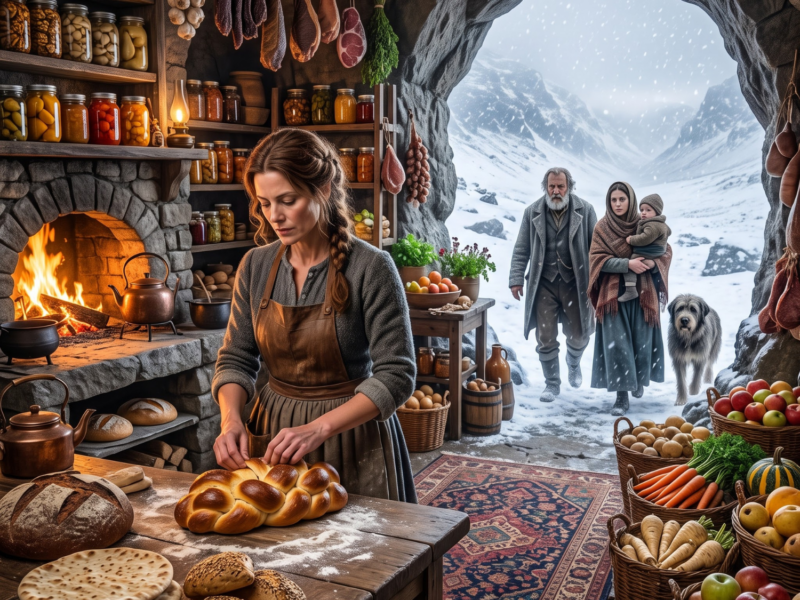
They Expected a Frozen Widow in a Savage Blizzard—Instead They Found Fresh Bread and a Warm Shelter
Roots and Ruin
Days 3-10
The storm kept them trapped in the ravine, but it could not occupy every hour of daylight. Survival was a matter of mathematics, as Edwin Crowther had said, but Mara’s calculus involved life, not coin.
On the third morning, while exploring the rear of the alcove for more firewood, Mara followed a narrow, twisting passage beyond the main living area. She squeezed between two jagged boulders and stepped into a second, hidden chamber deeper inside the cave system.
It was smaller, incredibly warm, and surprisingly dry. But more importantly, a thin, jagged crack in the high ceiling—a tectonic fissure reaching all the way to the surface—allowed a brilliant, concentrated shaft of sunlight to pierce the gloom and strike the cave floor for several hours each midday.
Mara stood there for a long time, the golden light illuminating the dust motes dancing in the still air. She watched the light slowly crawl across the dark, loamy stone. A terrifying, beautiful plan began forming in her mind.
The shelter had to become more than just a place to sleep and hide. To survive until the spring thaw, it had to become a system.
The first part of the system was obvious. Bread meant dense calories, internal warmth, and psychological stability. The sourdough starter Elsie carried was too valuable to lose; it was an engine of life.
The second part required an impossible patience. If the cave truly held a steady source of geothermal warmth, and if the sunlight from the fissure was consistent, then a small, subterranean winter garden might be possible.
Along with the weathered map and the sourdough starter, her late husband had left behind one final legacy: a small, oiled-leather pouch of cold-hardy seeds. Winter rye, turnip, beet, and kale. He had once dreamed of cultivating his own plot, a dream that died with his lungs the previous spring. When they were forced out of the mill, Mara had packed the pouch almost out of blind habit, clinging to the memory without ever expecting to plant them in the freezing earth.
But now, standing beneath this fragile, miraculous shaft of light, those seeds were no longer just tragic keepsakes. They were ammunition against the winter.
Back in the main alcove, Mara meticulously sorted the ruined flour sack Edwin had given her. She separated the damp, clumped flour from the dry. The driest portion was sealed away in a tin for baking. The damaged, wet flour was spread thinly on a piece of clean cloth near the warmest section of the rock wall. For hours, she sifted it carefully, crushing the clumps with a smooth stone, evaporating the moisture. The work was agonizingly slow. The reward was highly uncertain.
Yet, for the first time since leaving Ashen Creek, Mara realized her mindset had shifted. She was no longer just trying to endure the winter. She was planning how to build a life in the middle of it.
Mara’s first oven was a monument to good instinct and too little mass.
Using the wet clay from the ravine floor, she shaped a dome over a low ring of flat stones, packed dry ash beneath it for insulation, and fed a fire inside it slowly until the chamber seemed hot enough. When she slid the first ball of dough inside, the smell of baking bread changed the entire atmosphere of the cave. It smelled of home. It smelled of victory.
Elsie sat impossibly close, the sourdough jar resting in her lap, watching the clay door as if the oven might answer every question in the universe at once.
It did answer, but it answered with the cruel physics of thermodynamics.
When Mara pulled the loaf out with a wooden paddle, the crust was black, charred, and split violently open. Bitter smoke clung to the surface. But when she tapped the bottom, there was no hollow sound. She broke it open, and her heart sank. Inside, the bread was heavy, wet, and utterly raw near the center.
The fire had touched the bread, but the thin clay walls lacked the thermal mass to store the heat. The temperature had plummeted the moment the coals were removed. The heat had not stayed long enough to finish the bake.
Three days of painstakingly saved flour had gone into the ruined loaf.
Elsie looked at the raw dough, then broke off a piece of the charred crust anyway. She tried to chew through the soft, gummy middle. She managed two bites before her jaw slowed, and she quietly lowered her hand, trying to hide her disappointment.
Mara studied the thin oven wall, then looked at the ruined loaf. Failure was not an option, which meant this failure was just data. By morning, she was out in the freezing ravine, hauling heavier, denser blocks of sandstone.
While the new, massive oven dried—its walls now a foot thick with stone and clay—she turned her attention to the chamber with the ceiling fissure.
The soil there was soft, but it needed nutrients. Elsie spent a day carrying baskets of ancient, decayed leaf mold from the deepest corners of the ravine floor. Mara mixed the rich organic matter with sand, crushed limestone, and a little clean white ash from their fire.
Into this first, perfectly manicured bed went the winter rye, the turnip, the beet, and the kale.
For three days, the bed looked incredibly promising. The warmth of the earth seemed to awaken the seeds. Then, on the fourth morning, the tragedy struck. The fragile, green turnip leaves softened. By the next morning, several had collapsed entirely, rotting against the dark soil.
Mara knelt beside the bed. A cold, unnatural shine coated the limestone ceiling directly above the crops. She reached up and touched the rock wall. Heavy, cold moisture was gathering there, condensing from the warm air, pooling, and then dripping like an icy rain directly down onto the delicate turnip sprouts.
The geothermal warmth had fooled her. Temperature was only one variable in the equation of life. The stone was breathing, exhaling damp condensation into the exact wrong place.
She pulled the dead, rotting turnip starts from the soil one by one and laid them gently beside the bed. Elsie watched from the passage, her eyes wide, without speaking. Mara did not look away from the ruined row.
This time, the failure had roots.









