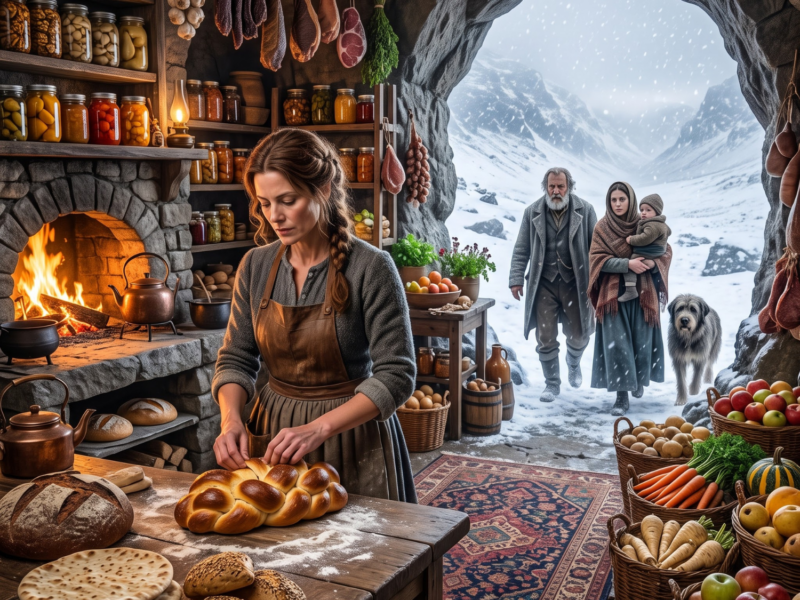
They Expected a Frozen Widow in a Savage Blizzard—Instead They Found Fresh Bread and a Warm Shelter
The Fall of Ashen Creek
Weeks 8-10
The arrangement settled into a meticulous, dangerous rhythm over the following weeks.
Whenever the brutal weather allowed, Jonah Pike made the exhausting trek on snowshoes between Ashen Creek and Black Furnace Ravine. He carried letters when he had them, small supplies like salt or matches when he could spare them, and he returned with whatever the cave was able to produce.
The system Mara had built kept growing, loaf by loaf, row by row. The bread oven worked more reliably with each firing, its stones seasoned by the constant heat. The kale matured rapidly in the geothermal warmth. The beet greens flourished. A second, larger planting of turnips succeeded brilliantly where the first had failed, thanks to the willow lattice. The rye advanced slowly but steadily beneath the filtered winter light.
Back in Ashen Creek, no one knew exactly where the food was coming from. In a town desperate for hope, stories appeared long before facts did.
Some citizens believed an eccentric trapper had discovered a hidden pioneer cache in the hills. Others claimed a wealthy rancher beyond the mountains was sending supplies in secret to repent for past sins. A few cynics insisted the rumors of fresh bread were nonsense altogether—until they saw it with their own eyes.
The deliveries came in plain burlap sacks, left on snow-covered porches in the dead of night without announcements or explanations.
The impact was quiet but profound. Children who had been losing weight and growing lethargic began looking stronger, color returning to their pale cheeks. Several elderly residents survived bitter cold spells that had worried their families only weeks earlier, fortified by the dense calories of the mysterious bread and the vitamins of the fresh greens.
One evening, Jonah stopped at a small, drafty cabin on the freezing edge of town. Inside, a seven-year-old boy who had spent weeks picking apathetically at every meager meal sat beside the woodstove, holding a still-warm, heavy loaf of sourdough. His mother wept quietly as she watched him tear off a piece, then another, eating with a ravenous joy. By the end of the meal, nothing remained except a few crumbs on the rough-hewn table. For the first time in a long, terrifying while, the child had finished everything placed in front of him.
The cave received no credit. The widow received no praise. For now, the miraculous results were traveling far faster than the story behind them.
But the secrets of winter never hold forever.
The storm that finally broke Ashen Creek’s spirit was the exact same storm many residents had feared all winter. For two days and two nights, a horrific gale hammered the settlement without mercy. Snow piled in ten-foot drifts against the buildings. Unseasonal, freezing rain followed, forming inches of solid ice where water should never have reached.
Then, sometime before dawn on a Tuesday, the groan of overstressed timber woke the town.
Part of the main flour warehouse roof at Crowther’s mill finally gave way, collapsing under the colossal weight of the ice.
The damage spread with terrifying speed. Meltwater found its way directly into the main storage bays. Hundred-pound sacks of flour instantly absorbed the moisture, turning into solid blocks of useless, rotting paste. Entire sections of the town’s emergency reserve became utterly ruined within days.
At nearly the exact same time, the communal baking oven in the town square suffered a catastrophic failure. A widening, structural crack in the brick chimney, exacerbated by the freezing and thawing of the ice storm, disrupted the draft completely. Thick, blinding smoke rolled back into the workspace. Fires would not burn correctly, choking on their own exhaust. Baking ground to a complete halt.
The town, now facing the very real prospect of mass starvation, suddenly faced a question it could no longer afford to avoid: Where had the secret bread been coming from?
The answer arrived during a crowded, frantic meeting inside the freezing church hall.
Jonah Pike stood at the front of the room, facing the panicked, exhausted faces of the same people who had spent weeks inventing wild theories about angels and secret ranchers. He looked at Edwin Crowther, who sat near the front, looking hollowed out. He looked at Reverend Bell.
Then, Jonah told them the truth.
“The bread,” Jonah’s voice rang out over the murmurs, “the vegetables, the winter greens. All of it comes from Black Furnace Ravine.” He paused, letting the silence stretch. “And all of it comes from the hands of Mara Whitlock.”
Absolute, stunned silence followed.
Caleb Door, the town carpenter who had spent most of the winter mocking the idea of earth-built shelters, stared at Jonah with his mouth open. Edwin Crowther did not speak; he seemed to shrink into his expensive coat. Reverend Silas Bell looked down at his boots, unable to find a single scripture that applied. Around the room, faces shifted from desperate confusion to profound, ashamed disbelief.
Most of the town had expected Mara Whitlock to die before the first major blizzard ended. It was the accepted reality.
Instead, she had built a working, brilliant shelter. She had grown food in the frozen earth. She had baked bread with the stones. And while Ashen Creek struggled to feed itself, while its leaders made excuses, that same evicted widow had quietly, systematically been keeping them alive.
Edwin lowered his eyes. Months earlier, Mara had stood in his mill and warned him about the moisture entering the flour stores through the damaged roof. She had pointed at it. The roof had remained unfixed. The leak had remained. Now, the warehouse stood partially ruined, the town’s food supply was devastated, and the horrific consequences of his arrogance sat in plain view for everyone to see.
At last, the story behind the bread could no longer remain hidden.









