They Expected a Frozen Widow in a Savage Blizzard—Instead They Found Fresh Bread and a Warm Shelter
The Intruder
Day 46
Day 46 began exactly like any other winter morning inside Black Furnace Ravine.
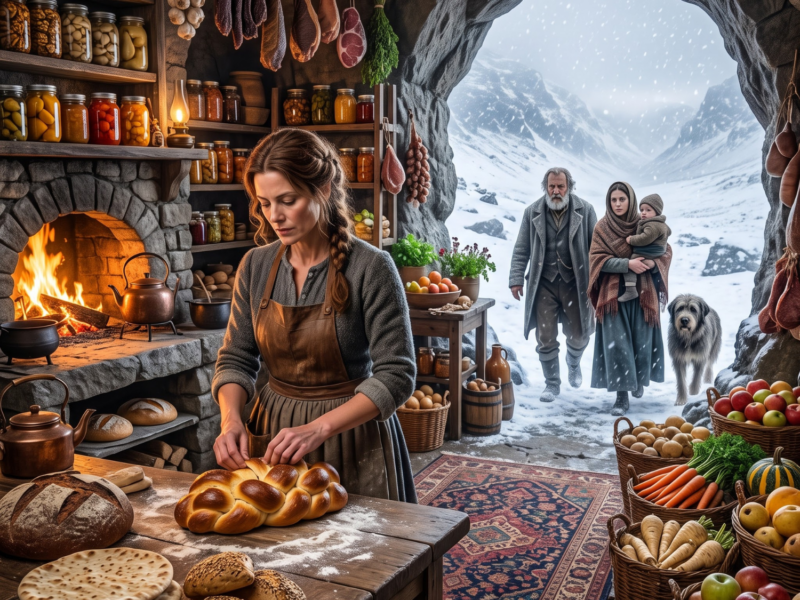
The fire was burning low, a mound of glowing orange coals. Fresh, proofed dough rested beneath a damp cloth near the warm limestone wall, ready for the oven. A thin, crystalline beam of sunlight had just reached the garden chamber.
Mara was tending the fire when Bramble suddenly lifted his head.
The dog did not bark. That was what caught Mara’s attention, freezing the blood in her veins. He simply stood up, the hair along his spine bristling, his ears swiveled forward, staring intensely toward the ravine entrance. A low, continuous growl vibrated in his chest.
A moment later, Mara heard it. Distant, crunching footsteps echoed between the stone walls. Someone was approaching. They were not wandering aimlessly, and they were not hunting. The cadence of the steps meant they were coming directly toward the shelter.
Mara silently set down the basket of firewood she was carrying. She reached for the heavy iron fire poker, her knuckles turning white, and stepped into the shadows near the entrance, listening.
Outside, a man named Jonah Pike was following a trail that absolutely should not have existed.
Jonah was Ashen Creek’s winter mail carrier and saddle repairman. He was a lean, weather-beaten man who survived the winters by knowing the mountains better than anyone else. The town of Ashen Creek had assumed the widow Whitlock was gone. Dead. Most believed the initial blizzard had settled the matter weeks ago, burying her and her child under a drift.
Jonah had not been so certain. He had seen the way Mara looked at the sky that day. Curiosity, and a nagging sense of guilt that he had done nothing to stop Edwin, had brought him into the ravine while checking his distant trap lines.
The smell stopped him dead in his tracks before the shelter even came into view.
Fresh, baking bread.
For several seconds, Jonah simply stood in the freezing, sub-zero air, his mind violently rejecting what his nose was telling him. It was a hallucination. A phantom scent brought on by the cold. But the scent grew stronger, richer, and sweeter as he moved cautiously forward through the limestone gap.
Then, the alcove appeared.
Jonah dropped his rifle to his side. His jaw went slack.
A massive, expertly constructed stone oven sat near the rear wall, radiating heat. Dry firewood was stacked neatly beside it in organized cords. Heavy wool blankets covered a raised, dry sleeping platform. Bundles of dried meat and supplies hung from a suspended storage rack overhead. Near the entrance, a mule stood healthy and well-fed beneath a wind barrier built from stone and timber.
But none of that shocked him as much as what he saw in the secondary chamber to his left.
Green leaves stretched upward beneath a shaft of golden sunlight falling through a ceiling fissure. Kale. Young rye. Beet greens. Life growing, thriving, in the dead center of a catastrophic winter.
Jonah stepped slowly into the chamber, moving like a man inside a dream, and slowly pulled the heavy leather gloves from his hands. His wide eyes moved from the oven to the crops, then to the warm, dry walls surrounding them. The shelter felt impossible. It was not magical; it was impossible in the way a perfectly solved problem often appears to people who never had to witness the agonizing labor behind it.
Elsie emerged from the garden chamber carrying a small woven basket of fresh kale leaves. Mara stepped out of the shadows a moment later, the iron poker still in her hand, her eyes locked on Jonah.
Neither the mother nor the daughter looked surprised or frightened to see another person. The shock belonged entirely to the intruder.
On a flat, clean stone near the oven rested a loaf of bread that had come out only a short time earlier. Steam still escaped from a jagged, beautiful crack along the dark crust.
Jonah stared at it longer than he intended, his stomach giving a violent, audible rumble. Beyond the limestone gap behind him, snow drifted relentlessly through the gray, freezing air. Yet Jonah stood paralyzed, completely enveloped in the rich, warm, defying scent of fresh yeast and life.
The widow that everyone in town expected to find frozen solid was standing beside a working oven, looking at him with the calm authority of a queen in her castle.
Jonah remained in the shelter for most of the afternoon. He ate a thick slice of warm bread smeared with rendered hare fat, chewing it as if it were the finest meal he had ever tasted.
Eventually, the conversation turned back toward Ashen Creek. The news Jonah brought was grim.
“The flour stores are shrinking faster than Edwin expected,” Jonah said, staring into the fire. “Moisture got into the warehouse. Spoiled a quarter of the grain before they even realized it. It’s bad, Mara. Several families are stretching meals by adding boiled pine roots and whatever dried scraps they have left.”
Mara sat quietly, her face unreadable in the firelight.
“The community baking oven is failing, too,” Jonah continued. “The masonry cracked in the last freeze. Smoke leaks into the work area whenever the wind shifts. They can’t get the fires to burn hot enough. Baking has slowed to a crawl. The children… they’re eating less. The old folks are struggling with hard, underbaked rations.”
As Jonah spoke, Mara listened without interrupting. When he finished, she began to ask precise, clinical questions.
“How much unspoiled flour remains in the town?” she asked. “Which households are struggling the most? Who has young children? Who has elderly family members?”
The answers came one at a time. Jonah listed the families, painting a picture of a town slowly starving in the dark.
When he finished, a heavy silence settled across the chamber. The great stone oven clicked softly as it cooled. Light from the ceiling fissure drifted imperceptibly across the rows of winter greens.
Mara looked toward the garden, then toward the fresh loaf resting beside the hearth. The memory of the town’s silence on the day she was evicted burned in her mind. They had watched her walk into a blizzard. They had done nothing.
Her decision arrived quietly, without fanfare or dramatic speeches.
“The first deliveries,” Mara said, her voice steady, “will go to the families with the greatest need. Bread. Kale. Beets. Whatever the shelter can spare each week.”
Jonah nodded immediately. He had already understood what she was offering just by the way she looked at the food. What surprised him, what shocked him to his core, was the list of names she rattled off next.
Several names belonged to the very people who had stood on their porches and watched her leave Ashen Creek without saying a word. One name belonged to a household that had loudly supported Edwin Crowther’s decision to evict her. Another belonged to a woman who had physically turned away when Mara had asked for an advance on her wages.
“Mara,” Jonah said softly. “They turned you out. They left you to die.”
“I know,” Mara said. She wrapped a fresh loaf in a clean cloth. “The food goes anyway.”
By sunset, Jonah Pike was helping prepare heavy sacks for the perilous journey back to town. The frozen peaks remained firmly in winter’s merciless grip. But deep within the glowing alcove of Black Furnace Ravine, a entirely new kind of system had taken root. It was no longer built only to keep three lives alive.
Now, it was preparing to carry a little warmth beyond the ravine, into the heart of the cold.









