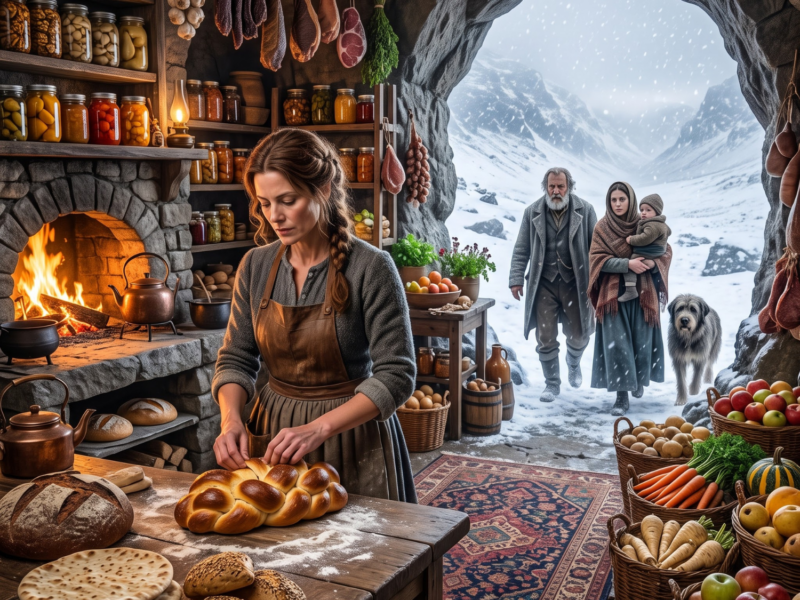
They Expected a Frozen Widow in a Savage Blizzard—Instead They Found Fresh Bread and a Warm Shelter
The Architecture of Survival
Days 11-30
Mara left the empty, wet row untouched for two days. Planting another batch of turnips immediately would have felt productive, a way to soothe her anxiety. It also would have repeated the exact same mistake. Instead, she became a student of the cave.
Each morning began with a silent walk through the garden chamber before the main fire was lit. She placed small, white pebbles to mark the damp spots where water gathered overnight. By afternoon, she tracked the narrow beam of sunlight, noting exactly where it struck and how fast it crawled across the floor. Darkness revealed entirely different clues. By candlelight, she saw how moisture appeared only where the rising warmth met the freezing cold of the upper stone, and how certain sections of the wall remained wet long after the others had dried.
Elsie helped, moving the pebbles whenever she found fresh droplets on the soil. Slowly, a pattern emerged from the chaos. The trouble always started along the northeast edge of the growing bed, right where the cold draft from a micro-fissure met the warm air of the garden.
A thin, sloped drainage trench dug along the wall solved part of the problem, channeling the drips away. The rest required architectural intervention. Mara cut long, flexible willow branches from the ravine and spent an evening weaving them together. She built a light, sturdy lattice and suspended it several inches away from the weeping limestone wall.
Now, the air could move dynamically through the gap, and any condensation dripped harmlessly down the back of the lattice, completely avoiding the crops.
Nothing changed overnight. Nature does not applaud. The kale simply stopped getting worse. But a few days later, the beet leaves regained their deep, vibrant color, standing upright.
That was enough. The chamber had delivered its lesson. Warm ground could support growth, but warmth alone was not a system. Water, airflow, and stone were making decisions, too. Standing beside the repaired bed, Mara finally understood. The failed turnips were not proof that the garden could not work. They were evidence that she had been measuring the wrong problem.
The second batch of bread demanded more patience than anything Mara had ever done.
The new oven was a beast of sandstone and heavy clay. Mara fired it for four solid hours, burning thick, heavy logs, allowing the massive stones to absorb the thermal energy deep beneath their surfaces. When the flames finally died down to a bed of glowing, ruby coals, she pulled them out.
She did not rush. She waited. The dough rested. The oven rested, its internal temperature equalizing, transforming from a fiery inferno into a steady, radiant womb of heat.
She slid the dough inside and sealed the door with a wooden block.
Dawn arrived on the twelfth day. A steady, shrieking wind pushed against the ravine outside, rattling the windbreak, while Mara crouched beside the oven. She removed the door and eased the loaf into the light of the fire.
Its shape was slightly uneven. One side had cracked beautifully during the oven spring. The crust carried dark, caramelized scars from the intense heat of the floor. None of that mattered. When she tapped the bottom, it sang with a hollow, perfect resonance. This time, the bread was fully cooked.
Warm steam escaped through the split crust, carrying the intoxicating, yeasty aroma of roasted grain across the chamber. The smell reached Elsie before the sunlight did.
The little girl opened her eyes, sat up abruptly beneath her wool blanket, and followed the scent like a sleepwalker, not saying a word. Bramble lifted his heavy head from his paws beside the oven, his tail thumping once, quietly against the dirt.
Mara cut the loaf on a flat, sanitized stone. The crust shattered with a crisp crunch. The crumb inside was steaming, soft, and perfect. The larger piece went to her daughter. The smaller one stayed in her own hand.
Outside, winter continued its relentless, murderous assault on the cliffs. But here, in the dark, a warm loaf of bread now existed right where frozen ground and empty promises from Edwin Crowther were supposed to have won.
Elsie closed her eyes after the first bite. She held the piece of bread carefully with both hands, chewing slowly, as if warmth itself had become something physical that could be carried in the chest.
A week after the first successful loaf, winter reminded Mara that one victory solved only one problem.
An arctic front, colder than anything they had yet experienced, swept across the mountains and buried the upper ridges beneath ten feet of fresh, powdery snow. The cave remained livable. The geothermal ground still held its temperature. Water continued to flow where it had before.
Yet, the sourdough starter began to sicken.
The change was incredibly subtle at first. The jar smelled right—sour and fermented—and the mixture looked healthy, but the dough stopped rising the way it should. It became sluggish. Each batch moved slower than the last, producing denser, flatter bread.
Mara panicked quietly. She tested different locations throughout the shelter. She placed the jar near the oven, but it was too hot. She placed it near the sleeping platform, but it was too drafty. She moved it closer to the garden chamber. Nothing worked for more than a day.
Several agonizing days passed before she noticed the real, silent killer. The stone floor, though geothermally active in places, was drawing heat away from the jar through direct conduction during the coldest, darkest hours of the night. The starter never froze, but it lost just enough warmth to severely slow the living yeast culture inside.
The solution turned out to be absurdly simple once the physics of the problem were understood. She moved the stoneware jar to a slightly elevated shelf of naturally warm limestone near the rear wall, and then wrapped it tightly in a thick, folded wool blanket that had belonged to her husband. She was insulating the life inside.
Two mornings later, the starter became furiously active again. Tiny, beautiful bubbles returned to the surface. The dough responded, rising high and light.
For a brief, private moment, Mara rested her forehead against the cool stone wall, her hand on the wrapped jar. Losing the ability to make bread would have been physically difficult. Losing that specific jar would have felt like losing her husband a second time.
As the weather outside briefly settled into a bitter, stagnant cold, the garden finally began answering back.
The kale moved first. Small, resilient green leaves unfolded, stretching desperately toward the shaft of light that entered through the ceiling fissure. A few days later, thin, brilliant green blades of winter rye pushed through the dark soil. The surviving beets followed more slowly, but they followed.
Green appeared where winter insisted it should not exist.
Mara widened the growing area one painstaking section at a time. Nothing happened quickly. Every single addition required hauling soil, engineering microscopic drainage systems, and studying how moisture behaved around the stone. Elsie became a vital part of the routine. The girl carried composted material from the ravine floor, helped press the tiny seeds into the prepared rows, and checked the young plants each morning before breakfast, speaking to them in soft whispers.
Bread and winter greens provided hope and vitamins, but enduring the bitter cold required more than just carbohydrates. The human body demanded fat and protein to keep the internal furnace burning.
Repurposing scraps of old, rusted baling wire she had salvaged from the mill yard on her last day, Mara twisted them into simple, lethal snares. Guided by Bramble’s keen nose, she braved the freezing temperatures just outside the ravine, setting the traps along the narrow, packed snowpack trails that snowshoe hares used beneath the dense sagebrush.
It was a grim mathematics. Every few days, the traps yielded a catch. The meat provided life-saving nourishment and rich fat. The bones were boiled down for hours into a thick, marrow-rich broth to soak their bread. The pelts were carefully scraped, stretched, and dried to add a crucial layer of insulating warmth to their sleeping platform.
The main chamber looked vastly different now. It was not dramatic, and it was certainly not abundant. Yet, it no longer resembled a desperate emergency shelter hidden inside a cave. Food was growing. Bread was baking. The snares were providing. The systems were finally beginning to support one another in a fragile, beautiful web of survival.
One afternoon, Elsie stopped beside the newest bed of kale and stared at the patch of vibrant green for several long minutes. Outside, the mountains remained a blinding, desolate white from horizon to horizon. She had not seen the color green in weeks. She touched a leaf, gently, as if making sure it was real.









