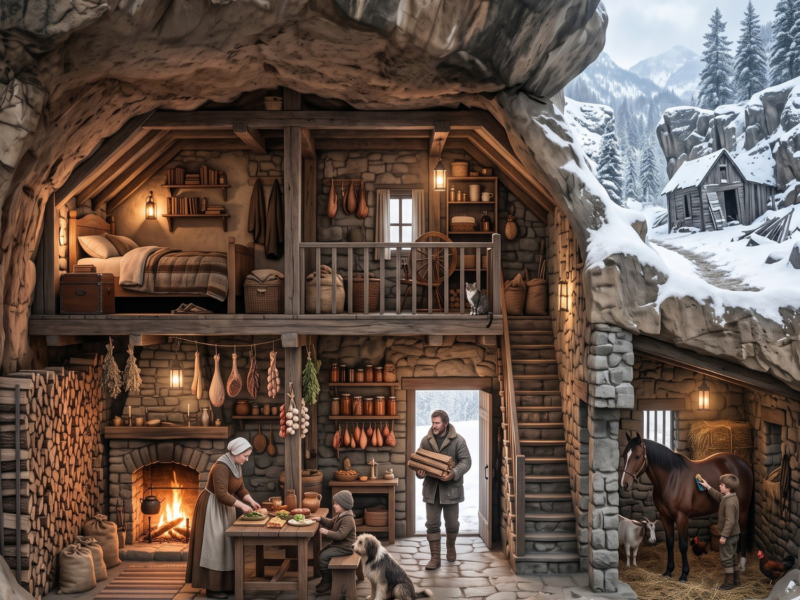
They Laughed at Her Rock House—Until 7 Feet of Snow Buried Calder’s Bend 🥶
The Logic of Limestone
Vera Ashton had learned to read stone the way other children learn to read books—slowly at first, then hungrily, then with a fluency that became so natural it ceased to feel like a acquired skill.
Her father, Thomas Wren, had emigrated to Pennsylvania from England in 1840 with two possessions: a set of mason’s chisels worn smooth at the handles, and a belief, held as firmly as any religious conviction, that the most honest work a human being could do was shape something that would outlast the body that shaped it. He had built church facades in Pittsburgh and laid the cornerstones of county courthouses in Philadelphia.
Thomas could look at an unblemished slab of limestone and tell you precisely where it would cleave under pressure, where it would hold a crushing load, and where the ancient, invisible seam ran that would betray you on the coldest January morning if you trusted it with too much weight.
Vera was twelve when she first picked up a chisel. It wasn’t because her father pushed her toward the trade; he would have vastly preferred she take up schoolteaching or piano—something appropriate for the daughter of a craftsman with upwardly mobile ambitions for her. She picked it up because she had watched him work for seven years with the particular quality of intense, absolute attention that children give to things they love before they even understand what love is.
One morning, while Pittsburgh’s industrial smog hung heavy and her father was taking his lunch on a pile of scaffolding, she simply picked up the heaviest iron-headed mallet and a flat chisel, set the tool against a block of raw sandstone he had been preparing, and struck it once.
The stone split along a line so clean it looked deliberate, a razor-edge fracture.
Her father came back from lunch, looked at the split stone, looked at his twelve-year-old daughter, and said nothing for a long moment. Then: “Again. But slower. Let the tool do the work.”
She spent the next twenty years doing exactly that. She learned to distinguish sandstone grades by pressing her palm flat against a rough surface—some varieties felt warm and faintly gritty, others cool and dense as old bone. She learned which geologic formations could be carved into permanent rooms that would last centuries, and which would dissolve like human ambition in the first hard, acidic rain.
She learned that stone forgave nothing, yet punished with terrifying slowness. A small mistake in a foundation did not announce itself immediately; it waited sometimes years, settling imperceptibly, before failing all at once without warning.
By the time she was thirty, she was the undisputed master mason within a four-county radius of Philadelphia. She worked on prestigious contracts that officially went to men with credentials and clean collars, while she carried out the actual, grueling craft in the dust while they signed the invoices. She didn’t resent this the way a younger, angrier woman might have. She understood it as simply the way the world was arranged—temporary as bad weather—and she kept her fierce, unblinking attention squarely on the stone.
Her first husband, George Ashton, died in the spring of 1873 when a rotten scaffolding gave way on a commercial construction site three blocks from their house. She heard the sound from her kitchen before she saw anything. She didn’t know yet what it was—a deep, concussive crack, followed by shouting, and then a heavy, echoing silence. But something in her body understood the mathematics of gravity before her mind caught up. She was already moving toward the door when the neighbor boy came running.
She mourned George with the thoroughness of a woman who had loved him genuinely, without performative theatrics. Then she returned to work. Because the stone was still there, and it still needed her attention.
Edmund came into her life three years later through the strange collision of academic coincidence and professional readiness that sometimes substitutes for fate. He was teaching history at a private academy in Baltimore—Roman architecture, medieval fortifications, and the brilliant engineering logic of the great Gothic cathedrals. He had hired Vera to assess the structural integrity of the school’s main building, which was subsiding on one corner in a way that gave the headmaster night terrors.
Vera looked at the failing foundation for twenty minutes, made three meticulous measurements, wrote a brief report in her direct, unornnamented handwriting, and told the headmaster the building would be entirely fine for another forty years if they simply stopped routing wastewater from the east drainpipe directly toward the northeast corner.
Edmund had been watching from the doorway. He was thirty-eight, quiet in the way some people are quiet because they’ve learned through trial that observation yields vastly more than commentary. He had read everything written about ancient Roman construction techniques, and he possessed the burning frustration of a man who understood something deeply in theory but had never once touched it with his calloused hands.
He asked her three questions about the foundation. They were good questions—the kind that showed he already understood half the answer and was genuinely, humbly uncertain about the other half.
They had dinner that evening. They were married the following year.
What bound them together wasn’t romance in any conventional Hollywood sense, though a quiet tenderness was certainly present. It was something rarer: the mutual recognition of a matched disposition toward permanence. Edmund had spent twenty years studying civilizations that had built magnificent things meant to last, and then watched those things crumble into dust while the civilizations themselves dissolved into myth. Vera had spent twenty years building physical things explicitly designed to outlive their builders.
They both understood in their different registers that the single greatest act of arrogance a mortal human being could commit against time was to build something cheap.
The idea of moving west crystallized in the winter of 1877, when Edmund brought home a government geological survey report that included, almost as an afterthought, several pages describing ancient cliff dwellings found in the remote canyon country of the southwestern territories. Stone rooms carved directly into the sheer faces of vertical cliffs, constructed centuries earlier by an indigenous people who had since vanished into the winds of history. Yet, their buildings were still standing in near-perfect condition, while every wooden shack built by more recent, hurried arrivals rotted, burned, or collapsed.
Edmund read the relevant passages aloud over dinner. Vera listened without moving her fork, which she had set down after the very first sentence.
The structures faced south. They were sheltered by massive, natural rock overhangs that kept the torrential rain off the entrances and prevented snow from accumulating at the doorways. The incredible thermal mass of the surrounding cliff maintained interior temperatures within a remarkably narrow, comfortable range year-round, entirely regardless of what the weather did outside.
“The people who built them hadn’t conquered their landscape,” Edmund said, setting down the report. “They’d entered into a kind of profound negotiation with it, accepting the severe constraints the stone imposed in exchange for the ultimate protections the stone offered.”
“They understood something we’ve completely forgotten,” Edmund said.
Vera picked up her fork again. “Then we go find it.”









