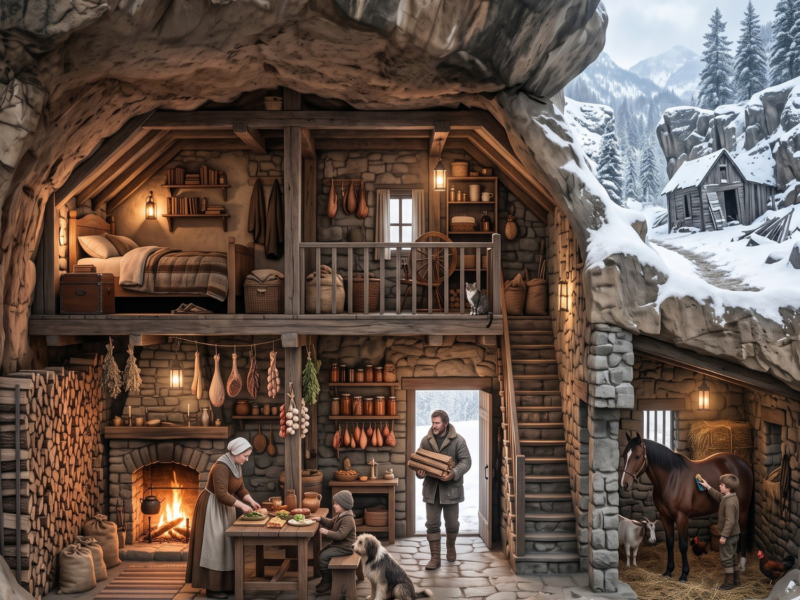
They Laughed at Her Rock House—Until 7 Feet of Snow Buried Calder’s Bend 🥶
The Great Stillness
Walter Greer was seventy years old in the autumn of 1880. He had lived in the Calder’s Bend valley longer than anyone currently resident there.
He’d arrived in 1840 as a young, desperate prospector, found just enough silver in the creeks to stay intensely interested, but never quite enough to get rich, and stayed anyway. The mountains had quite literally grown into him, the way a living tree grows around iron spikes over sufficient time.
He knew the valley’s temperamental weather the way Vera knew the grain of Pennsylvania sandstone—not from reading meteorological books or consulting scientific instruments, but from forty years of physical, uninterrupted attention. He possessed the accumulated mental record of ten thousand harsh mornings, noting precisely what the sky was doing, and comparing it instantly to what the sky had done twenty years prior.
He sat on the splintered wooden bench outside the general store on an afternoon in early October, his calloused hands resting flat on his knees, his faded eyes fixed entirely on the jagged peaks to the northwest.
The elk had come down from the high alpine meadows two weeks early. They were moving in herds significantly larger than usual, with an urgent, driven purposefulness that suggested they weren’t just responding to a casual autumn cold snap, but to something deeply coded in the barometric pressure. The red squirrels had been frantically working the pine stands at what Greer could only describe as an anxious, desperate intensity. The permanent snowline on the western peaks had dropped a thousand vertical feet faster than the previous four autumns.
The afternoons had developed a particular quality of terrifying stillness—a heavy, suffocating quiet that Greer associated, without being able to scientifically explain why, with the legendary, murderous winters that did not behave by the rules.
“This one’s going to be fundamentally different,” Greer muttered to the general store clerk, who was sweeping the boardwalk. “I’ve been here forty years. I know what the regular winters feel like when they’re coming in. This doesn’t feel regular.”
Silas Dunore happened to be passing the store entrance at that exact moment, returning from his bank. He overheard Greer’s gloomy prognostications through the open door.
Dunore paused, offering a condescending, patronizing smile. He had no patience for old men forecasting doom.
“Old Walter sees bad winters in every shadow,” Dunore remarked loudly to the man walking beside him, ensuring the whole street heard. “Last year he predicted an alpine catastrophe, and we had the mildest January in a decade.”
Dunore kept moving, his polished boots clicking rhythmically on the boardwalk.
Inside the store, Vera Ashton stood quietly at the counter, waiting for her modest order of coarse salt and tallow to be tallied. She had heard every single word of Greer’s warning through the open door, and she had heard Dunore’s arrogant dismissal from the street.
She said nothing. She paid for her order, added two additional fifty-pound sacks of heavy flour to her bill that she hadn’t originally intended to purchase, and quietly arranged for them to be set aside for pickup in the morning when she would bring Copper down with a larger pack frame.
That evening, on the high ledge, unpacking the unexpected flour sacks in the fading amber light, she made a quiet, definitive inventory of everything currently in her subterranean storage.
Then she made a second, much more ruthless inventory of what she projected might actually be needed if the old man was right.
The mathematical gap between the two numbers was significantly larger than she’d expected, and it sat heavily in her chest all evening like an unpolished stone.
The weeks leading up to the storm were ordinary in every visible, deceptive way.
Or Street did its booming business. Dunore’s bank continued issuing speculative mining loans. The silver kept coming out of the mountain in quantities that aggressively sustained everyone’s collective, dangerous consensus that the future was an uncomplicated upward slope of infinite wealth.
Roy Becker, the land registrar, processed a routine claim transfer at the land office one Thursday afternoon. He looked up from his messy desk to see Vera Ashton passing the window on her way through town, Copper plodding behind her with a laden pack frame.
Becker felt the exact same small, unaccountable unease that her presence had always produced in him for three years. It wasn’t outright dislike, precisely; it was the deep psychological discomfort of a bureaucrat who suspected, without possessing a shred of hard evidence, that she quietly knew something profound about the valley that he was completely blind to.
The storm arrived on the morning of March 2nd, 1881.
It did not begin with dramatic thunder, or howling gales, or a theatrical drop in temperature.
It began with the wind. A low, strange keening from the northwest that pulled at the loose timber boards of Dunore Manor. It was a sound that had no acoustic precedent in Vera’s extensive experience of the valley. It was too low, too sustained. It sounded like an instrument vastly too large for human ears to comprehend, playing a single, unchanging, agonizing note.
Vera was already awake at four in the morning when it started.
She lay perfectly still in the absolute dark of the sleeping room, her bare hand pressed flat against the cold stone wall beside her bed. She was reading through her fingertips, feeling through the solid granite what her ears were already frantically trying to process.
The wall was warm. That deep, patient warmth the cliff had been storing since the height of summer was still there. It was releasing its energy so steadily, so predictably, that you only noticed the miracle if you pressed your skin directly against the rock and paid absolute attention.
Edmund was still sleeping peacefully beside her.
She dressed silently without lighting a tallow candle, moving smoothly through the familiar geometry of the dark sleeping room by pure muscle memory. She walked into the main room and went straight to the south-facing window.
The valley below was pitch black. The first, gray, anemic suggestion of dawn was just beginning to stain the eastern edge of the peaks, but Calder’s Bend was still merely a faint scatter of orange lamp glow from uncurtained windows. The grid of Ore Street was visible only by the dark gaps between lit buildings.
The wind was hitting the valley floor at an aggressive angle she could instantly calculate from the way the smoke from the nearest residential chimney was behaving. It wasn’t blowing straight across the valley; it was violently spiraling, caught in the narrow, vertical compression between the towering stone walls, doubling back on itself in chaotic vortexes.
That was the terrifying effect of the valley’s narrow geometry. Storms that might have merely been serious, manageable weather events in open, flat country became something entirely monstrous here. Contrained, intensified, and reflected back and forth between the massive stone walls until their kinetic energy was hyper-concentrated.
Snow began to fall at precisely 4:47 AM.
She noted the exact time in her mind, because she had developed the rigorous habit of recording beginnings. Not for any formal system of record-keeping, but because her father had taught her that knowing precisely when a disaster started told you vital things about its character.
Snow that began before sunrise, in early March, at this specific barometric pressure, driven by this particular northern wind pattern, could mean only one thing.
This was not a snowstorm. This was a siege.









