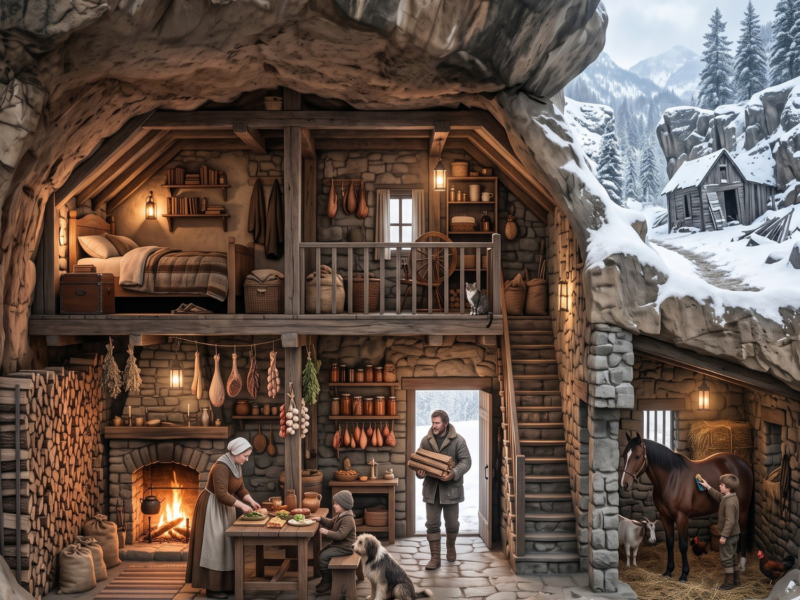
They Laughed at Her Rock House—Until 7 Feet of Snow Buried Calder’s Bend 🥶
The First Trial
The first true winter—the winter of 1879 into 1880—arrived with significantly less lethal fury than the high Colorado peaks sometimes threatened.
The snowfall was steady and reliable, but completely lacking in malicious excess. The temperatures fell sharply, but they did not drop to the historic, bone-crushing extremes the old-timers loved to recount in the taverns.
Down in the valley, the struggling residents of Calder’s Bend managed their survival through a combination of heavy fuel consumption and sheer, stubborn optimism.
In Dunore Manor, despite its massive financial expense and ambitious framing, the sprawling gaps between the unseasoned Oregon pine boards admitted vastly more freezing air than anticipated. The three-story volume proved mathematically punishing to heat evenly. The expensive, delicate glass windows—glorious and transparent in the autumn—became thermal conduits of pure cold in January, radiating an icy draft that no amount of roaring hearth fire could fully offset.
Dunore said absolutely nothing about this public failure. A man who had staked his entire financial and social reputation on his own infallible judgment did not easily or gracefully advertise the cold evidence stacked against him.
Up on the ledge, however, Vera and Edmund burned precisely half the cordwood they’d mathematically projected and budgeted for.
The massive stone floor, charged gently by four hours of direct winter sunlight streaming through the south-facing window each afternoon, released its stored thermal energy with agonizing slowness through the dark, sub-zero nights.
Copper the gelding stood comfortably in his stone stable, enjoying a ambient warmth that his previous miserable owners in Pennsylvania stables had never managed to achieve with twice the insulation or blankets.
“A mild winter proves nothing,” Vera noted flatly one evening when Edmund observed that the ledge had performed beyond even her most optimistic mathematical predictions.
“The mild winters aren’t the ones that matter,” she added, stoking the low coals. “It’s the ones that come to break you.”
She spent the following summer of 1880 systematically expanding the storage capacity of the rear storage passage. She layered in dried salted meats, whole sacks of flour, barrels of lamp oil, coffee beans, and the raw, unglamorous arithmetic of survival calculated precisely against the statistical possibility of a winter that did not cooperate.
Edmund watched the accumulating supplies with the expression of a man trying to decide whether to feel deeply reassured or mildly alarmed.
“You’re preparing for a medieval siege,” he said in October, watching her roll a heavy barrel of salted pork into the deepest, darkest section of the rock shelf.
“I’m preparing for winter,” she corrected him without looking up. “In the high mountains, the difference between those two things is entirely theoretical.”
In October 1880, while Edmund was occupied with academic correspondence and Copper was contentedly working through his second massive bale of hay, Vera spent three intensive days driving heavy iron rings into the sandstone along the full length of the outer ledge.
There were eight massive rings in total, spaced at precisely measured intervals. Each one was set deep into pre-drilled holes in the granite at a calculated downward angle that would hold an immense lateral rope pull against a catastrophic outward slide.
She worked methodically, testing the structural load rating of each ring before moving to the next, hammering them home until she was completely certain of their unyielding depth and angle.
Edmund, returning from a rare supply run to the valley on the third day, found her examining the final ring with both hands, applying what appeared to be her full body weight to confirm its hold.
“What are those for?” he asked, dropping his mail pouch.
“In case we need anchor points for rope work.”
He looked at the eight iron rings spaced along the exposed ledge like a series of fixed, unanswered questions. “Rope work for what?”
Vera released the iron ring, stood up, and wiped her dusty palms on her apron. Her expression was the one she used when she’d already thought through every horrific extension of a hypothetical question and found that the answer was too large to say casually.
“Things I’d rather not ever need them for,” she said.
She went inside to wash the stone dust from her hands.
That night, Edmund sat by the window and wrote a single sentence in his personal journal:
Vera installed eight iron anchor points along the outer ledge today. She wouldn’t explain their purpose beyond vague ‘rope work.’ I’ve been married to her long enough to know that when she prepares for something she refuses to name, I should trust the preparation and not press for the name. She has always looked vastly further ahead than I have. It is one of the things I most depend on in her.









