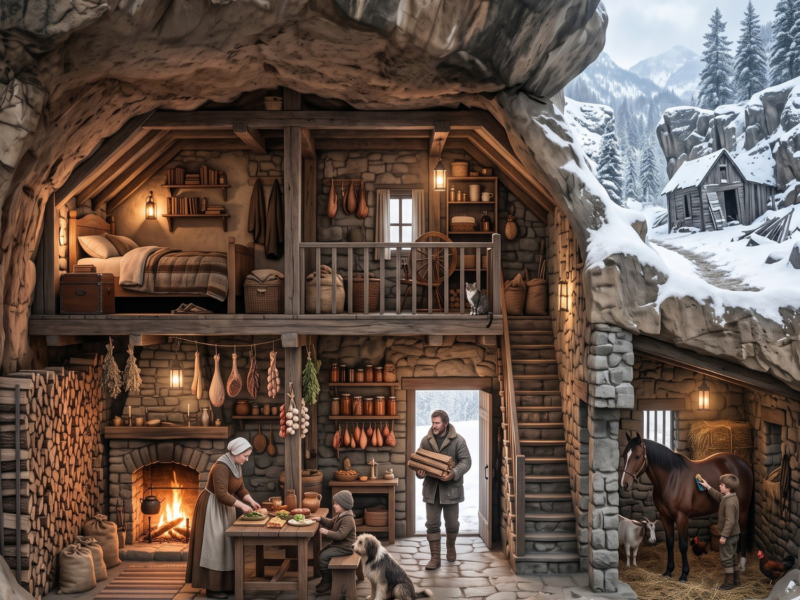
They Laughed at Her Rock House—Until 7 Feet of Snow Buried Calder’s Bend 🥶
The White Out
By mid-morning, the accumulation on the valley floor was already eight inches deep.
Ore Street had entirely emptied of all foot and wagon traffic. The sound of the wind through the natural funnel of the valley walls was now continuous—not coming in sudden, manageable gusts, but sustained as a massive, crushing physical pressure against every vertical surface.
Snow did not fall vertically. It drifted horizontally, driven with such velocity that it blurred the entire world outside the window into a solid, impenetrable gray wall of flying ice crystals.
By nightfall of day one, the massive snowdrifts against the north-facing walls of the valley’s buildings had already reached window level on the first floors.
The snow itself wasn’t the primary problem yet. The problem was the wind’s sheer, mechanical ability to pack it—to compress what fell into something drastically denser than loose snow had any right to be. It filled gaps under eaves, banked menacingly against doors, and began the slow, catastrophic process of transferring massive weight onto timber-frame roofs that had been built with zero structural expectation of bearing heavy ice loads.
Up on the ledge, however, Iron Wall Ledge collected absolutely nothing at the entrance.
The sweeping rock overhang did its brilliant work without a scrap of human drama, cleanly deflecting the heavy snow accumulation outward so that it fell four feet out in the empty air in front of the doorway, rather than banking up and blocking the exit.
The south-facing window showed a remarkably clear, albeit gray, view, even as the valley below completely disappeared into white opacity. The ancient stone walls neither flexed nor groaned.
Down in the stable, Copper stood comfortably, munching his hay in a deep, ambient warmth that his previous miserable life in Pennsylvania had never afforded him.
Day three brought the first catastrophic crisis from the valley below.
Vera saw the smoke change from the south window. It wasn’t the regular, healthy chimney smoke she’d been monitoring since the storm began—reading it the way an experienced physician reads a patient’s respiratory rhythm. It was a sudden, unnatural cessation of smoke from Dunore Manor’s main exterior flue.
The tall stone stack on the north face of the grand building—clearly visible when the wind momentarily thinned the swirling blizzard—went from a steady, gray column to absolute nothing. Then, minutes later, thin, pathetic wisps of dark smoke began emerging from entirely wrong places: the horizontal joints between the second-floor wall planks, the gap beneath a north-facing window, the unmistakable, terrifying signature of smoke finding internal routes it was never meant to travel.
She understood the mechanics immediately. The massive chimney flue had been completely choked and packed solid by the wind driving swirling snow straight down its open brick top. It was a common, fatal problem that timber-frame buildings on valley floors faced when storms blew from the northwest at the wrong sustained angle.
The fire inside the massive manor would still be burning fiercely for quite some time, starved of oxygen, its toxic smoke now filling the lower, sealed floors with nowhere to go. It would rapidly force the trapped family upward in their own house, as surely as a rising tide of black water.
Edmund came to look when she called him urgently to the glass. He saw what she saw.
“How many other buildings in town will have the same lethal problem?” his voice was flat with the effort of keeping it strictly controlled.
“Every single one that faces the wrong direction,” Vera said, turning from the window. “Every house with a poorly flashed chimney.”
She walked swiftly to the storage passage, not running, not panicked, but moving with the concentrated, ruthless economy of someone for whom the time for considering theoretical options had abruptly ended.
She checked the hemp rope coils. She checked the eight iron anchor rings along the outer ledge. She checked the four small shovels she’d acquired from the hardware store across the previous autumn—two good ones, two adequate ones—stacked neatly in the corner with their wooden handles easily accessible.
She counted the blankets: fourteen folded flat in the feed sack. She counted the food stores against the terrifying new arithmetic of possible community need.
When she came back to the main room, Edmund was still standing at the window, watching the dead town.
“We can’t go down yet,” Vera said, her voice carrying the absolute weight of a decision already fully made. “The storm is currently at its absolute worst. If we go down into that whiteout right now, we will simply get lost twenty feet from the cliff base. We cannot help rescue a single person if we are dead in a drift.”
Edmund turned from the window. His face held something she rarely saw there—not anger, but its dangerous precursor. The place where a man’s sudden helplessness converts itself into violent urgency, because helplessness is entirely unbearable.
“There are children down there, Vera,” he said, his voice tight. “Families.”
“I know,” she said, pressing her palm flat against the south window frame. The wood was solid, set deep enough into the rock that it conducted the cliff’s internal warmth. “Some of them will survive this. Not all of them. But we go down the exact second the wind drops below a threshold where we can navigate by the ropes.”
Edmund looked at her. He took a long, shaky breath, and the urgency in his posture compressed, held firmly under the iron weight of an understanding he hadn’t finished accepting.
“How long?”
“Until it breaks,” she said. “Two days. Maybe three.”
He sat down heavily in his chair. He didn’t open his journal. He put his hands flat on his knees and stared at the stone floor between his boots.
“Then we wait.”
She turned back to her rigorous preparations. There was still vital work to do. And the doing of it was the only useful, sane response to the heavy feeling that had settled in her chest like packed snow.









