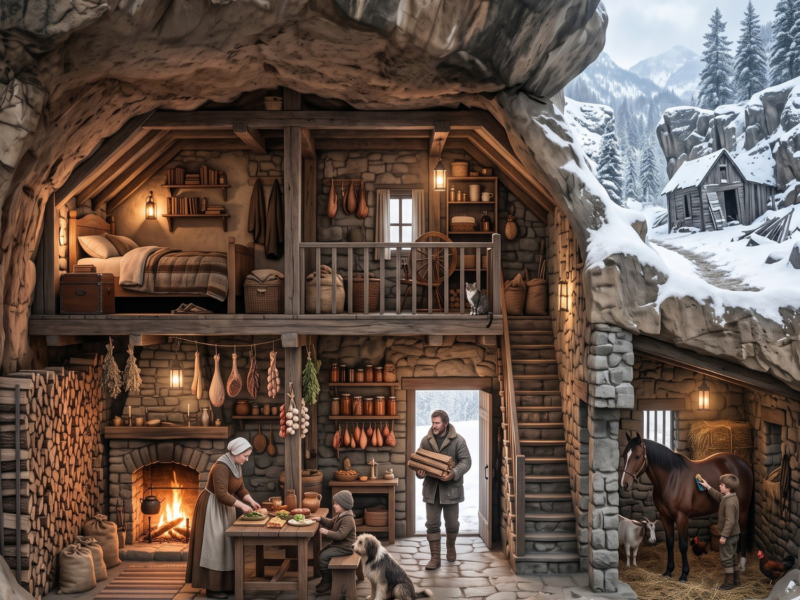
They Laughed at Her Rock House—Until 7 Feet of Snow Buried Calder’s Bend 🥶
The First Winter
Construction on Iron Wall Ledge—the name Vera quietly gave it in her ledger, rejecting the mocking town moniker—began the first week of June 1878.
It continued with the relentless, unhurried pace of someone who understood deeply that speed and permanence are fundamentally incompatible ambitions.
She had brought from Philadelphia a set of her father’s hand-forged chisels, the handles worn dark and smooth by decades of use, alongside three of her own favorite blades. She brought a heavy mason’s hammer with a sturdy hickory handle she’d replaced twice in the past decade, a set of brass measuring rods, a plumb line, and a bronze level that had belonged to her father’s father.
These were not sentimental keepsakes. They were the precise, uncompromised instruments the brutal work required.
The sandstone of the south cliff was, as she’d brilliantly assessed from the valley floor, exceptionally well-suited to her purposes: fine-grained, uniform in density, soft enough to be carved away without requiring weeks of pneumatic drilling, yet structurally hard enough to bear massive compressive loads without crumbling.
It had been laid down thirty million years ago when this part of Colorado was the floor of a shallow, inland sea, compressed over eons into stone that would, if left alone by human folly, outlast every single ambitious brick building currently being rushed up in the valley below.
She began with the main room—the largest interior space, the one that would do the heaviest thermal work. Four yards wide, four and a half yards deep, carved directly into the heart of the cliff face, with the massive natural overhang serving as the permanent, monolithic ceiling above the entrance.
She worked the steel chisel in long, deliberate, rhythmic strokes. She read the hidden grain of the sandstone the way she’d been taught, gracefully following its natural geological logic rather than violently imposing her own design upon it. Where the rock naturally wanted to cleave along a specific fault angle, she let it cleave. Where it violently resisted, she accepted the stone’s resistance and gracefully worked around it.
Edmund participated in every single aspect of the grueling construction that didn’t require specialized, professional mason’s skill—which, humbling to admit, was vastly more than he’d initially anticipated.
He mixed heavy batches of mortar with a thoroughness that Vera reluctantly approved of, though it left his academic hands blistered and bleeding by midday. He hauled massive building materials up the terrifyingly narrow ledge path using Copper, the small, steady gelding they’d acquired in Denver. Copper was a magnificent animal—steady-tempered and remarkably sure-footed in a way that the treacherous path absolutely required.
Window frames of milled pine came up the mountain in separate pieces, lashed securely to a makeshift wooden pack frame. Thick glass windowpanes came up wrapped tightly in horse blankets, with Edmund walking directly behind Copper’s hindquarters, one hand constantly ready to catch anything if the animal slipped on the scree.
Iron hinges, heavy mounting bolts, two hundred feet of high-grade hemp rope, oil lamp fixtures—Edmund kept meticulous, exhaustive notes of every item. This was partly professional academic habit; twenty years of university lecturing had made meticulous record-keeping completely instinctive. But it was also something far more deliberate.
He had begun to understand, silently watching Vera work day after day under the hot sun, that what she was doing represented a massive, unwritten body of knowledge that existed nowhere in architectural textbooks.
The precise positioning of the main room to capture the maximum south-facing winter sun. The exact mathematical angle of the rock overhang designed to deliberately deflect cascading snow out into empty space rather than allowing it to accumulate at the vulnerable wooden doorway. The calculated thickness of the exterior wall on the north side that would buffer against the brutal temperature differential between the cliff’s interior core and the worst of the sub-zero alpine air. The placement of the small natural spring—a gentle, continuous seep of water filtering through a sandstone stratum eight feet above the ledge—so that it could be cleverly channeled into a carved stone basin inside the domestic structure.
“You’re making structural decisions that master architects don’t even think about,” Edmund said one evening in July, sitting on the dusty ledge while Vera quietly cleaned and oiled her chisels.
The valley far below was washing in the golden, slanting light of late afternoon. The distant, faint sounds of Calder’s Bend carried up to them—the ring of a blacksmith’s hammer, a shout, the rattle of a dray wagon.
“Most builders are building exclusively for now,” Vera said, running a wet oilstone along a chisel edge with a smooth, singing sound. “I’m building for January. There’s a profound difference.”
Edmund wrote that exact sentence down in his journal. He would write down dozens of her brilliant observations over the course of those fourteen months. He did not attribute them to her in his formal notes—she hadn’t said them for public attribution—but he preserved them the way a dedicated naturalist preserves rare botanical specimens, because the practical knowledge mattered intensely, regardless of who happened to catalog it.
The private sleeping room came next. It was carved significantly further into the cliff, set at a slight, clever angle to the main chamber so that the residual body heat from two sleeping people would be trapped within the dense stone rather than escaping outward through the open entrance passage.
The dark passage leading to the stable and dry storage space—cut to the east, following a natural, fractured fault line in the sandstone—took three weeks of agonizing, claustrophobic work. The fracture, though convenient in direction, possessed a dangerous structural weakness at its upper edge. It required extensive reinforcement with heavy, mortared dry-stack stone before Vera would ever trust it to hold a weight overhead.
The total out-of-pocket materials cost at completion was an astonishingly modest $247—including the four-dollar land filing fee—standing in stark, beautiful contrast to Dunore’s ostentatious $9,200.
This financial figure was almost comical, except that neither Vera nor Edmund found it even slightly funny. To them, it simply confirmed that they’d built the right thing, for the right reasons, with the right absolute priorities.
Dunore Manor was finally completed in September 1879, heralded by an extravagant inauguration party that Ore Street talked about with breathless awe for a month.
There were glowing lanterns hanging from every single story. A professional fiddle band had been imported all the way from Pueblo. Cases of expensive, imported Kentucky whiskey were uncorked.
The three-story structure rose proudly at the northern end of Ore Street like a financial and architectural declaration. All clean angles, soaring gables, and gleaming, imported glass. The second-floor porch ran the full width of the impressive facade, clearly visible from almost any point in the valley floor.
Dunore had not sent an invitation to the Ashtons. He didn’t need to; he knew they wouldn’t come.
From the high, shadowed ledge that evening, Vera sat quietly and watched the manor’s illuminated windows reflect brilliantly off the frost-dusted valley floor below. The energetic sound of the fiddle music drifted up on the mountain thermals, and then abruptly dissolved into the cold night air before it even reached the cliff base.
Edmund sat behind her, writing by the flickering light of a single tallow candle, not in his construction journal, but in the intimate personal record he’d kept since his days in Baltimore.
They build explicitly to be looked up at, he wrote, scratching the nib across the paper. We build to endure. These are not merely competing architectural philosophies; they belong to entirely different, incompatible conversations about what a house is actually for.
Winter will settle which conversation was worth having.
He didn’t read the sentence aloud to Vera. She wouldn’t have disagreed with a word of it, but she also wouldn’t have needed to hear it. She already knew.









