They Laughed at Her Rock House—Until 7 Feet of Snow Buried Calder’s Bend 🥶
The Eagle's Nest
Calder’s Bend in the spring of 1878 was everything a Colorado silver-boom town was supposed to be: loud, provisional, and deliriously optimistic in the specific way of places where money is changing hands so fast that no one has started thinking about what happens when the vein runs dry.
The main artery, Ore Street, ran for six blocks along the south bank of a cold, fast-flowing mountain creek. It was lined with hastily erected timber-frame buildings that had been thrown up with impressive speed and almost zero attention to structural permanence. The sharp, clean smell of the local sawmill was everywhere. So was horse manure, cheap coal smoke, and the distinct, sour human sweat of men working physically hard in close quarters.
The valley was remarkably narrow—maybe three hundred yards across at its widest point—with massive red-orange sandstone cliffs rising nearly ninety feet on both sides. They were striated in dramatic horizontal bands that recorded thirty million years of patient geological deposition.
Most people in Calder’s Bend looked at those looming cliffs the way you look at a painted wall backdrop—a boundary entirely irrelevant to the daily business of making money.
Vera looked at them the way a master violinist looks at an instrument no one else in the room knows how to play.
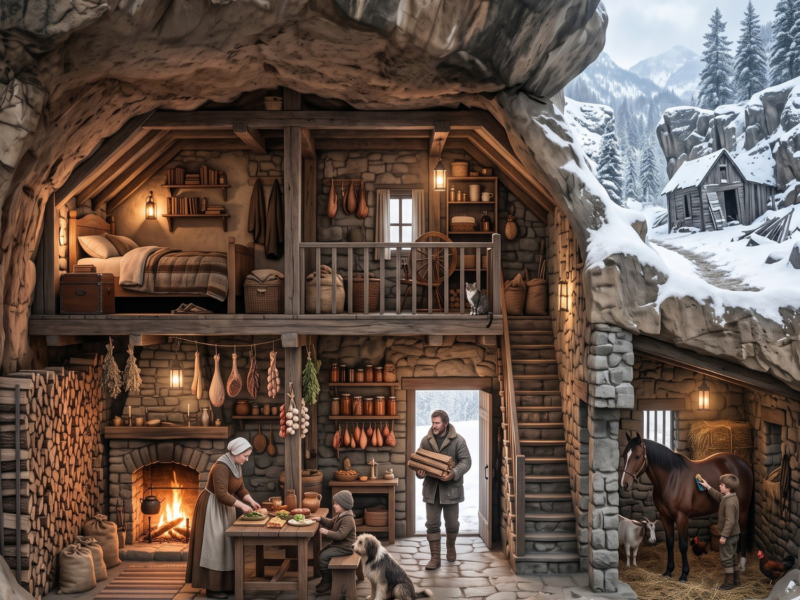
The south-facing wall featured a natural geological formation about eighteen feet up that immediately arrested her attention. A massive, sweeping natural overhang pushed four and a half feet out from the sheer cliff face, creating a deep, shadowy alcove below it roughly the width of a modest residential room.
The sandstone in the alcove was the color of old brick—dense, fine-grained, the kind of rock that yielded gracefully to careful chisel work without crumbling into sand. A narrow, treacherous path, barely more than a goat ledge, wound upward from the valley floor in a series of natural stone steps that a sure-footed person, or a small, steady pack animal, could navigate with extreme care.
She stood at the base of the cliff for nearly an hour the morning after their arrival, looking silently up at that overhang.
Edmund stood beside her and said nothing. He recognized the particular quality of her silence—the quiet stillness that meant complex structural calculations were running through her mind.
The land office on Ore Street was a single-room building anchored by a potbelly stove going hard despite the mild spring weather. Behind a scarred oak desk sat Roy Becker, the county’s land registrar. He was a lean man in his mid-thirties whose wire-rimmed spectacles gave him an air of academic precision that his haphazard record-keeping did not entirely deserve.
He had a distinct habit of tipping his head slightly to one side whenever he was confronted with something he found difficult to categorize—a physical gesture he deployed now as Vera set her finger on his dirty survey map and indicated the specific section of the south cliff containing the alcove.
“That section,” Vera’s finger was steady. “The alcove formation under the natural overhang. Is it currently claimed?”
Becker tipped his head, squinting. “Nobody’s claimed that scrap of rock. Nobody’s ever claimed any of the cliff sections in this valley. There’s no silver up there worth pulling.”
“I’m not interested in silver.”
The registrar’s head tipped further. “What are you interested in, ma’am?”
“Building a house.”
The silence that followed had a strange texture to it. It was the particular, uncomfortable density of a man trying to decide if he’d profoundly misheard something absurd.
Behind Vera, Edmund stood with his hands clasped neatly behind his back, studying a framed survey map on the wall with the expression of a person carefully choosing not to participate in someone else’s negotiation.
Becker looked at Vera, looked back at the map, and then looked out the office’s single north-facing window at the red stripe of shadow visible below the cliff’s overhang.
“You want to live on a cliff? Like a… like a bird?”
“Like a person who understands stone,” Vera replied.
Her tone carried zero edge, zero defensive hostility. It was simply the correct, unvarnished answer to his question.
“What’s the filing fee?”
“Four dollars.”
Becker collected the coins with the bewildered expression of a man accepting legal payment for something he strongly suspected was a terrible mistake, but couldn’t legally decline.
As Vera folded her official receipt into her coat pocket and turned to leave, she paused at the door, her hand resting on the wooden frame—not for theatrical effect, not for dramatic tension, but simply because something worth saying had occurred to her.
“Mr. Becker,” she said quietly. “When the first serious winter comes—not this year, maybe not next year, but when it comes—remember the path up the south cliff.”
Becker watched her go. He told the baffling story to three different men before supper that evening.
Silas Dunore heard the story the same evening in the back room of the Calder’s Bend Bank office, where a small, exclusive group of the town’s most consequential financial men gathered on Tuesday evenings to drink good Kentucky whiskey and discuss matters of mutual profit.
Dunore presided over these gatherings the way he presided over most things in Calder’s Bend: not loudly, not crudely, but with the settled, unshakable confidence of a man who owned the only bank within fifty miles, and therefore owned, in some profound sense, the economic ambitions of everyone living in the shadow of the peaks.
He was fifty years old, broad-shouldered, with soft hands that had never done physical labor, and a face that had learned to reveal precisely as much as he intended it to, and not a fraction more. He’d arrived in Colorado in 1873 and understood immediately that the real money in a silver boom was never found in the silver itself. It was in the land, the financing, the mortgages, and the infrastructure of extraction.
He had bought prime parcels in Calder’s Bend when they were worth pennies, subdivided them, leased them, and sold them at multiples that made the original purchase prices look like rounding errors. He’d financed the sawmill, the grand hotel, the general store, and three of the six raucous saloons. He understood financial leverage the way Vera understood stone: as the foundational principle underlying everything.
His current, crowning project was Dunore Manor, currently under construction at the northern end of Ore Street on the largest, flatest lot in the valley. It was designed as three stories of Douglas fir timber shipped in from Oregon at considerable expense. Real glass windows ordered from a distant Denver supplier—twenty-two panes per window. It was a physical demonstration of the vast distance between rustic Calder’s Bend and the refined civilization Dunore intended to drag it toward. A grand tin roof, a full-length porch on the second floor, and a projected total cost of $9,200—a staggering figure Dunore had not kept private from anyone.
When one of the other men in the back room repeated the story of the eastern woman who had bought a sheer cliff for four dollars with the intention of carving a dwelling into the granite, Dunore listened with a slight forward lean that indicated genuine, if deeply amused, attention.
Then he leaned back and took a sip of his amber whiskey.
“A woman,” Dunore mused, a smirk playing across his lips. “Ashton, I think they said. Eastern woman. Her husband is some kind of academic. A teacher’s wife who wants to live in a hole in the wall.”
Dunore considered this with palpable pleasure. “What does she think she’s building? A prehistoric cave?”
“That’s what they’re saying down at the mercantile. Call it Eagle’s Nest, some of the boys are joking.”
The name pleased Dunore, not because he’d invented it, but because it captured the profound absurdity of the endeavor so efficiently. He repeated it twice under his breath on his way home that evening, trying it in different inflections, finding it funnier each time.
The following morning, he sent his junior clerk to the land office with a formal, written offer: forty dollars for the exact same cliff section Vera Ashton had purchased the previous day. It was a remarkably fair, generous price—ten times what she had paid, before she had even lifted a tool.
The clerk came back two hours later with the offer uncountered, unmodified, and simply refused.
Vera Ashton had listened to the clerk, thanked him for his time, and returned to looking at whatever she’d been looking at on the cliff face before he’d interrupted her.
Dunore sat with this strange information much longer than the situation seemed to warrant. In twenty-three years of buying, selling, and breaking men in three different states, he had not often encountered a flat, unyielding refusal to a mathematically sound, profitable offer from someone who had risked almost nothing.
It wasn’t even about the money. Forty dollars was nothing to a man of his stature. It was the categorical nature of the refusal. She hadn’t countered to negotiate a higher price. She hadn’t asked for explanations. She had simply said no, and gone back to her rock.
“Give her one winter,” Dunore said that evening to the men assembled around his half-finished dining room table, the raw framing of Dunore Manor rising around them while the crisp September air drifted through the unglazed window spaces. “Give them one single winter in whatever childish thing they’re building up there, and they’ll be begging the town for a proper, heated room to rent.”
The men around the table nodded in agreement. The topic smoothly moved on.
Outside, barely visible in the fading twilight through the open wall framing, the south cliff face showed nothing of note. Just shadow pooling beneath the heavy overhang. The narrow path was invisible at this distance. The alcove where Vera Ashton had already begun making her precise measurements appeared as nothing more than a thin, insignificant stripe of darkness in the unforgiving red stone.









