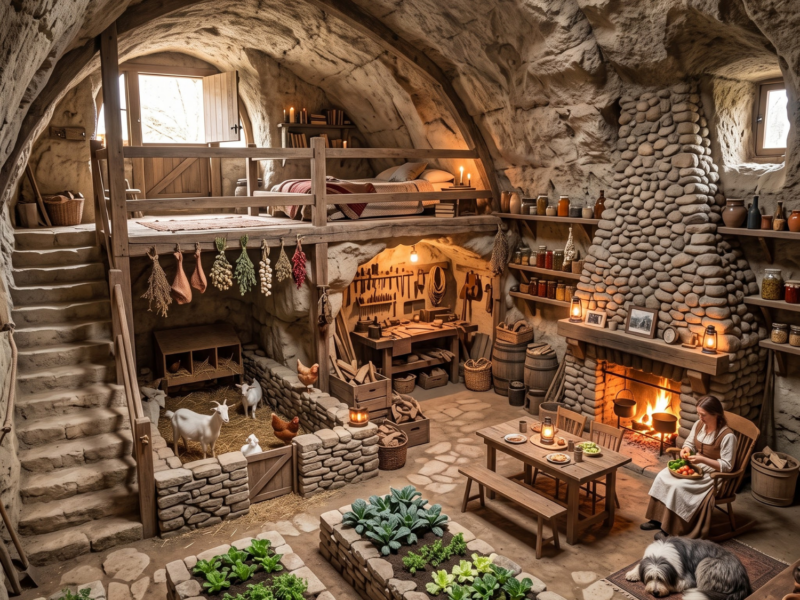
They Laughed at the Cave She Inherited—Then a 7 Day Blizzard Buried the Montana Valley
They Laughed at the Cave She Inherited—Then a 7 Da…
The valley below Elkhorn Ridge had gone utterly silent. It was not the soft, expectant hush that pulls in a valley before a gentle sunrise, nor the drowsy, contented quiet of farms still folded in deep sleep. This silence had a terrifying, physical weight to it. It felt as though the entirety of Elkhorn Ridge had drawn one long, freezing breath and absolutely refused to let it go.
No rooster called from the Pruitt place across the draw. No wagon wheel groaned over the frozen ruts of the road far below. Even the towering lodgepole pines along the crest stood as motionless as things carved from black stone, framed starkly against a sky the color of a cold gun barrel.
High on the rocky, unforgiving slope, seventeen-year-old Wren Aldridge stood alone.
A heavy canvas sack of potatoes rode uncomfortably against her spine. A strip of dark, dried venison was knotted tightly at her waist. Frost had gathered at the tail of her long chestnut braid, tiny crystalline beads catching what little, anemic light the morning offered. Each breath left her lips in a pale ribbon that hung suspended for a moment in the still air, before the bitter, aggressive edge of that October dawn swallowed it whole.
Halfway up the steep, winding deer trail, she paused, turned, and looked back down toward the town of Cold Water Bend.
Thin, gray threads of smoke lifted from the chimneys below, rising as straight as plumb lines in the windless, freezing air. Down there, the people were beginning another unremarkable morning. They were filling their enameled coffee pots, casually stoking their cast-iron stoves, and they had absolutely no notion that winter had already started its long, silent climb down out of the high country toward them.
Down in those streets, men had laughed from their warm porches as Wren had dragged a loaded, makeshift sled up this same frozen trail for days. They had slapped each other on the back and made jokes about the girl building a castle in the rocks.
None of those laughing men had noticed the ravens. They had not seen the black flocks abandoning the high, exposed ridges two days prior. They had not noticed the elk herds drifting down through the yellowing aspen benches far too early in the season.
Wren alone read the warning. Her dead father had taught her how to hear the things the stillness was trying to say.
She shifted the heavy sack higher on her bruised shoulders and climbed on.
The narrow trail wound upward through scattered, stunted pines before abruptly losing itself behind a massive, jutting shoulder of pale limestone. A thick, ancient screen of juniper had grown across the opening she sought—so incredibly dense that a stranger might pass within arm’s reach and see nothing more than tangled, hostile branches and rough stone.
Her father had shown her this hidden place when she was young enough to believe that every secret he kept was a kind of magic. He had never once called it a cave. He had only smiled that slow, weathered, sad smile of his one afternoon while teaching her to read the tracks of animals in the snow.
“Some places do not belong to the map, Wren,” he had told her, his voice rough from the mines. “They belong to the people who know how to listen.”
She pushed through the stiff, scratching juniper branches. Instantly, the biting wind that had been worrying at her collar simply ceased to exist. The narrow passage swallowed the cold. It opened, after a dozen careful, blind steps, into a massive chamber deep in the mountain’s body.
It was dry-walled by natural granite on every side. The air inside held itself at a peculiar, steady temperature that summer’s brutal heat never reached, and winter’s killing teeth never found.
A fire pit sat blackened and waiting beneath a natural fracture in the high rock ceiling—a geological flaw through which smoke could climb and escape without ever filling the room. Along one smooth wall, sturdy shelves fashioned from incredibly old, gray pine planking waited empty. Split firewood stood stacked neatly to the height of her shoulder, dry as bone.
There was a profound strangeness to the place that she had never been able to name, even as a little girl. Everything in it waited. The split wood, the shelves, the swept floor of packed earth. All of it seemed arranged with the patient, deliberate care of someone who fully expected, someday, that another visitor would come.
She had never asked her father who built it. She had simply assumed, in the naive way children assume, that he had.
Now, kneeling to lower the fifty-pound sack of potatoes beside the small store of provisions she had already begun to gather, she found herself wondering for the very first time whose hands had actually cut those shelves. Whose axe had split that wood? And how had any of it survived so long, seemingly untouched by the world outside?
She pushed the thought aside. Wondering did not fill a larder. She did her work.
Potatoes, flour, salt, dried beans, a small, precious store of dried apples, heavy bundles of smoked meat wrapped tightly in waxed cloth. Every agonizing trip up from the town added something to the pile. Every trip left her shoulders aching a little deeper into the joint.
She checked each bundle by hand, exactly the way her father had taught her. Running her bare fingers along the cloth for any microscopic trace of dampness. Feeling for any suspicious softness that meant rot had crept in. Looking for any sign that mice had found what she’d hidden.
Food keeps only for those who respect it.
Down in the valley, folks chased comfort and called it living. Up here, in the cold, unyielding heart of the stone, Wren was learning again how to prepare for the things that comfort always forgot.
Her father had spent the better part of two decades bent double in the suffocating silver mines that had originally drawn desperate men to this corner of the territory. The mountain had schooled him in brutal ways no schoolhouse ever could. He had learned to fiercely distrust a warm week in October, the same way a person learns to distrust a smiling stranger with soft hands. He had learned never to waste dry wood, never to assume the spring would come early, and to always leave a little room in the cellar for a leaner tomorrow.
Two winters gone, the earth had finally closed over him in a massive collapse deep in the Number Four shaft. The men had carried her father home to her under a heavy, blood-stained canvas tarp—a day she still did not let herself think about when the sun went down. She had been fifteen.
The harsh lessons he’d left her had vastly outlasted the sound of his voice. Lately, she had begun to suspect they were the only inheritance that would ever truly matter.
After they buried him in the frozen ground, the house changed faster than the season’s turn. Her mother, Margaret, terrified of starvation, married again before the following spring unlocked the creeks.
The man she married was not a physically cruel one. Cornelius Vane did not raise his hand to strike them, nor did he raise his voice in drunken anger. He was worse than cruel in a much quieter, vastly more devastating way.
He was a man of ledgers. He measured every single loaf that came from the oven, every bucket of grain from the bin, every wool blanket, and every mouth that opened at his table. He weighed them all against one another in a heavy, leather-bound book he kept beside his dinner plate, and he did his brutal arithmetic aloud.
One evening, near the tail of that first autumn under his roof, Cornelius spread the ledger open across the kitchen table. He let his ink-stained finger travel slowly down a column of careful figures. The kerosene lamp threw his shadow long and menacing against the wall. His finger stopped. He studied the number beneath it as though it were a divine verdict handed down from somewhere higher than himself.
“We’ve provisions enough to carry four through to spring,” Cornelius addressed the room, looking at no one’s soul in it.
No one answered. The iron stove ticked as it cooled. Her mother’s wooden spoon went around and around the soup pot in a slow, hypnotic circle that never once faltered.
Cornelius lifted his cold eyes at last, and they came to rest directly on Wren, where she sat rigidly at the far end of the table.
“There are five of us.”
Her mother kept stirring. The spoon circled the pot, and circled it again. Margaret did not raise her head. And in that small, cowardly refusal to look her daughter in the eye, Wren understood everything that would not be said aloud in that house.
Later, when the lamp had been carried up and the house had gone dark, Wren found a canvas pack waiting at the foot of the loft ladder. Someone had already filled it for her. Two weeks’ worth of flour. A gray wool blanket worn dangerously thin at one corner. Her father’s heavy winter coat, the one that still smelled faintly of pipe smoke and pine pitch. A small sack of dried apples.
Nothing about the pack required explanation, and no one offered any.
By the time the sun cleared the eastern rim the next morning, Wren was gone. She carried out through that door everything in the world that belonged to her. She did not look back at the house, because looking back was a thing that cost more emotional energy than it ever returned.
The first nights of her exile tried every promise she had ever made herself about being strong. She slept shivering beneath the bed of a broken-down wagon behind the livery stable. She slept inside an abandoned line shack whose door hung by a single leather hinge. Once, she slept beneath the sweeping boughs of a fallen spruce, where the early snow came down faster than she could brush it from her shoulders.
The cold hunted her relentlessly through every gap and frayed seam in her clothing. Hunger walked beside her like a second, silent traveler who never tired and never fell behind.
She went to three different farms in those desperate days. Three doors closed against her. Not because the people behind them were inherently hard-hearted, but because each frontier family counted its own thin sacks of grain before it opened to a stranger, and found the numbers wanting. She understood it, even as the heavy iron latches dropped into place. Winter had a way of making decent people fold their arms tightly across what little they had, and call it wisdom.
On the fifth morning, she had climbed up into the hills hunting for deadwood firewood, moving more to keep her blood flowing than from any real hope of finding warmth.
And that was when the hidden place found her again.
She stood before the curtain of juniper, her breath sawing painfully in her chest. She did not see a childhood secret this time. She saw a future. She saw the one door in all the world that had not been shut against her. And something in her chest that had been slowly, painfully closing all week came violently open again.
That afternoon, she marched back down to the town and spent the absolute last of her money. The few coins she had meticulously sewn into the hem of her skirt against exactly this kind of ruin.
She walked into Whitlock’s general store and laid them on the wooden counter. She bought heavy potatoes instead of fresh, warm bread. She bought dried beans instead of the peppermint sticks she’d loved as a child. She bought salt instead of any single thing that might have been called a comfort.
Mr. Whitlock, the storekeeper, watched her load it all onto a rough, heavy sled she’d cobbled together from busted crate lumber. He leaned his knuckles on the counter, a grin tugging at the corner of his mouth.
“Laying in for next year already, are you, Wren?”
“For next month,” she said, cinching the last knot and testing the rope with a sharp tug.
He laughed at that. It was an easy laugh, with no meanness in it. “So does every squirrel on the mountain, girl.”
She gave him a polite, tight smile and pulled the heavy sled out into the biting cold, the wooden runners hissing loudly over the packed snow of the street.
That was the beginning of the part the town would remember later, though no one paid it much mind while it was actively happening. Every morning she crossed the exact same stretch of road at the exact same hour. Every afternoon she leaned into the same frayed rope and dragged the same heavy sled up the same treacherous mountain. It was always heavier going up than it had been coming down, and she was always, entirely, alone.
Outside the blacksmith’s shop, where the roaring forge threw a demonic red glow onto the trampled snow and the air smelled sharply of scorched iron, Amos Tanner leaned in his doorway. He was a massive, broad-shouldered man with soot ground permanently into the deep creases of his leather apron. He had known her father well. He watched her pass, day after day, with the loose sled runners chattering behind her.
“Girl!” Amos called out one afternoon, friendly enough. “What in the world are you hauling up that hill day after day? You building yourself a castle up there in the rocks?”
She stopped only long enough to snug the rope where it had begun to slip off her bruised shoulder.
“Winter,” she said. Just the one word. And she left it standing in the air.
The men gathered near the warm forge found that incredibly funny. One clapped another on the shoulder. Another shook his head and spat a long stream of brown tobacco juice into the pristine snow, allowing as how the ground hadn’t even taken a hard freeze yet.
Wren turned her face toward the north, toward the high peaks that stacked one behind another into the gray distance, and she saw the terrifying thing they did not.
A wall of cloud lay banked heavily above the farthest ridge. It was dark, low, and utterly without motion. It was the way clouds sit when they are not merely passing through a valley, but actively gathering an army. The wind that came off it carried a bite that absolutely did not belong to October. It had an edge like the flat of a cold steel knife laid against a bare cheek.
“My father always said the mountain speaks long before the storm, Mr. Tanner,” Wren told Amos. She meant it as a kindness, a warning, though she could see it did not land as one.
Amos followed her gaze up toward the peaks. He squinted. All he found up there was weather—the same weather that came every year, and mostly amounted to nothing but a few days of shoveling. He shrugged his massive shoulders, chuckled, and went back to the comforting heat of his fire.
None of them had marked the ravens that had left the high ridges in the last two days, lifting off in black, chaotic scatters and drifting urgently toward the lowlands. None of them had marked the elk that had come down off the high benches weeks earlier than any year in memory. None of them had marked the strange, held, suffocating stillness that had settled over the whole basin—like the agonizing pause between a struck match and the flare of the flame.
Wren marked all of it.
She had been raised to notice. And noticing was the absolute last thing her father had left her that could not be packed into a canvas bag or subtracted in a ledger.
Related Articles

They Mocked the Widow’s Dirt Cellar—Then the Freeze Left Every Cabin Cold but Hers Warm
They Mocked the Widow’s Dirt Cellar—Then the Freeze Left Every Cabin Cold but Hers Warm…

A Homeless Veteran and His German Shepherd Inherited a Ridge No One Wanted — 35 Feet In, They Found
Chapter 1 / 7 A Homeless Veteran and His German Shepherd Inherit… A Homeless Veteran…

Neighbors Laughed When He Built A Cabin Inside An Old Barn—Until It Kept His Home 35 Degrees Warmer
Chapter 1 / 8 Neighbors Laughed When He Built A Cabin Inside An… Neighbors Laughed…

His Sod House Had No Woodpile in January – Until the Trains Stopped and the Town Came Begging
Chapter 1 / 10 His Sod House Had No Woodpile in January – Until t……

She Built Her Cabin Over the Woodshed and Never Burned Wet Wood Again
Chapter 1 / 8 She Built Her Cabin Over the Woodshed and Never Bu… She…

The Duke Abandoned Her on Their Wedding Day—Years Later, He Discovered What He Had Lost
Chapter 1 / 7 The Duke Abandoned Her on Their Wedding Day—Years… The Duke Abandoned…

He Wedged a Tiny A Frame Into a Crevice Before Winter and His Family Slept at 75°F While Town Hit
Chapter 1 / 7 He Wedged a Tiny A Frame Into a Crevice Before Win……

He Was Too Old to Ride—So He Bought the Ruined Ranch and Found the Room Behind the Fireplac
Chapter 1 / 5 He Was Too Old to Ride—So He Bought the Ruined Ran……

Settlers Laughed at His Underground Heat Recovery Duct — Until It Kept His Cabin 71°F Warmer
Chapter 1 / 9 Settlers Laughed at His Underground Heat Recovery… Settlers Laughed at His…

A Navy SEAL Built a Home Inside a Mountain—Then His Dog Warned Him Before the Storm
Chapter 1 / 5 A Navy SEAL Built a Home Inside a Mountain—Then Hi… A…