They Laughed at the Cave She Inherited—Then a 7 Day Blizzard Buried the Montana Valley
The Sound in the Dark
She made another exhausting trip before the light failed that day. And then, because the ominous wall of cloud had not moved an inch—and that unnatural stillness troubled her vastly more than violent movement would have—she made one more trip after that.
By the time full dark came down over the mountain, she set the last heavy sack beside the others and stood a moment in the middle of the cavern, letting herself look at what she had built.
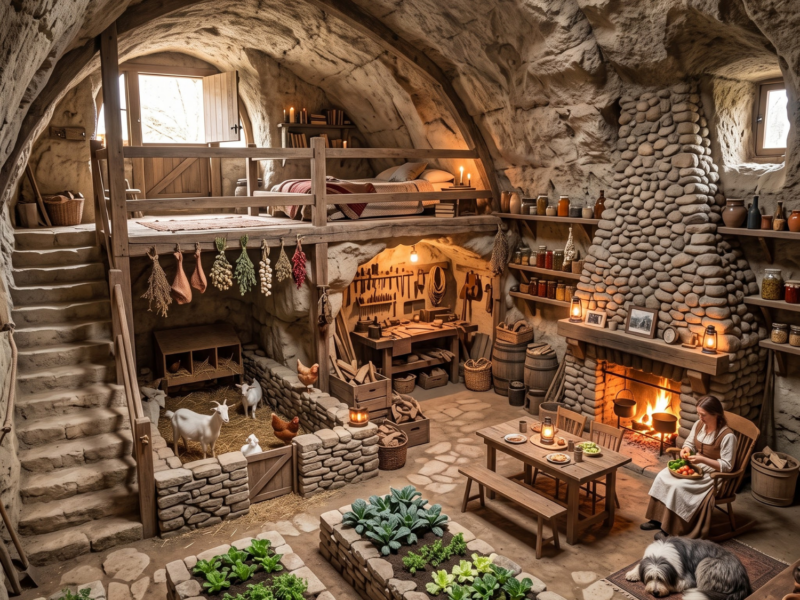
Food lined the ancient pine shelves in ranked, meticulous bundles. Firewood filled the back corner nearly to the ceiling. Heavy jars of water stood along the base of the stone wall, filled from the spring below, while the spring still ran open and free. It was the grueling labor of many days, carried up one agonizing, aching load at a time. For the space of a few shallow breaths, she allowed herself to feel something close to pride.
Then, beneath the low, first stirrings of the rising wind beginning to find the mountain outside, she heard something that turned her slowly, rigidly on her heel to face the black throat at the rear of the chamber.
It was not the settling groan of cooling rock. It was not the frantic skitter of some small animal that had wandered in from another passage.
It was the slow, deliberate, heavy scrape of a boot sole dragging over stone.
It came from somewhere deep beyond the reach of her lantern’s golden light. The lantern trembled violently in her hand, and the cold was not what shook it.
The sound came again. One measured step. Then another. Thick leather grinding against granite grit, back where the chamber narrowed and the light gave out entirely.
She held herself perfectly still. She let her breathing go slow and shallow, exactly the way her father had taught her when a massive thing in the brush had not yet decided whether it feared you or hungered for you.
Above every other rule he’d left her, one stood tallest: Never rush toward a sound you do not understand. A hurried step in the dark has put more people in the ground than any bear or blizzard ever has.
Her free hand dropped to her belt and found the small hatchet she kept propped against the stones of the fire pit. Her freezing fingers closed tightly around the worn hickory of its handle.
The steps stopped.
Silence poured back into the chamber, thick and total. The cave seemed to hold its own breath along with hers.
She lifted the lantern higher. The light stretched a little deeper into the room. It found only stacked stone, the dusty shelves, and the cracked basin she used for washing. The back wall stayed drowned in impenetrable shadow.
She counted a slow minute in the dark of her own mind before she trusted her voice to remain steady.
“If you’re back there,” she called out into the black, and she was fiercely pleased that her voice came out level, “then you already know I’m the one who found your shelter.”
Nothing answered her. Only the faint, comforting crackle of the pine she had already set burning in the pit.
She waited. No shape detached itself from the dark. No second footfall came.
After a long while, her heart still hammering against her ribs, she crouched and fed another split log onto the coals. The flames climbed, throwing their orange reach farther across the chamber, pushing the shadows back. The strange, crawling feeling of being hunted along the back of her neck slowly loosened its icy grip.
Perhaps the mountain had only shifted in its sleep, as old mountains did, mimicking a footfall. Perhaps some large animal had slipped through a fissure she’d never mapped, and moved on. Whatever had made the sound, blindly chasing it into the pitch black would answer nothing and risk everything she had built.
So she went back to her work instead. She forced herself to focus.
She counted the stores again. Not from worry, but from obsessive habit, laying her raw hand on each in turn. Thirty-eight pounds of potatoes. Four heavy sacks of flour. Three of dried beans. Salt, sealed carefully away in waxed cloth against the damp. Smoked meat hung high from the iron hooks she had driven into cracks in the stone.
It was enough for one person to winter on.
If the winter behaved itself. If the snow came at a decent hour and left at a decent one.
But something low and primal in her—some inherited instinct she could not argue down with logic—kept repeating the exact same warning against the rising wind whistling through the juniper outside.
This one will not behave.









