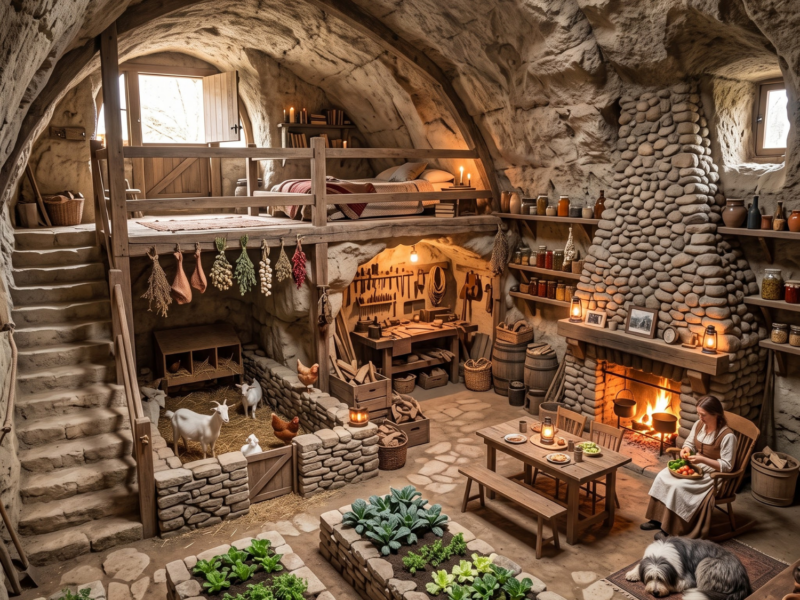
They Laughed at the Cave She Inherited—Then a 7 Day Blizzard Buried the Montana Valley
The Empty Town
She walked into Cold Water Bend the next morning, while the eastern sky was still the bruised gray of wood ash.
The streets carried all the ordinary, comforting sounds of a town about its living. Children chased one another in shrieking, joyful loops around the schoolhouse steps. A heavy freight wagon rolled toward the grist mill, its bed heaped high with grain. The intoxicating smell of fresh loaves drifted from the bakery, warm and golden in the biting cold.
Nothing looked wrong. And that was precisely the thing that put a cold stone in her stomach.
She would have rested significantly easier walking into shared fear. Instead, she walked into a town that was certain, down to its very bones, that it had all the time in the world.
She stopped outside the general store. A knot of prosperous ranchers stood beneath the porch roof, tin cups of steaming coffee in their fists, discussing cattle prices. One of them took in her empty wooden sled with a wide grin.
“Back down for another haul so soon, Wren?”
She gave a single, tight nod and reached for the door handle.
“You’ll wear the runners clean through before the first flake ever falls, child!” another man called out, leaning back against a support post. “Reckon she’s building herself a summer palace up in them rocks.”
The little group laughed together, comfortable in their collective warmth and their absolute certainty. She let the laughter roll off her the way rain rolls off oiled canvas, and she stepped inside.
Mr. Whitlock looked up from the brass scale where he was weighing out flour. Something crossed his lined face when he saw her. A flicker that was absolutely not amusement.
“The usual, Wren?”
“Yes. And lamp oil. And salt… if you have any left.”
He filled the order without a single patronizing question. He folded the top of each heavy sack down with the neat, practiced creases of a man who had measured out other people’s survival for thirty years.
When she counted her coins onto the glass counter, the little stack had grown pitifully short. Heat climbed her face at the sight of the meager copper and silver. She was nearly out of time, and out of capital.
Whitlock looked at the coins, then at her. He did a thing she would remember for the rest of her life.
“You don’t have to shoulder every ounce of this alone, you know,” his voice dropped low, meant only for her ears, beneath the noise of the store. “You’ve got people. You’ve got kin down here, Wren.”
She went perfectly still. “They’ve got their own winter to worry over.”
The old storekeeper held her eyes for a long moment. Whatever he read there seemed to settle something heavy in him. He turned around, took down a small, heavy sack of dried corn from the high shelf behind him, and set it on the counter beside her order.
“You forgot this one,” Whitlock said.
“I didn’t order corn.”
“No.” He pushed it gently across the worn wood until the rough burlap touched her hand. “But you’ll be wanting it before you’re through.”
She looked down at the sack, then up at him. Their eyes met for no more than the space of a heartbeat. Something profound passed between them that neither would ever put into words. It was an acknowledgment of the storm.
She nodded once, her throat suddenly gone tight. “Thank you, Mr. Whitlock.”
Outside, the very first snow of the season had begun to fall.
It came down in tiny, unhurried flakes. They were almost playful, drifting lazily sideways on the faint stir of air. The townsfolk on the boardwalk hardly lifted their eyes to it. By noon, they assumed, it would melt to nothing on the sun-warmed boards of the walk, and everyone would forget it had come at all.
But Wren, standing on the store’s porch with the heavy sack of corn cradled against her hip, marked the other thing.
The wind had stopped shifting.
All morning it had come steady out of the north, and only the north. It was cold, sharp, and entirely constant. It lacked the restless, wandering, playful quality that ordinary weather always carried.
Wind that settled aggressively into one quarter and stayed there was wind with a purpose.
That evening, she dragged another heavy, back-breaking load up the mountain. Halfway along the steep trail, she stopped so suddenly the sled ran up hard against her heels.
Across the fresh, pristine white of the path lay tracks that were absolutely not her own.
Bootprints. Large ones. Far too broad and deep to have come from her narrow boots. They were already softening at the edges as the falling snow filled them in, meaning they were hours old. They came down off the eastern ridge, crossed her trail deliberately, and stopped right beside the very juniper bush that screened her cave.
There, they turned. They climbed away again toward the higher, impassable slopes, growing shallower with every yard as the blowing snow smoothed them under.
Someone had come. Someone who had walked directly to the hidden entrance without a single moment of searching. As though he had known exactly where to set his feet.
She stood over the tracks and felt her pulse hammer in her throat. She looked up the eastern ridge toward the dark timber, where the prints vanished. The timber gave her nothing back but the soft, sinister hiss of snow settling on snow.
Slowly, she pushed through the juniper branches and stepped inside, her hand gripping the hatchet at her belt.
Everything within lay exactly as she had left it. Nothing had been carried off. Not a single bundle sat out of place on the shelves.
But beside the cold fire pit, laid out carefully on the swept earth where she absolutely could not miss it, rested something that had not been there that morning.
A rabbit. Freshly dressed and cleaned. Still holding the faint, residual warmth of a body only lately living. It was wrapped with immense care in a supple, beautifully tanned square of deer hide.
No note lay with it. The single set of bootprints in the fresh snow outside had stopped at the juniper and never crossed the threshold. This meant whoever left it had reached in through the branches with a long arm, setting the gift just past the entrance and withdrawing without ever setting foot inside.
Only the rabbit. Offered and abandoned in the same silent motion.
Wren turned a slow circle in the middle of the cavern, taking in the untouched shelves, the undisturbed wood, and the single, strange kindness left steaming faintly in the cold air.
“Thank you,” she said aloud to the stone, to the dark, to whoever the mountain had sent.
The cave gave her back only silence. And for the first time, the silence was not unfriendly.
She cooked the rabbit over the fire that night, and absolutely nothing of it went to waste. The rich meat filled her belly for the first time in longer than she cared to count. The soft hide she set carefully aside to cure into straps for her boots. The bones she cleaned and saved for a hearty broth that would stretch across three more days of rationing. The fat she rendered slowly in the pan and poured off into a tin to grease a skillet or waterproof a boot seam.
Her father had told her more than once that true survival did not begin when a person had plenty. It began the exact moment a person learned that nothing was ever useless.









