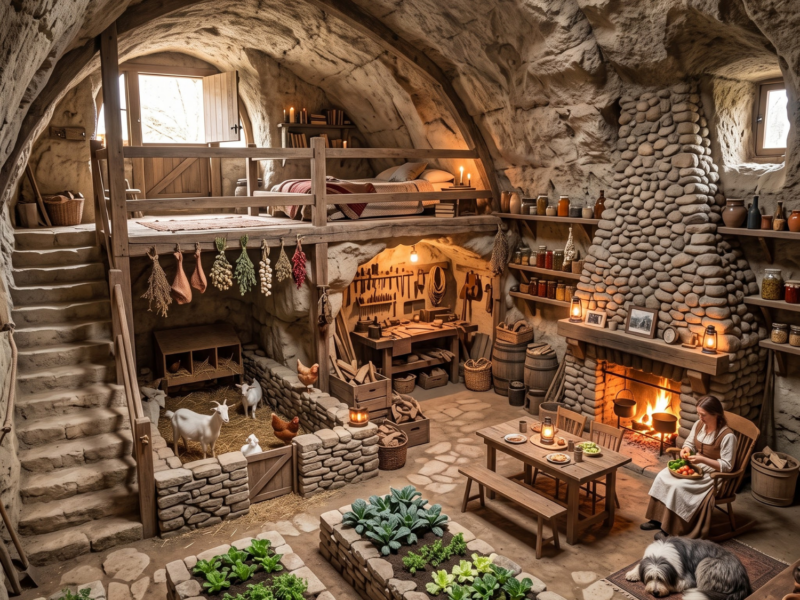
They Laughed at the Cave She Inherited—Then a 7 Day Blizzard Buried the Montana Valley
The Debt of the Town
Three mornings later, the whole of Cold Water Bend crowded into the church.
More of them came than for any Sunday service, and they did not come to be preached at. Mayor Harlon Booth stood at the front with his hat in his hands and waited for the shuffling and the scraping of wooden benches to die away.
When the room had gone totally still, he did not reach for scripture or ceremony. He looked vastly older than he had two weeks passed. He looked humbler—a man who had led a town straight into the path of a disaster it refused to see.
“We can’t stand here and pretend this storm was ordinary,” Mayor Booth began, the words coming heavy from him. “It wasn’t. But we were warned. Every one of us in this room was warned, plain, more than once, by someone who read the sky truer than the whole lot of us put together.”
His gaze moved across the crowded pews until it found Wren, where she sat near the back beside Prudence Gale.
“We laughed. God forgive us. We laughed at a girl for the crime of being right. And that laughing near buried this town under the snow it wouldn’t look at.”
No voice rose to argue with him. The silence of the room was a confession in itself.
It was Amos Tanner who broke it, hauling his massive frame up from a bench near the front. The blacksmith turned so the whole church could see his face, and there was no ease in it now. None of the porchside humor he’d aimed at her from his forge door.
“I laughed loudest of anybody,” Amos said, his voice echoing. “Called it a castle. Made sport of her to my own boys.” His voice thickened with emotion. “Those same boys came through that storm warm and whole because of that castle. I got no way to square that. All I’ve got is I was wrong. And I’ll be wrong out loud here, in front of everyone I made her small in front of.”
He sat down heavily.
Jonah Redford rose in his place without being asked. He was still pale from his ordeal, and did not trust himself to more than a few words.
“She carried my girl up a mountain through a storm that had already put me on my knees.” Jonah looked toward Wren, his jaw working with the effort of holding steady. “I called what she was doing foolish. I’ll spend the rest of my days grateful she didn’t listen to men like me.”
One after another, they stood. The men who had spat tobacco in the snow, and the women who had watched her drag her sled through town without offering a hand. Each said the same small, hard thing in their own words. No grand speeches, no excuses dressed as apologies, just the plain naming of a wrong laid down one voice at a time, until it seemed the whole town had emptied its pockets of the guilt it had been carrying.
The heavy door at the back of the church opened while the last of them was still speaking, letting in a wedge of cold white light. Cornelius and Margaret Vane stepped through it.
A ripple of turned heads followed them up the aisle. For everyone in that valley knew the story of the girl who’d been measured out of that house. And here was the man who’d held the pencil, come to stand in the one room where he could not hide from it.
Cornelius did not take a seat. He walked to the front, passed the mayor, and turned to face the town that had watched him do his sums for years. Wren saw what it cost him to stand exposed before them.
“Most of you know what I did,” Cornelius said. His voice did not shake, because he had clearly resolved that it would not. “I put my wife’s daughter out of my house because my ledger told me I hadn’t food enough for five. I was so arrogant. So certain of my figures.”
He drew a breath that seemed to scrape his lungs raw.
“That same girl fed fourteen people for the better part of a week on less than I claimed couldn’t stretch to five. She did with an open hand what I couldn’t do with a full cellar and a closed one.”
His gaze found Wren and held. “I could account for everything I owned. I never could account for what I threw away. I’m standing up here so every man in this valley who measures his people the way I measured mine can see exactly where that road ends, and turn off it while there’s still time.”
Margaret went to her daughter in the pew, there in front of the whole town. She sat close beside her and took her hand. And this time, Wren did not draw it back. She let her mother hold on. She felt the town watching, and she found she did not mind their watching. Because what they were seeing was not weakness, but the slow, agonizing, hard work of a family trying to find its way back from a thing that could not be undone, only lived past.
When the confessions had run their course, Prudence Gale rose from beside Wren. The old woman’s rising quieted the church more surely than any gavel could have. She waited until every eye had come to her, leaning heavily on the pew before her with her knotted hands.
“This mountain gave us more than a place to hide from the wind,” Prudence said, her dry voice carrying to the back wall without effort. “It gave us a mirror. It showed us exactly what we are when the roof comes off, and the well freezes, and there’s nothing left to trade on but each other.”
She turned toward Wren. “One person got ready while the rest of us called her a fool. And that one person is the reason every family that climbed that mountain came home.”
A murmur of assent moved through the pews.
“So the question that ought to trouble us isn’t how she knew,” Prudence continued. “It’s what we mean to do with the shelter that saved us. Do we shut it back up and forget it ’til the next fool has to save us from ourselves? Or do we finally learn the lesson it was built to teach?”
The church stirred. Someone near the front called out that the cave ought to bear the girl’s name. That they should raise a marker to what she’d done. The notion caught and swelled among the pews—a wave of grateful voices rising to fix her name to the stone forever.
Wren stood up.
The room fell away to silence at the sight of her on her feet. She looked around at the faces that had laughed, and now longed to lift her up, and she understood that both impulses missed the exact same mark. She shook her head slowly. When she spoke, her voice was quiet, but the church strained to catch every word.
“Don’t put my name on it.”
She let that settle.
“A name on a rock doesn’t keep anybody warm. It just tells the next hungry family that the shelter belonged to somebody else.”
She looked toward Ezra Holloway, who had come in unnoticed and stood at the back against the door, his frost long melted, watching her with something fierce and glad in his weathered face.
“That hollow was built twice by men who never carved their names in it, because they understood it was never theirs. It was only ever borrowed for whoever needed it next.”
She turned back to the town. “Fill it. Every autumn before the first hard wind, every family that’s able carries something up that trail and puts it on those shelves. Food, blankets, lamp oil, medicine. Cordwood split and dry.”
Her gaze moved across them, steady, giving no one the comfort of looking away.
“So the next soul the winter turns out of their home… the next child carried up that mountain with frost in their hair… doesn’t have to start with empty shelves and a prayer. So nobody in this valley ever again has to be lucky to survive.”
For a long moment, no one answered her.
Then Mayor Booth cleared his throat. His voice had gone thick. “It’ll belong to the whole town,” he said. “Every man, woman, and child of us. And every October, we’ll stock it together, so long as there’s a Cold Water Bend to do the stocking.”
No hand rose against it. The motion carried on a wave of voices, and it was not the dutiful assent of people agreeing to a chore. It was the powerful sound of a town that had finally understood something profound about itself, thrown wholehearted behind the one good thing to come out of the worst winter any of them had ever known.
Epilogue: The Open Door
That spring, when the mountain passes finally opened and the creeks ran brown and loud with the melt, the trail up Elkhorn Ridge saw more traffic than it had in twenty years.
They went up in twos and threes and whole families at a time. And the work they did was not the work of mourning, but the work of preparing.
Amos Tanner forged a set of heavy iron hooks, vastly better than the ones Wren had carved her handholds beside, and hung them along the wall for the curing of meat. Mr. Whitlock sent up sound oak barrels that would keep flour perfectly dry through any thaw.
The Sadderly brothers, who had never in forty years asked a soul for help, spent a week strengthening the entrance against the floods that had once caved it, packing the seams with mortar hauled up on their own elderly backs. Children carried kindling in bundles sized specifically to their arms.
Even the families with the least to give brought something. A double handful of beans, a single folded blanket, a length of rope. Because Prudence Gale had set it plainest in the church, and no one had forgotten it. There was no yours and mine on that mountain anymore. Only ours.
Cornelius Vane climbed the trail more often than any man in the valley.
He came up under a hundred-weight of flour the first time, a heavy barrel of salt pork the next, cordwood after that. He never once spoke of it, or asked to be seen doing it. He simply appeared at the hollow week after week with something heavy on his back, set it on the shelves, turned around, and went back down for more.
It was the only language of apology the broken man had ever been able to speak. The language of a full sack carried up a hard hill for someone he would never meet.
And Wren, watching him labor up the last pitch of trail one afternoon, his gray head bowed under the weight, understood he was not trying to buy back what he’d done. He was desperately trying to become the kind of man who never could have done it. There was a vast difference, and she let him have the room to find it.
Late one afternoon, near the end of that first spring, Wren climbed to the hollow alone. Drawn up the trail by something she could not have named.
The snow was gone from all but the highest gullies. Vibrant green had come creeping back up the slopes. The aspens were unfurling their first pale leaves, the whole scarred valley below washing itself clean of the terrible white it had worn so long.
She checked the shelves out of habit and found them fuller than she had ever kept them. Better ordered, watched over now by a whole town instead of one desperate girl. Everything sat in its place, ready, waiting for a need that might not come for years, and would be met when it did.
She found Ezra Holloway outside, seated on a flat shelf of stone that overlooked the entire length of the valley. His hat was beside him, the low sun full on his weathered face. He did not turn as she came up, but he had heard her, the way he heard everything.
“You know why this place lasted?” Ezra asked, watching the light move down the far ridges.
She lowered herself onto the warm stone beside him and considered it honestly. “Because it stayed hidden? Because nobody could take from it what they didn’t know was there?”
He shook his head slowly, a smile working its way up through the gray of his beard. “No. It lasted because someone finally understood why it existed.”
He set one rough hand flat against the sun-warmed rock of the entrance beside him, the way a man might lay a hand on the shoulder of an old friend.
“I built this shelter hoping it might save my family. One family. Yours, when it came to it, before you were even born, and mine. And the strangers your father hauled up here on his back.”
He turned to look at her at last, and the brutal years sat heavy and peaceful in his face. “You did what neither your father nor I ever managed. You turned a thing built to save a few into a thing that’ll save anyone this valley ever loses to the cold. You gave it away so completely that now it can’t ever be lost.”
Wren looked out over the valley greening below them, at the thin trails of smoke rising peaceful from the chimneys of a town that had learned the hard way to look up at the sky in time.
“You could stay,” she said, though she already knew the shape of his answer. “There’s a place for you down there now. After everything. Nobody in that valley would let you want for anything.”
“A man who builds shelters isn’t much good at sitting in them,” Ezra said, and there was absolutely no sorrow in it. Only the plain truth of a life lived a certain way too long to change.
He picked up his hat and turned it in his hands. For a moment, his eyes went far off, back to that first hard winter, and the young miner who had walked a ruined family up a mountain asking nothing.
“Tell them, when they ask about me down there, that I was just a fellow passing through who owed a debt. That’s the true of it, mostly.” He rose, his joints creaking, and settled the hat on his gray head. “The rest belongs to your father. Let him keep it. He earned the keeping.”
He laid his hand once on her shoulder, the grip of it firm and brief and final. And then he started up the trail toward the high country, the direction opposite the town, where the dark timber climbed toward the passes and the untracked places beyond.
Wren stood and watched him go. A stooped figure in faded buckskin, growing smaller against the green, until the trees folded quietly around him and took him from her sight. She never saw Ezra Holloway again.
In the years that followed, she would sometimes hear of an old trapper glimpsed on a far ridge, or of supplies left without word at a homestead cut off by weather. She would smile and say nothing, and let the mountain keep its own.
The seasons wheeled on over Cold Water Bend. The children who had slept curled by the fire in the worst of that storm grew into men and women. And some of them married and raised children of their own. And the tale of the winter the sky fell became the story every family told when the first hard wind came down off Elkhorn Ridge.
Travelers passing through would sometimes ask why the old cave up the mountain stood stocked with food and blankets, even in the fat years when the granaries were full and no storm threatened. And the people of the valley would only smile, nod toward the ridge, and give the exact same answer, worn smooth by the telling:
Because a seventeen-year-old girl once taught this whole town that winter never waits for the people who keep saying tomorrow.
And every autumn, before the first snow ever touched the peaks, long before the wind turned its cruel edge against the valley, the families of Cold Water Bend climbed that narrow trail together. Up through the aspen and the scattered pines to the hidden hollow in the stone, their arms full and their breath clouding in the sharpening air.
They did not climb it out of fear.
They climbed it because they remembered what arrogance had nearly cost them. And because somewhere in the hard heart of that winter, they had all finally learned the thing the mountain had been waiting a generation to teach them:
The only warmth a person truly keeps is the warmth they carry up a cold hill, and leave behind for a stranger they will never meet.









