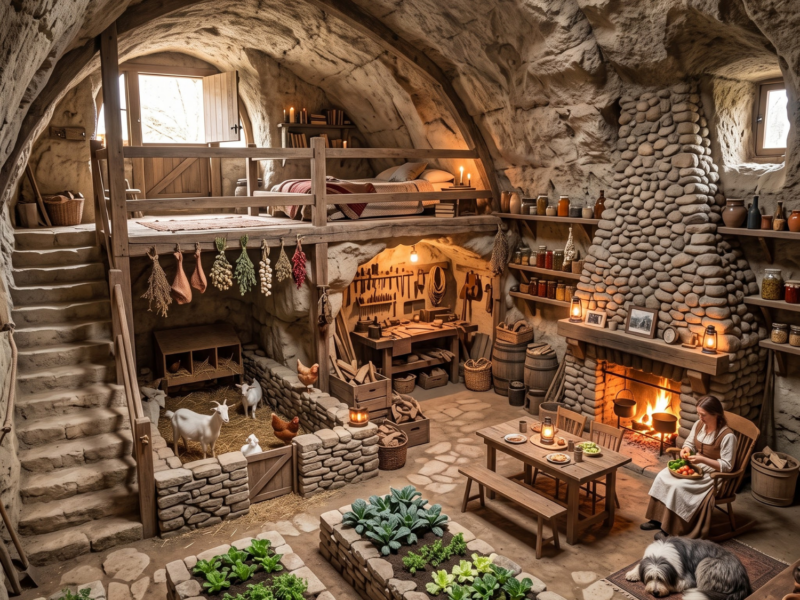
They Laughed at the Cave She Inherited—Then a 7 Day Blizzard Buried the Montana Valley
The Return
They banked the fire together and gathered the last of the gear. Wren took a final, slow turn through the chamber that had been her whole world for the length of the storm.
The shelves stood fuller than she’d found them, restocked from Ezra’s sleds. The sealed fissure in the corner held firm. She lifted her father’s heavy coat from its peg and drew it on. The smell of pipe smoke and pine pitch met her the way it always did, only now it carried the ghost of a whole hidden life she was only beginning to learn.
She left the shelter exactly as her father would have left it—ready for the next stranger the mountain sent—and pushed out into the blinding morning after the old man.
The descent took the better part of the day. The families ahead had beaten a rough trough down through the drifts, but the snow lay deep and treacherous over hidden rock. More than once, Wren went in to her hip and had to catch herself on a buried branch.
By the time the trail leveled toward the valley floor, the low sun had turned the whole basin into fire and glass, every buried fence post and snow-shrouded roof glittering and blinding.
Cold Water Bend rose up out of the white to meet them. Dug half-free of its burial, alive with the sound of shovels, and calling voices, and the bawl of stock being watered at last from opened wells.
Word of them ran ahead through the drifts faster than they could walk. By the time Wren reached the edge of town, people had come out to the ends of the shoveled paths to watch her pass.
And the watching had fundamentally changed.
These were the exact same faces that had laughed at her from warm porches and forge doors and the fogged windows of the eating house. The same men who had joked about her castle in the rocks while she leaned into her rope day after day.
Not one of them was laughing now.
The men who had gathered at the forge to spit into the snow and shake their heads at a foolish girl now pulled the hats from their heads as she came even with them, one after another, down the line. A silent uncovering of respect that moved along the street ahead of her like wind through grass.
Hetty Combs came to Wren’s side at the head of the street, walking careful on the packed path, and she took the girl’s cold hand in both of hers.
“There’s not a soul in this valley,” Hetty said, her voice unsteady with emotion, “who will ever again laugh at somebody carrying more than they seem to need.”
Bess Kereday had thrown open the eating house, and the immense warmth pouring from its door drew the returning families in like the promise of morning after a long night. She would take no coin from any of them. She sat the children nearest the great iron stove and heaped their plates with hot food.
She pressed a steaming cup of coffee into Wren’s raw hands. And for once, the fiercely independent girl let herself be tended rather than tending, if only because refusing would have wounded a woman trying desperately to make right two weeks of mockery.
The room that had turned its warm, arrogant certainty against her not long ago now went deathly quiet when she entered. And it was not the quiet of doubt. It was the profound quiet of a room full of people who did not have adequate words.
She did not stay long among them. There was one house in Cold Water Bend she had not let herself think about since the storm broke. One door she had walked out of at dawn with everything she owned on her back. And she found her feet carrying her toward it before she had consciously decided to go.
The Vane place sat on the north edge of town, where the wind had banked the snow highest. And as she came up the buried lane, she saw the storm had used it hard. A massive section of the barn roof had caved under the weight of the drift. A window on the weather side had blown in, and someone had frantically nailed a horse blanket across the gap from the inside.
Smoke rose from the chimney, thin and grudging, but it rose, which meant they had come through.
She stopped at the edge of the yard. She did not know why she had come. Only that some things have to be looked at squarely before a person can be truly free of them.
The door opened. Cornelius Vane stood in it.
And the man who had measured her out of his household in a ledger by lamplight was absolutely not the man she remembered.
Two weeks had aged him a decade. His face had gone gaunt and gray. The skin loosed at the jaw. The eyes sunk deep and rimmed red from cold or sleeplessness, or something worse that had no name.
He looked at her standing in the snow of his yard in her dead father’s coat. And whatever cruel arithmetic had always run behind his eyes had stopped completely.
“You’re alive,” he said. It came out of him cracked and low. There was no relief in it he’d let himself claim. Only a kind of stunned astonishment, as though he had already added her into the final column of the lost, and could not make the figures balance now that she stood before him.
“I am.”
Her mother appeared behind him in the doorway. Margaret Vane made a sound Wren had not heard from her since the day they lowered Thomas into the ground. A broken, agonizing intake of breath that was half her daughter’s name.
She came out into the brutal cold without a shawl, stumbling in the deep snow. She caught Wren’s face in both bare hands, as though to physically prove it was truly warm and living flesh beneath her palms, and the tears froze on her cheeks as fast as they fell.
“I looked for you,” Margaret sobbed, the words tearing out. “When it broke… when I understood what was coming… I went out into it looking for you. And Cornelius had to pull me back before it took us both. I thought…” Her voice failed her. “I let you walk out that door. I stirred a pot and let my own child walk into the winter. And I have not slept a night since without seeing it.”
Wren stood inside her mother’s frozen hands. She felt the old wound and the old anger, and found to her absolute surprise that she did not want to press on either.
“You made a choice,” Wren said gently. “So did I. Mine kept fourteen people alive.” She looked past her mother to the broken man in the doorway. “Yours nearly cost you everything, and I think you already know it.”
Cornelius Vane came down the single step into the yard, moving like a man walking toward a brutal reckoning he had prepared for, and still dreaded. He stopped an arm’s length from her. The arrogance that had armored him at every supper table she’d ever shared with him was simply gone. Stripped off by the storm the way it had stripped the roof from his barn.
“I’ve spent my whole life counting,” Cornelius said, his voice hollow. “Grain and coin and cordwood and days. I built my sense of the world on what could be added up and set down in a column. Because numbers don’t lie, and they don’t leave, and they don’t ask more of a man than he has to give.”
His hands hung open and empty at his sides.
“I looked at my own table and counted five where I wanted four. And I crossed off the one figure I told myself I could spare. I could account for every sack in that cellar.” His ruined eyes came up to hers. “I never once learned to reckon what a person was worth. And that was the only sum that ever mattered.”
He looked at the snow at her boots. “It took the whole sky falling to teach me how wrong I had it. I’m not asking you to come back under my roof, Wren. I’m only asking you to believe I know now what I threw out that door.”
It was as near to breaking as such a man could come. And Wren understood. He had said it not to buy his way back into her good graces, but because it was true. And because a thing that true had to be spoken aloud, or it would rot the man who carried it.
She did not fall into his arms. Too much lay between them for that, and she was not a child who could be gathered back up as though the ledger had never been opened. But she inclined her head, granting him the one thing she could grant without lying: the acknowledgment that he had finally seen.
“The mountain doesn’t care what a man can count,” she told him softly. “It only asks what he’s willing to carry. You’ve the rest of your life to learn the difference. That’s more than a good many folks in this valley can say this morning.”
She did not go into the house. She had not come to move back into a loft she’d been pushed out of. And both of them knew a wound that deep did not close in a single afternoon in a snowbound yard.
But she let her mother hold her a moment longer, and she pressed Margaret’s cold hands once before she stepped back. And when she turned to go, she did not carry the heavy anger out of the yard with her. She left it there in the snow where it belonged—not forgiven exactly, but set down, which was its own kind of immense freedom.
Behind her, Cornelius Vane stood bareheaded in the cold and watched her walk away. She felt his eyes on her spine the whole length of the buried lane, and she did not need to look back to know something in the man had changed for good.









