They Laughed at the Cave She Inherited—Then a 7 Day Blizzard Buried the Montana Valley
The Lowering Lid
The days that followed folded into a punishing rhythm of steady, wordless labor. Down the mountain in the pale, freezing morning, into the town for the last few supplies, back up again before the light failed. Every single trip left the cave a little stronger than she’d found it.
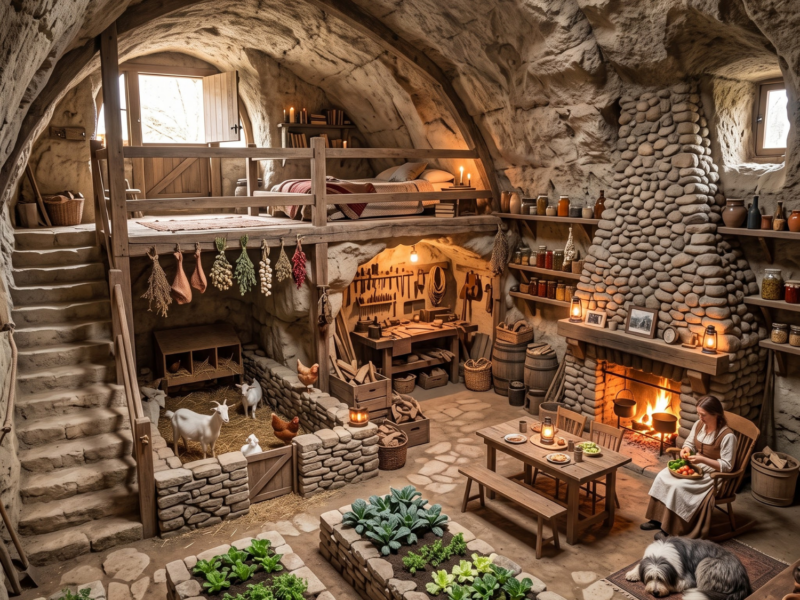
She sealed the small, drafty cracks in the stone walls with wet clay dug from the spring bank, working it soft and pliable between her freezing palms. She raised her bedding off the cold stone floor, building a low platform of split pine poles so the deadly chill of the ground could not reach her in the night to steal her heat. She stacked the wood higher, packing it incredibly tight near to the ceiling.
She built a second shelf from planking she carried up in agonizing pieces, and she ordered every single store upon it by the date she had brought it in. Nothing would sit forgotten in a dark corner to spoil.
Each evening, before she let herself collapse onto the bed, she stepped to the mouth of the cave and read the northern sky.
The wall of cloud never left. It only grew day upon day. It grew darker, lower, and heavier, until it seemed less a bank of weather than a massive, iron lid being slowly lowered over the world.
One raw, freezing afternoon, she pushed open the door of Bess Kereday’s eating house on the town’s main street. The immense warmth of it rolled over her, thick with the smell of roasting coffee, baking biscuits, and wet wool drying aggressively by the potbelly stove.
Nearly every wooden table was full. Ranch hands, millmen, and two of the town’s storekeepers sat eating. Their voices were braided into an easy, comfortable din. Their booming laughter was fogging the glass windows white.
Wren pulled off her worn gloves and stood just inside the door. One by one, the faces turned toward her. The noise thinned, then died completely.
“The storm that’s coming isn’t an ordinary one,” she said.
She let the words fall plainly into the quiet room. She spoke without heat, without pleading, and without apology.
“You’ll want more food laid by than you think you need. You’ll want vastly more firewood than seems sensible. And you’ll want to fill every empty barrel and washtub you own with water before the ground freezes hard. Because once it freezes, you’ll not draw another drop from the wells ’til spring.”
For a long, terrible moment, no one spoke.
Then Frank Dawson, a man who ran cattle east of town, who had buried two wives and outlived most of his own good humor, tipped his chair back on two legs. He looked at her condescendingly over the rim of his coffee cup.
“And since when,” he asked the room as much as her, “did slips of girls take to reading the weather off the sky like it was scripture?”
A ripple of laughter went around the tables. It was gentler than it might have been, a patronizing chuckle, but it was laughter all the same. Others only shook their heads and turned back to their hot plates—the exact way grown folks turn away from a child who has said something both earnest and completely absurd.
Wren did not argue. Arguing was a way of asking to be believed, and she had already learned the hard way that belief could not be pried loose from a warm room and a full cup of coffee.
She looked around the eating house one last time. She looked at the fogged glass, the steaming coffee, the untroubled, arrogant faces. And she saw that every single soul in it was absolutely certain there was time yet. Time to see if it got bad. Time to decide later. Time to begin preparing tomorrow.
She drew her gloves back on and turned for the door.
She had gotten as far as the edge of the porch, stepping out into the sting of the cold, when the heavy door opened again behind her. An old woman stepped out into the gray afternoon.
Prudence Gale had lived in the shadow of Elkhorn Ridge vastly longer than anyone else drawing breath in Cold Water Bend. Long enough that the town half-believed she had been here before the town itself was built. Silver hair escaped in wild wisps from beneath an ancient, moth-eaten wool bonnet.
She came to the porch rail. She did not look at Wren. She looked north, toward the mountains. And for a long while, she said nothing at all. She only looked, as though she were reading something written in a hand only she could still make out.
“I’ve seen a sky sit exactly like that twice in my life,” Prudence said at last. Her voice was dry as dust, unhurried, and entirely without a threat of doubt in it.
Wren waited. She had learned the supreme value of waiting.
“The first time,” the old woman’s throat worked visibly, her gloved hands tightening on the wooden rail, “the folks who wouldn’t ready themselves had to be dug out of their houses and carried down to the valley on wagon beds when it finally broke. Every last one of them lived, mind you. But it was a near thing. And it was the ones who’d laughed the loudest who came the closest to not making it out at all.”
She turned then, fixing Wren with eyes gone pale as river ice, but as sharp as ever.
“The ones who prepared saved the rest of them,” Prudence said. “Remember that, girl. It’s always the ones who prepared.”
The wind lifted a fine skin of snow off the porch boards, swirling it into the empty street. Prudence Gale laid one rough, arthritic hand over Wren’s forearm and pressed it—a grip surprising in its fierce strength.
“Don’t you stop,” the old woman hissed. “Whatever they say to you down here. Whatever they laugh at. Don’t you stop getting ready.”
Then she took her hand away, went carefully down the wooden steps, and walked off along the boardwalk without another word. A small, bent figure growing smaller against the great, gray weight of the coming weather.
That night, Wren doubled the firewood stacked inside the chamber. She carried up load after heavy load by lantern light, working until her arms shook uncontrollably and her breath came ragged in the thin, freezing air.
She filled every jar she owned with spring water, and two more she had scavenged, packing them close along the interior wall where the fire’s radiant warmth would keep them from freezing solid. She laid out extra blankets near the pit, folded and ready for use.
When at last there was absolutely nothing left undone, she stepped outside beneath the sky to rest her burning eyes on something other than stone.
And she found the sky had changed again.
The stars were gone. They were not dimmed by haze, not veiled. They were gone entirely, blotted out from one dark horizon to the other by a ceiling of clouds so impossibly thick she could not find even the faintest smudge of the moon behind it. The mountains themselves had vanished into it, swallowed whole.
And then she heard it.
It was not thunder, though it rolled deep like thunder. It was not the wind, though the wind had begun at last to rise, keening thin and high and desperate through the junipers.
It came from beneath her. A deep, grinding, tectonic murmur that seemed to travel up through the soles of her boots from somewhere incredibly far down in the roots of the mountain itself. As though the whole vast body of Elkhorn Ridge had drawn one long, slow, agonizing breath, and was finally letting it go.
She felt it vibrate in her teeth. She felt it in the marrow of her bones.
Wren stood alone in the dark at the mouth of the shelter her father’s people had built and never named. The first hard, stinging flakes began to whip against her cheek. She reached down and tightened the hemp rope on the last sack of food with hands gone incredibly steady and sure.
There was no more waiting to be done. There was no more warning left to give. There was no more room for the small, arrogant mercy of tomorrow.
The wall of cloud that had hung motionless above the peaks for two long weeks had finally begun to move. And it was moving down. And it was moving fast.
The storm she had felt in the terrifying silence of the ravens, and the panicked flight of the elk, and the steady northern wind, was no longer a thing coming toward Cold Water Bend.
It had arrived.









