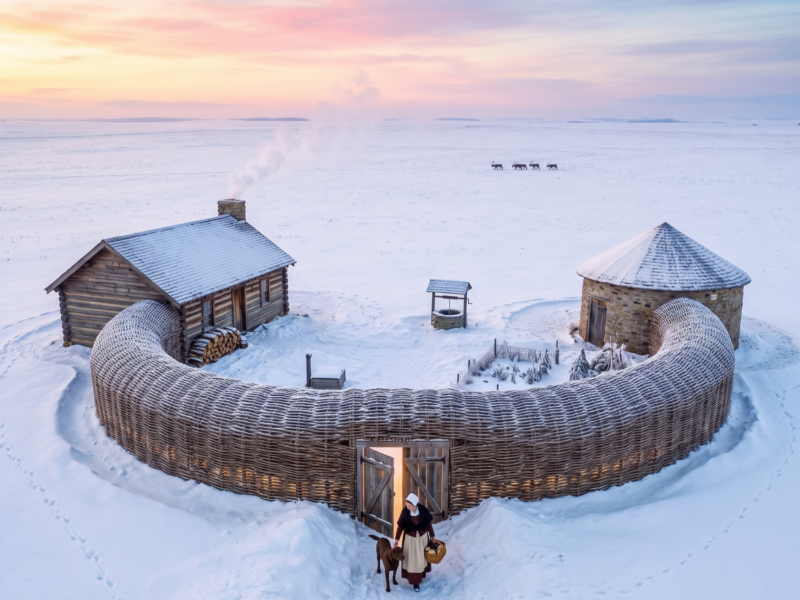
They Mocked the Sapling Tunnel She Built — Then the Deadliest Winter Proved Her Right
They Mocked the Sapling Tunnel She Built — Then th…
They Mocked the Sapling Tunnel She Built — Then the Deadliest Winter Proved Her Right
Harold Gaines saw it first from the ridge.
He had come up that way out of habit, tracing the same route he had ridden every June morning for forty years to check the east fence line before the summer heat settled into the valley dust. His horse moved slow on the slope, picking its way through the sage and scrub, and Harold let it, his eyes already drifting south. They drifted the way old eyes do when they have learned that most trouble in Montana announces itself from a distance.
He saw Margaret Avery standing in the field between her house and the storage barn. He saw the wooden post she had driven deep into the soil. He saw the bent willow ribs arcing between them, pale and curved against the dry, yellowing grass. It was a shape forming in the open air, connecting two fixed points like the spine of some ancient, half-buried beast.
He sat in the saddle and watched her for ten minutes. Then, he turned his horse and rode back down the ridge without stopping to ask her what she was doing. Harold Gaines had spent four decades learning which things were worth asking about. He had not yet decided if this was one of them.
Down in the field, Margaret did not see him watching. She was on her knees, pressing the seventeenth post into the earth at the exact angle she had calculated. Not guessing. Calculating. The whole structure depended on the angle.
On her wooden workbench beside her sat a notebook so thick the cover had begun to separate from the binding. Inside, there were no blueprints. There were no technical drawings downloaded from the internet, no measurements borrowed from a university extension manual. What filled that notebook, page after page, from the bleak thaw of March through the middle of June, was wind.
Every morning since the spring thaw, she had stood in that exact spot at the same hour and recorded what she felt. Direction. Estimated velocity. Where the snow had drifted after each weather event, and where the ground had scoured bare. She noted which corners of the property held the biting cold longer than others, and where the earth stayed frozen long after the sun should have touched it.
She had covered nearly two hundred pages this way. Only now, in June, was she ready to begin building.
She pressed the post another inch into the soil, checked the angle with a level she had fashioned herself from a length of copper pipe and a bubble of oil, and moved to the next mark. She had not started building in March. March was too soon. March is grief pretending to be action, and Margaret had learned in the devastating weeks following Robert’s funeral that grief pretending to be action produces objects that look like answers, but function like nothing at all.
She had sat with the question for two months first. She had driven the county roads in the early, blue-lit mornings, watching how the snow moved across each farm in the valley. What she learned in those months was that the land tells you things, provided you ask it the right question.
The wrong question was: How do I stop winter from being dangerous? That question has no answer.
The right question was: Where does winter become dangerous on this specific piece of ground, and what exactly happens there? That question had an answer. It required watching. So, she watched.
The first page of her notebook was different from the others. She had not filled it with compass headings or barometric drops. She had written three lines in blue ballpoint pen, pressing hard enough that the words left physical grooves in the paper beneath:
Robert left at 6:14 in the morning. I found him at 6:52. 60 feet. 38 minutes.
The rest of the notebook was her answer to those three lines.
What she had come to understand, working through the grim arithmetic alone in the empty house, was not complicated once she stopped trying to think of winter as a monster that could be defeated. Robert Avery had not been a weak man. He was fifty-one years old and had spent his entire adult life doing brutal physical work in the cold. He had gone out that morning in March to bring in fuel. Sixty feet from the back door to the storage barn. He had done it hundreds of times.
But that morning, the temperature was twenty-seven below zero. The wind was running at thirty-eight miles per hour out of the northeast. The combination of those two things was not simply “cold.” It was a mechanism.
In those conditions, the human body loses heat at roughly twice the rate it does in still air at the same temperature. The body responds by pulling resources inward toward the core, abandoning the extremities, starving the muscles of warm blood. A person walking sixty feet into that wind is not just walking; the body is fighting to stay warm at the exact same moment it is trying to move, and those two demands are draining the exact same reserve.
Robert had not slipped. He had not lost his way in the whiteout. He had simply run out.
Margaret had found him eight feet from the barn door, on his knees, facing forward, his rigid hands still gripping the handle of the axe. She understood now what had happened in those thirty-eight minutes. She understood why the distance hadn’t been the problem, why the cold hadn’t been the problem, and why the combination of distance, cold, and wind—for a man who had already burned through his morning reserves working the livestock—had been a deficit he could not survive.
She was not building a tunnel to keep the cold out. She was building a tunnel so that the distance between the house and the barn would not cost more than a human body had to spend.
She pressed the eighteenth post and moved to the next mark. She did not think about Robert while she worked. She had found that thinking about him slowed her hands.
Related Articles

They Mocked the Widow’s Dirt Cellar—Then the Freeze Left Every Cabin Cold but Hers Warm
They Mocked the Widow’s Dirt Cellar—Then the Freeze Left Every Cabin Cold but Hers Warm…

A Homeless Veteran and His German Shepherd Inherited a Ridge No One Wanted — 35 Feet In, They Found
Chapter 1 / 7 A Homeless Veteran and His German Shepherd Inherit… A Homeless Veteran…

Neighbors Laughed When He Built A Cabin Inside An Old Barn—Until It Kept His Home 35 Degrees Warmer
Chapter 1 / 8 Neighbors Laughed When He Built A Cabin Inside An… Neighbors Laughed…

His Sod House Had No Woodpile in January – Until the Trains Stopped and the Town Came Begging
Chapter 1 / 10 His Sod House Had No Woodpile in January – Until t……

She Built Her Cabin Over the Woodshed and Never Burned Wet Wood Again
Chapter 1 / 8 She Built Her Cabin Over the Woodshed and Never Bu… She…

The Duke Abandoned Her on Their Wedding Day—Years Later, He Discovered What He Had Lost
Chapter 1 / 7 The Duke Abandoned Her on Their Wedding Day—Years… The Duke Abandoned…

He Wedged a Tiny A Frame Into a Crevice Before Winter and His Family Slept at 75°F While Town Hit
Chapter 1 / 7 He Wedged a Tiny A Frame Into a Crevice Before Win……

He Was Too Old to Ride—So He Bought the Ruined Ranch and Found the Room Behind the Fireplac
Chapter 1 / 5 He Was Too Old to Ride—So He Bought the Ruined Ran……

Settlers Laughed at His Underground Heat Recovery Duct — Until It Kept His Cabin 71°F Warmer
Chapter 1 / 9 Settlers Laughed at His Underground Heat Recovery… Settlers Laughed at His…

A Navy SEAL Built a Home Inside a Mountain—Then His Dog Warned Him Before the Storm
Chapter 1 / 5 A Navy SEAL Built a Home Inside a Mountain—Then Hi… A…