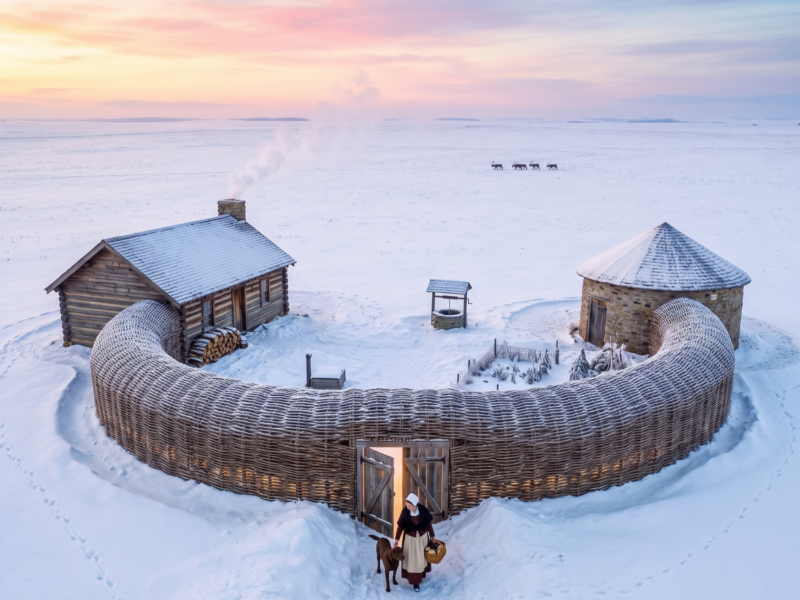
They Mocked the Sapling Tunnel She Built — Then the Deadliest Winter Proved Her Right
A Change in the Valley
The storm ended the way it had come in. Not with a grand announcement, not with a cinematic moment that could be pointed to later and called “the turn.” The wind simply became marginally less than it had been, and then less than that, and somewhere in that slow diminishment, the world began to return its edges.
The top of the silo came back first. Then the fence line. Then the county road reappeared as a slight difference in the texture of the white, a suggestion of direction rather than a path.
Margaret stood at the back window and watched the valley reassemble itself piece by piece. She did not feel a rush of relief. She felt the particular, exhausted attention of an accountant who has been counting pennies and is now beginning to recalculate the ledger.
The tunnel stood.
That was the foundational fact she came back to. Not triumphant in the way she had imagined in July, when she was pressing posts into warm soil and the whole thing was still just a desperate hypothesis. The tunnel stood, and she had moved through it every single day for fifteen days, and she was warm, the children were fed, and Harold was alive. That was the measure of success.
Dale Mercer came alone on the second day after the skies cleared.
She saw him from the window while she was writing. He had walked from the Mercer property, a mile and a half across land that was still mostly thigh-deep drifts, and he had come by himself, without Roy and without the horses. He crossed the yard with the particular deliberateness of a man who has decided something and is in the process of arriving at it.
He stood at the entrance to the tunnel for a long time. He looked at the structure the way she had looked at it in March, measuring it against some internal standard, finding the places where it had been severely stressed and the places where it had held.
A piece of willow had snapped off near the lower section, lying on the tamped snow beside the entrance. Dale reached down and picked it up. He turned it over in his gloved hands, looking at the clean break. Then, he walked to the gap in the weave and set the broken stick back in place. It did not fit. It could not fit, being loose and no longer woven into the tension of the wall. He set it there anyway, balancing it.
Margaret watched this through the glass. She did not go out.
Dale knocked on the back door five minutes later. She opened it. He looked at her the way proud men look when they have arrived at an apology they were not certain they would ever make, and the uncertainty has cost them their ego.
“Show me,” Dale said.
She turned and walked to the interior tunnel entrance without looking back. He followed. His brother followed behind him, because Roy had come quietly around the far side of the house while Dale was at the door, and Margaret had not seen him until he stepped in.
They moved through the long, dark structure in silence. She did not guide them, and she did not explain. The space did what it did: it muffled the glaring light from the snow, shifted the air currents, and required the slow pace it required. She heard both of the Mercer boys slow their breathing without being told.
At the barn end, Dale stepped out first and stood looking back at the snow-caked structure from the outside.
“It is not warm,” he observed. “No,” Margaret said. “It just holds.” “Yes,” Dale nodded. He looked at the place where the broken willow piece lay.
Roy came out behind him and stood slightly apart. He was quiet for a moment in a way that was fundamentally different from Dale’s analytical quiet. Dale’s quiet was a man processing physical evidence. Roy’s was the quiet of a man building toward an emotional admission.
“Last summer,” Roy said, his breath pluming in the cold. “In the field. I told you it looked like something a person does when they don’t know what else to do.”
Margaret waited.
“I want to know if that was true,” Roy said. “Not whether it was rude. I know it was rude. I want to know whether it was accurate.”
She looked at him. Twenty-four years old. The storm had put something entirely different behind his directness.
“Half,” she said. “Which half?” “I didn’t know for certain if it would work,” Margaret said softly. “But I knew exactly why I had to try it. Not knowing the outcome is not the same as not knowing the reason.”
Roy considered this, his eyes scanning the woven mud. “That’s the half I got wrong,” he said.
He walked back into the tunnel without being invited, moving through it again on his own, taking far longer this time. When he came out, he did not say anything more. He and Dale walked back across the white field toward their property, and Margaret stood by the barn and watched them go until their shapes disappeared into the distance.
Frank Aldridge came on the third day. He did not come alone.
He brought two people Margaret instantly recognized as reporters from the Flathead Valley Courier. A man in his forties carrying a professional camera, and a younger woman holding a digital recorder and a notebook considerably smaller than Margaret’s. They crossed the yard in a loose group, Frank striding slightly ahead.
Margaret came out onto the porch to meet them.
Frank’s face arranged itself into the expression he used when he wanted to appear brilliantly collaborative. “Margaret,” he beamed. “What you did here is frankly remarkable. The Farmers Association wants to talk about how we can work together to bring this design to more properties throughout the valley. We have resources. We have outreach. The community needs something like this presented through a channel that carries institutional credibility.”
Margaret looked at the two reporters. Then she looked at Frank.
“Frank,” she said, her voice carrying over the snow. “How much wood did Dorothy Hale have left when the storm ended?”
A small, painful silence. Frank’s smile froze. “She was fine. She’s a resilient woman.” “How much wood, Frank?” He looked nervously at the reporters, then back to Margaret. “Enough for two or three days.”
“The storm lasted fifteen days,” Margaret said, her voice rising like a judge delivering a sentence. “She started with enough for eighteen. You went to her on day twelve because I called and explicitly asked you to, and you brought her additional fuel on day thirteen. She is alive today because someone manually checked on her.”
She looked directly at the reporters. “That someone was not the institutional Farmers Association. It was just a man who had every reason to stay in his own warm house, but went out anyway.”
Frank’s expression did not crack, but the foundation behind it shifted. “Margaret, I think there’s a way to frame this that serves everyone’s best interests here—”
“I’m going to tell these two people one thing,” Margaret interrupted. “The tunnel behind me was built out of willow branches, mud, and eight months of waking up at five o’clock in the morning to stand outside and watch where the wind went. It is not a program. It is not a government initiative. Anyone who wants to understand it has to do the exact same thing I did, which is watch their own land first. That is not something the Farmers Association can package into a PDF and distribute.”
The younger reporter, the woman with the small notebook, looked up from her rapid writing. “Mrs. Avery,” she said. “Did you build this because of your husband?”
The deeply personal question landed in the freezing air and stayed there, hovering. Frank did not move.
Margaret looked at the young reporter. She was young enough not to know yet that some questions permanently change the shape of a life.
“I built this,” Margaret said, looking out over the white valley, “because the right question in a crisis is not ‘How do we add more warmth?’ The right question is ‘What is taking the warmth away, and how do we slow that process down?’”
She stopped, feeling the ghost of Robert beside her. “Robert was the first person who taught me to ask questions that way. The storm that killed him was what made me find the answer.”
Frank stood in the snow with his hands at his sides, possessing no version of himself left to present to the cameras. He had come expecting to absorb Margaret’s hard-won credibility into his next annual report. Instead, he was standing in a snowy yard listening to a widow explain why survival could not be replicated by a committee.
He muttered something about following up, and walked back to his vehicle. The reporters lingered a moment longer, snapped two photos, and followed him.
Harold, who had been standing just inside the back door listening, spoke from behind her. “He’ll find another angle for the paper.” “I know,” Margaret said. “Does that concern you?” “Not as much as it did in September.”









