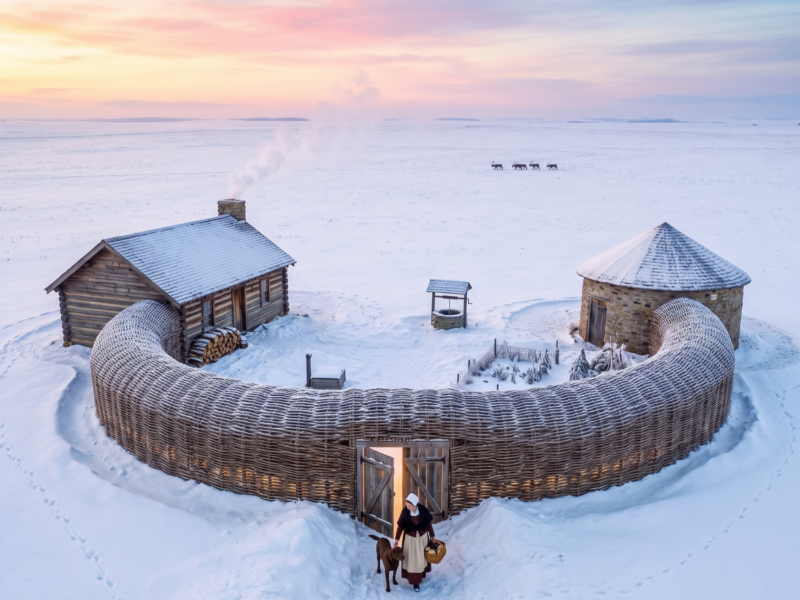
They Mocked the Sapling Tunnel She Built — Then the Deadliest Winter Proved Her Right
The Third Storm
The third storm did not announce itself. That was the insidious nature of the third storm, the pattern Margaret had been watching for since October.
The first two storms give a person the false feeling of having handled the winter. The sky clears, the temperature rises by fifteen degrees, and something deep in the human psyche interprets this as the worst being over. The body is wrong. It is not reading the season; it is only reading the last three days.
The third storm began on a Sunday evening with a sky that cleared rapidly instead of clouding over. This was the exact sign Margaret had written about when she first read the pattern in a decade of local weather records. A suddenly clearing sky in December, in this specific part of Montana, after two storms in three weeks, meant the temperature was about to drop faster than clouds could even form. The storm would come in from the north. It would come in brutally cold. And it would stay.
She brought in twice the wood she needed for one night. She filled every available water container inside the house. She checked the tunnel from end to end with her lantern, pressing each section of the wall with both palms, feeling for anything that had softened or shifted since the afternoon. She found nothing she had not already addressed.
She went to bed at nine o’clock. By morning, the world outside her windows was a single, shrieking color.
The first four days were survivable.
That was the exact word she used in the notebook. Survivable. Not comfortable. Not manageable. Survivable. Because she was trying to be scientifically precise, and precision mattered more now than comfort ever could.
She went through the tunnel in the mornings and evenings. She did not hurry. She had learned in October that hurrying inside the enclosed structure made her breathing faster and shallower, which mathematically meant more core heat loss per minute. She moved at the deliberate pace the space required.
Her sister’s two children, who had come to stay through the holidays and had been trapped by the weather, learned this without being told. They watched their aunt move through the house with a particular economy—nothing wasted, nothing rushed—and they matched it. They lowered their voices inside the tunnel when they played there, sensing the change in acoustics. Margaret marked those sections as performing perfectly.
On the fourth day, she heard a sound she was not expecting.
Something was striking the heavy front door. It wasn’t a knock. It was striking with far less control than a knock—the sound of a desperate fist that is not entirely working the way the person’s brain needs it to.
Margaret rushed across the room and hauled the door open.
Harold Gaines fell partially through the frame, collapsing onto the rug. He had come along the fence line, which was the correct decision—the only decision that had any logic in a total whiteout. But the fence line ran a quarter-mile from the road, and he had lost his grip on the wire twice, finding it again both times only by dropping to his knees and digging frantically for the wooden posts under the snow.
He was sixty-two years old, and he had made it, but the making of it had extracted almost everything he had brought with him.
Margaret grabbed him by the coat and dragged him fully inside. She slammed the door against the roaring wind. She sat him in the heavy chair near the stove. She did not barrage him with questions. She brought him a cup of room-temperature water, then a mug of warm broth, and she let his shivering body work through what it needed to work through. She understood that the terrifying gap between almost not making it and making it is not repaired by conversation.
It took him nearly five minutes before his breathing slowed enough to allow speech.
“The silo,” he gasped, pointing a shaking hand.
Margaret pointed toward the back of the house. Harold looked at the entrance to the tunnel from where he sat. He stared at the dark opening for a long moment. Then, he stood up slowly, leaning heavily on the back of the chair, and walked toward it.
He went through the tunnel the exact same way Margaret went through it: one bare hand trailing on the woven willow wall. Not because he needed the physical direction in the enclosed space, but because he was doing what she had done for months. He was feeling it.
He came back into the kitchen four minutes later and collapsed back into the chair. The silence between them lasted a long time, underscored by the screaming wind outside.
“It holds,” Harold said, his voice raspy. “Yes,” Margaret nodded.
Outside, the wind was a constant, crushing physical pressure against every wall of the house, finding no way in but loudly announcing at all times that it was trying. Harold stared at the glowing iron of the stove. Margaret waited. She had learned that Harold Gaines moved toward difficult things at his own unhurried speed, and arriving at the topic before him did not help.
“Walter Owens,” Harold said suddenly. “Nathan’s father.”
Margaret looked at him, her pulse ticking.
“Last February,” Harold continued, his voice level and terribly quiet. “He asked me if it was going to be bad… the storm that was coming. He’d heard the radio forecast, but he wanted to know what I thought.”
Harold looked at his hands, which were still bright, painful red from the frostbite. “I told him the fence line would be enough. I said, Stay close to the fence, Walter. You can always find your way back. I told him that like I knew it for a fact.”
He stopped. He squeezed his eyes shut.
“He did exactly what I told him,” Harold whispered. “He went out along the fence line. He made it to the barn. And he made it most of the way back. And then the wind changed, and he lost his grip on the wire… and he didn’t find it again.”
Margaret said nothing. There were no words that would fit inside a grief that large.
“I’ve been telling people things about winter for forty years,” Harold said. “Most of the time, I was right enough. Walter Owens was the time I wasn’t.” He looked up, his eyes shining in the firelight. “Nathan doesn’t know I told him that. And knowing it won’t make the boy hurt any less.”
“No,” Margaret agreed softly. “So, I’ve been carrying it.”
He said this not as a Catholic confession seeking absolution, but as a stark statement of fact. It was the way a man announces the brutal weight of something he has been carrying for so long that he had stopped noticing it, until the moment he finally sets it down.
Margaret looked at this man who had fought through a blinding blizzard at sixty-two years old, relying on a wire fence, just to get here. She understood that what he had just told her was not the kind of thing he had told anyone. Not his wife. Not his pastor. Not the whiskey bottle that sat on the shelf above his refrigerator. He had told her in this room, in the middle of the third storm, because the notebook on her table and the tunnel behind her wall had pried open a lock that more than a year of silence had kept shut.
“Harold,” she said gently. “Thank you for telling me.”
He nodded once, looked back at the stove, and that was the end of it. Not resolved. Not magically healed. But said, which is its own kind of salvation.
On the sixth day, the wind dropped.
The human body immediately feels the reduction in atmospheric pressure and reads it as safety. But what the drop actually meant was that the storm had simply changed its tactical approach. The wind had been moving snow sideways, keeping the accumulation irregular and scoured. When the wind stopped, the snow fell straight down in heavy, blinding sheets, building rapidly against every vertical surface it could find. Against the doors. Against the walls. Against the outer weave of the tunnel.
Margaret opened the back door on the seventh morning. The door moved exactly one inch and stopped, blocked by a wall of white. She closed it without forcing it; a cracked door frame in this cold was a fatal problem she could not fix from the inside.
She turned, walked to the interior tunnel entrance, and stepped in.
The outer weave had bowed violently inward in one section near the far end, crushed by the accumulated weight of two days of straight snowfall. It was not collapsed, but it was dangerously narrowed. She moved through it carefully, having to turn completely sideways in one place, reached the barn, took the wood she needed, and returned.
On the ninth day, the wind came back from the northwest.
It was stronger than anything the first week had produced. It was colder, and it came with the terrifying force of weather that has been gathering pressure behind a dam for days. The temperature outside plummeted to thirty-one below zero. Inside the house, thick frost lines appeared along the inner edges of the north wall, tracing the hidden gaps in the insulation.
Margaret went into the tunnel before dawn to inspect the damage. What she found stopped her dead at the midpoint.
The section she had reinforced before the storm was holding brilliantly. But a different section, eight feet further toward the barn—one she had not marked—had been catastrophically compressed. The weight of the accumulated snow was pushing down from the roof at the exact same moment the northwest wind was hammering inward from the side.
Two massive forces at two different angles. The result was a buckling she had not anticipated and could not have predicted without physically experiencing it. The passage was not blocked yet, but it was failing in a way that would seal it shut if she left it alone.
She had no lantern. She had brought only the small, battery-powered flashlight she carried in her coat pocket. The beam was narrow and threw jagged shadows that made the twisted weave look worse than it was, and then better than it was, depending on where she pointed it. She had to work by feel.
The temperature inside the structure was somewhere around fifteen below. Warmer than the death outside, but cold enough that her hands began losing fine motor sensation after the first ten minutes.
She kept working. The problem was not structural failure of the willow; the problem was distribution. The correction required her to manually ease the pressure from one side while simultaneously reinforcing the other with spare branches she kept stacked inside. It was a task that required both bare hands working in direct opposition, in a space barely wide enough to turn her shoulders.
Twenty minutes. Thirty minutes.
She was aware of the time passing the way a person is aware of a siren they cannot stop hearing. She was not frightened. She was focused. There is a vast difference, and the difference matters in survival because fear spends biological resources, and focus does not.
At forty minutes, the frozen section finally yielded to what she was asking of it. Not perfectly. But enough. She tested the passage by pressing her body through it, and it accepted her weight. She went to the barn, took what she needed, and came back.
Harold was standing at the interior tunnel entrance when she emerged.
He had been standing there, she understood from the rigid look on his face, for a large portion of those forty minutes. His face was the pale color of a man who has been waiting for something he absolutely could not control.
“I was going to come in,” he said, his voice tight.
Margaret dropped the firewood onto the floor. Her hands were shaking violently. Not from the cold. From the extended, brutal fine-motor demand of working in a confined space at sub-zero temperatures for the better part of an hour. The shaking was the body finally releasing the adrenaline it had held back in order to do the work.
“Don’t,” she gasped. “Don’t ever do that, Harold. If I don’t come out, you stand at the entrance and you call my name. You don’t go in. If we’re both inside and the roof fails, there is no one left to dig either of us out.”
Harold looked at her trembling hands. He did not look away quickly, the way a person looks away from something uncomfortable. He stared at them the way a man looks at evidence he has been trying his whole life not to see.
“How long were you in there?” he asked. “Long enough.”
He nodded slowly. He bent down, picked up the wood she had dropped, and carried it to the stove without being asked. Margaret understood this was the only form of response he had available to him at that moment, and it was enough.
That night, with Harold asleep in his chair and the children tucked under three layers of quilts in the back room, Margaret sat at the table with the notebook open. She uncapped her pen. And she did not write anything.
She sat for twenty minutes, staring at the blank page. She was not afraid. Fear would have been highly useful right now; it would have given her an emotion to push against. What she felt was much colder. It was the stark arithmetic of limited resources.
She was warm. She was fed. The tunnel was holding. The children were safe. Harold was alive. These were the indisputable facts. The facts were sufficient. But sufficient had a terrifying flaw to it tonight, and she was acutely aware of that flaw.
She capped the pen. She went to the stove, added two thick logs, watched the draft pull the orange flame up the chimney, and went to bed.









