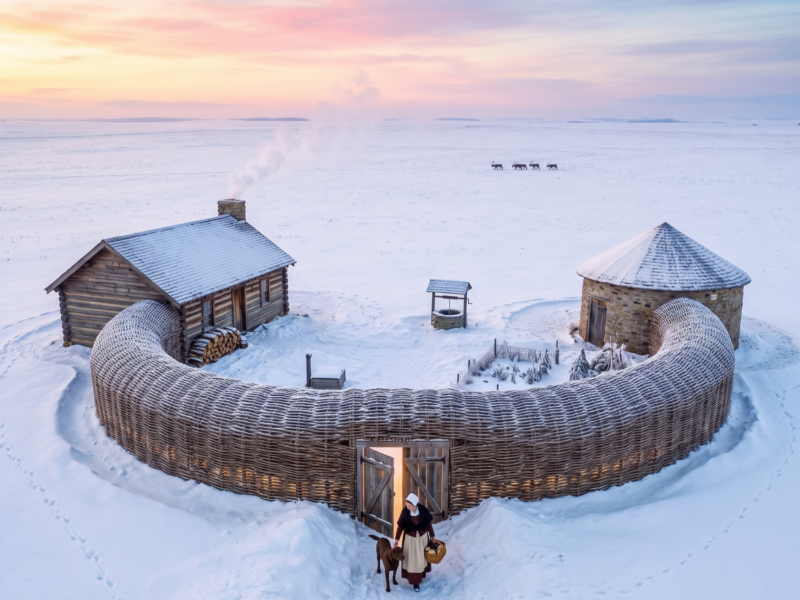
They Mocked the Sapling Tunnel She Built — Then the Deadliest Winter Proved Her Right
The Sound of Summer
The Mercer brothers came on a Tuesday in the second week of July.
She heard their horses before she saw them. The rhythmic thud of hooves carried across the dry grass with the particular, crystalline clarity of a Montana summer, where the air is thin and there is nothing between you and the horizon to break the sound before it arrives.
Dale was twenty-eight and rode in front, as he always did, because he was the older one and had never questioned whether that meant anything. Roy was twenty-four and rode a half-length behind, because that was the shape their entire lives had taken. They came along the fence line moving easy, not in any hurry. When they pulled up and looked at what Margaret was doing, they stopped.
They looked for a long moment without speaking. This was the part where they were genuinely trying to understand it, Margaret knew. And it was also the part where she knew they would soon stop trying.
“What is that?” Dale said. It was not quite a question.
“A tunnel,” Margaret said. She did not look up from her level.
She heard Dale repeat the word in a low breath to Roy. She heard Roy lean forward in his saddle, the leather creaking loudly in the heat.
“Between the house and the barn,” Roy said. “Yes.” “You’re building a tunnel… between your house and your barn.” “Yes.”
There was a pause. Then Roy said something she did not expect. His voice did not carry the broad, ignorant mockery she had braced herself for. It was almost conversational, and that made it infinitely worse in a way she did not immediately understand.
“Mrs. Avery,” Roy said, looking down at her, “that looks like something a person does when they don’t know what else to do.”
Margaret set her level down in the dirt. She looked at Roy Mercer sitting high on his horse in the July sun. Twenty-four years old. He possessed the kind of dangerous confidence that comes from never having been truly wrong about anything that mattered yet.
She had not planned to feel anything. She had been preparing for the laughter. She had constructed a psychological silence for it, the way she had methodically constructed the angle for each post in advance. But Roy’s sentence reached a dark, tender place that laughter would not have reached, because his assessment was not entirely untrue. She knew it.
She was not doing this because she was mathematically certain it would work. She was doing this because Robert was in the frozen ground, and she could not find any other way to answer the agonizing question she had written on the first page of her notebook.
She picked up her level and moved to the next mark.
She heard Dale say something low to Roy. She heard the horses shift as they started to ride away. Roy’s voice drifted back over his shoulder—not cruel exactly, but easy and loud, the way young men project when they are performing for one another.
“Building a basket big enough to live in!”
She heard the laughter. It lasted longer than it should have, the way things do when they are explicitly meant to carry. Margaret drove the next post.
Harold Gaines came down from the ridge two days later. He did not announce himself. He drove his battered truck along the unpaved track that ran behind Margaret’s south field. She heard the engine, looked up, and watched him park. He climbed out and walked toward her with the unhurried deliberateness of a man who has decided to do something, but has not yet decided what he is going to say about it.
He was sixty-two years old. Looked at honestly, he looked like someone the weather had worked on for a very long time without his permission.
He walked the entire length of what she had built without speaking a word. He pressed his calloused hand against one of the pale willow ribs and felt it give. He pressed harder. He watched the way the living wood returned to its shape.
“That won’t stop cold,” Harold said. “It’s not meant to,” Margaret said.
Harold looked at her. He was waiting for the rest of the explanation, she knew. She deliberately chose not to give it to him. Not because she was being difficult, but because she had learned already that an explanation offered to someone who is not yet ready to receive it does not land as an explanation. It lands as an argument. And Harold Gaines had buried too many people in this valley to be argued with.
“This will fail,” he said. “Then it will fail,” she replied.
Harold stood there, his hand still resting on the willow, looking at the angle of the posts, the precise spacing of the ribs, the way the shape moved the eye from the house to the barn. He was measuring something she could not see him measure. Then, his eyes went to the workbench. To the notebook.
“What do you have in there?” he asked.
Margaret wiped her muddy hands on her jeans and brought it to him without comment. Harold took it. He opened it at the beginning and read slowly. He read it the way a man reads something when he is not performing the act of reading for an audience, but actually absorbing it. He turned the pages. He stopped at a hand-drawn diagram showing wind direction overlaid against a rough map of the property. He studied it for a long time.
Then, he turned back to the first page. The three lines in blue ballpoint. He read them.
He stood there with the notebook open for what felt to Margaret like a full minute, though she knew time moved differently when she was watching it. When he finally looked up, his face had changed in a way she could not precisely name. Something raw had stepped out from behind the careful, stoic steadiness he wore—the expression men of his generation wore like a good winter coat: always on, always buttoned.
“My brother,” Harold said, his voice dropping a register. “He died in 2003. Thirty feet from the horse barn.”
Margaret looked at him, the wind shifting the grass between them.
“I told myself he slipped,” Harold said, staring through the notebook. “Ice on the step. Struck his head. I told myself that for twenty years.” He gently closed the notebook and held it for a moment before handing it back to her. “Now, I don’t know.”
He walked back to his truck. He did not say whether he would return, and Margaret did not ask. She watched him drive back along the track until the truck was a small speck against the flat land, and then gone.
She stood for a while without working. Harold Gaines had come down the ridge to tell her she was foolish and wrong, and he had walked away with his own twenty-year certainty knocked violently loose from its foundation. That was not nothing. But it was not yet anything she could build on, either.
She went back to the posts.









