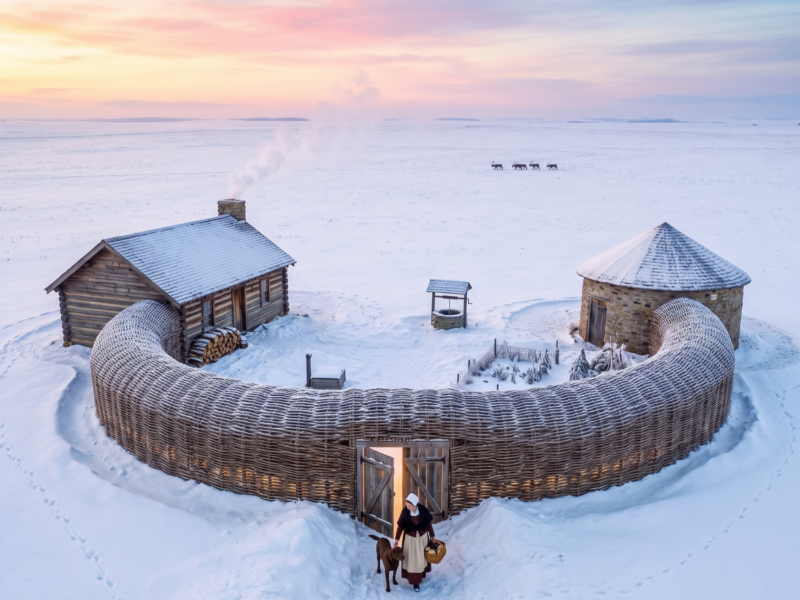
They Mocked the Sapling Tunnel She Built — Then the Deadliest Winter Proved Her Right
The Next Question
Spring came, and with it, the quiet, undeniable ripple effect.
More people came in the weeks that followed. They came the way people come to see miracles that have survived—carefully, in ones and twos, never announcing themselves. A man named Fletcher arrived from two miles south. He had lost nearly half his woodpile during the storm, not to theft, but to sheer consumption because the cold had run far longer than his estimates.
He stood at the tunnel entrance, asked what it was made of, and frowned when she told him. “And mud,” she added. “And time.”
“I could build something like this,” Fletcher said finally. “You could,” Margaret replied. “If you watch first. Your land is not my land. If you build for here instead of for there, you’ll build the wrong thing.”
Ralph Stinson came. He looked at the tunnel and said, “Carol would have used this.” “I think she would have,” Margaret said. “I’m going to build one. Show me where to start watching.”
Anna Mercer came and stayed after the others had gone. She sat at Margaret’s kitchen table and pulled a hardbound notebook from her bag. It was filled with daily observations, sketches, and wind patterns specific to the Mercer property. She had been recording data since July, refusing to speak until she was certain. Margaret looked at Anna—the woman who had walked eight hundred feet in a blizzard just to verify the truth—and saw the future of the valley.
Nathan Owens came back. He had spent six months watching his property. He had measured the distance to his woodpile—fifty-three feet, not fifty-five as he had blindly assumed. He had mapped his wind. He asked three specific questions, got three specific answers, and went home to build a structure that looked nothing like Margaret’s, but operated on the exact same logic.
The next winter, the second storm was worse than anything they had seen in a decade.
Three days in, Harold Gaines utilized his own newly built tunnel, and a series of connected sheltered windbreaks he had constructed along his fence line, to reach the Poole family at the far end of the valley. The Pooles had mocked the tunnels. They had built nothing. On day three, starving for fuel, the son had tried to cross the yard and turned back, nearly frostbitten.
Harold appeared at their door that afternoon, carrying fuel. He didn’t lecture them. He helped move what needed moving, and then walked back out into the storm. In the spring, Gerald Poole silently began cutting willow branches.
Harold and Margaret stood in her yard a week after that second winter finally broke.
Harold was sixty-three now, and the winter had put a satisfying weight in his face—the weight of a man who has seen a system he contributed to actually save a life. He looked across the field at Nathan Owens’s property, where a tunnel stood proud against the snow. In the distance, Nathan raised a hand in silent greeting. Margaret nodded back.
“You are not building a tunnel,” Harold said suddenly, looking at her. “No,” she said. “What were you building?”
Margaret looked at the bowed, cracked, mud-caked willow of her creation. She looked at the other properties across the valley.
“A way to lose less,” she said.
Harold was quiet. He recognized the truth of it. “My brother,” he said softly, “George… he would have built something like this. He always thought about systems. I only thought about the immediate problem. My answer for forty years was the fence line. George would have asked what happens when the fence is buried.”
“You’re asking it now,” Margaret said. “Twenty years late.” “The question doesn’t have an expiration date.”
They stood there together in the cold that existed but did not strip, looking at a valley that had changed the way real change happens—not all at once, but in small, accumulating additions.
Margaret went inside. She sat at her table. She opened the notebook to a blank page. She wrote the date. She began to write about the new wind patterns she had noticed, about the distances that were still too long on three other properties, about the questions she had not yet been able to answer.
The system was not finished. The system was never finished. That was not a failure; it was the nature of something that actually worked. It was a continuous act of attention.
Outside, the Halverson children ran through the tunnel, their laughter echoing, muffled and safe, within the mud walls. They ran without thinking about the structure, because they were growing up in a world where it simply existed, and they could not imagine a world where it did not.
Margaret smiled, dipped her pen, and kept writing.









