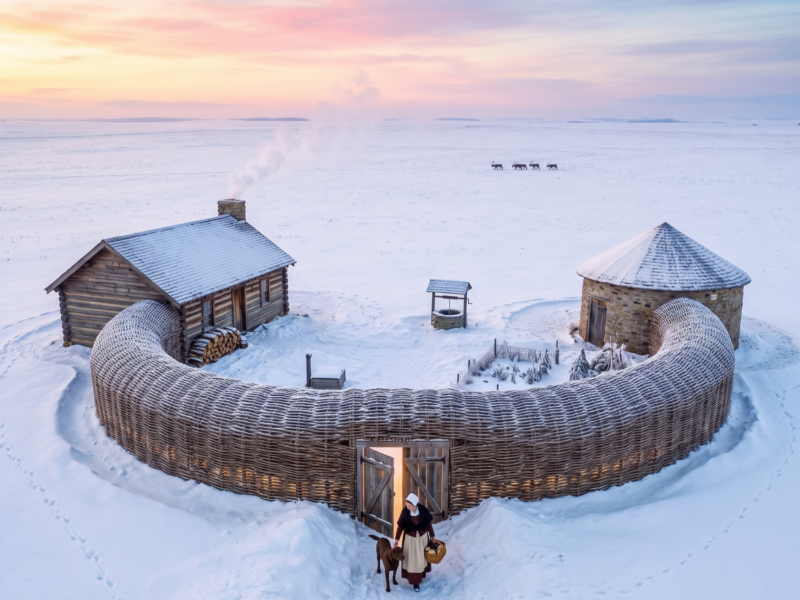
They Mocked the Sapling Tunnel She Built — Then the Deadliest Winter Proved Her Right
The Farmers Association
Nathan Owens came in late August.
He walked across the field from the road, rather than driving his truck down the track, as if he had parked and intentionally needed the physical distance of the walk before he arrived. He was thirty-one years old and built like a man who had worked outdoors since he was a teenager. He moved with a physical ease that did not match the tight, conflicted look on his face when he got close enough for Margaret to read it.
He stopped fifteen feet away. He stood with his hands shoved deep in his pockets, looking at the half-mudded structure. Margaret let him look. She knew exactly who he was. Walter Owens had been his father. Walter Owens had died in March of the previous year, just a half-mile from Margaret’s property, in the exact same storm that had taken Robert.
Nathan finally stepped forward. “My father died a half-mile from here,” he said. “I know,” Margaret said quietly.
“If you already knew what this was,” Nathan said, gesturing at the tunnel with a motion that was almost dismissive, but trembling with suppressed anger. “If you’d figured this out, why didn’t you tell anyone before that winter?”
“Because in March of last year,” Margaret said, her voice steady against his grief, “I had just buried my husband. I didn’t have an answer yet, Nathan. I started looking for one after.”
Nathan was quiet. He was evaluating whether this was true, she knew. He was also evaluating whether the truth of it changed the hollow feeling in his chest.
“He could have used this,” Nathan said. It was not a question. It was a devastating fact placed into the open air between them, where it could not be taken back.
Margaret did not answer. There was nothing to answer. Walter Owens could have used something like this. Robert Avery could have used something like this. The two of them were in the frozen ground, and the willow and mud Margaret was building would not reach them.
Nathan looked at the tunnel one more time, then turned and walked back to the road. He did not say goodbye. Margaret watched him go. She stood completely still for longer than usual after that. Then, she picked up her trowel and continued.
The Farmers Association meeting was held on the second Thursday of September in the echoing gymnasium of the Elk Creek Community Hall. It was the same room where they had held it every year for as long as anyone could remember, filled with rusted folding chairs, a pull-down projector screen, and a table of percolated coffee that was always burnt by the time anyone got to it.
Margaret had not been invited.
Anna Mercer sent her a text message at four o’clock in the afternoon. Three words: You should come.
Margaret drove to Elk Creek. She arrived after the meeting had already started and stood in the back, leaning against the cinderblock wall near the door. Frank Aldridge saw her when he looked up from his notes at the podium. His rhythm faltered for just half a beat before he smoothly picked it back up again.
The room held about sixty people. Farmers, their spouses, and a few younger faces Margaret did not immediately recognize. Frank was working through the standard winter preparation list: fuel reserves, livestock sheltering protocols, road monitoring contacts. It was the exact same list, she knew, that he had presented every September. The same list he had presented the year Robert died. The same list the year Walter Owens died.
From the third row, a man raised his hand. Ralph Stinson. Fifty-eight years old. He had lost his wife, Carol, in the blizzard of 2019. She had gone out to reach the woodpile and had not come back. Ralph had found her frozen in the yard. Margaret had heard this from Harold years ago, in the way tragic news travels in small valleys—quietly and completely.
“Frank,” Ralph said, his voice gravelly. “What’s different on this list from last year?”
Frank looked at him, adjusting his microphone. “We’ve expanded the section on pipe winterization, Ralph. And we’ve added contact information for the Cascade County emergency line.”
Ralph nodded slowly, staring at the back of the chair in front of him. “Carol went out for wood,” he said into the quiet room. “She didn’t need a plumber. And she didn’t need an emergency number. She needed to be able to get to the woodpile and make it back to the door.”
The gymnasium became deathly quiet.
Margaret stepped away from the door and walked slowly down the center aisle. She did not ask permission to speak.
“How many people in this room,” Margaret said, her voice carrying clear and hard over the folding chairs, “have lost someone—not because they ran out of supplies in the house, but because they couldn’t move safely between their house and their outbuildings in a storm?”
The silence lasted two seconds.
Then, Ralph Stinson raised his hand. Two older men sitting near the window raised their hands. A woman in the front row raised hers. And Harold Gaines, standing in the far back corner with his arms crossed over his chest, raised his hand without looking at anyone.
Seven people. Seven ghosts in a room of sixty.
Frank set down his papers on the podium. “Margaret, the structure you’re building on your property has not been through a winter. You’re asking this room to make life-or-death decisions based on something entirely unproven.”
“I’m not asking anyone to make any decision tonight, Frank,” she said, stopping at the front of the aisle. “I’m asking people to come to my property and see it before winter hits. Anyone who wants to.”
Frank glared at her. The look carried the particular, venomous frustration of a man who has prepared for a bureaucratic confrontation and been handed an emotional one.
Harold spoke from his corner in the back. He did not raise his voice, but the acoustics carried it perfectly. “I’ll come see it,” he said.
That was all. He did not advocate for her. He did not explain the physics of the tunnel. He simply said he would come and look. And in a room where Harold Gaines possessed sixty years of quiet credibility, that was enough to fundamentally change the temperature of the air.
The meeting ended twenty minutes later without resolving anything, and without needing to.
Frank Aldridge found Margaret in the gravel parking lot before she reached her truck. He had come around the side of the building, away from the headlights of departing cars, and he was no longer wearing the official, helpful expression. He looked like a man who has run out of versions of himself to present to the world.
“You understand,” Frank said, his voice low and tight, “that if that structure fails during a storm, and someone is inside it… that is entirely on you.”
Margaret looked at him. The parking lot was emptying out, and the night had gone cold in the way September nights in Montana go cold all at once—like a heavy door opening into a much larger, darker room.
“I understand,” she said. “I’ll make sure everyone else understands that, too,” he said. He turned and walked back to his heavy-duty truck.
Margaret got in her vehicle and drove home. She let herself into the quiet house, sat down at the kitchen table where the notebook lay open to the current date, and did not reach for her pen. The tunnel was visible through the back window, illuminated by the porch light. The pale willow ribs curved in the dark against a starless sky.
She had built something that had not yet been tested by the monster it was built for. Frank Aldridge had just guaranteed that if it failed, it would fail publicly, and she would carry the guilt of it alone.
She sat at the table and did not move for a long time. Then, she got up, put on her heavy jacket, and went outside with a flashlight to check the mud on the lower section before the frost set in overnight. There was still work to do, and the work did not wait just because she was afraid.









