The Daughter at the Gala
CHAPTER ONE — A Dress from a Dead Woman's Closet
The dress had belonged to her mother, and it did not quite fit.
Eleanor Hart stood at the top of the marble staircase of the Aurelian Hotel with one gloved hand on the banister and the other pressed flat against her ribs, and she told herself, for the fifth time since the taxi, that nobody would notice. It was a slip of champagne satin, cut on the bias, with thin straps and a hem that whispered against her ankles. Her mother had worn it once, thirty years ago, to a dinner she never talked about. It had hung in a garment bag at the back of a wardrobe in a rented flat in Leeds for the whole of Eleanor’s childhood, and in March, in the week after the funeral, she had unzipped the bag looking for a black dress to bury her in, and found this instead.
She had tried it on that night in the dark, in the empty bedroom, with the curtains open and the streetlamp throwing orange squares on the wall. It had been two inches too long and a half-size too tight across the shoulders. She had stood in front of the wardrobe mirror in her mother’s dress and cried until she was sick.
Then she had taken it to a tailor on Harehills Road and said, Make it fit, but don’t change anything.
Below her, through the arched doorway of the ballroom, four hundred people were laughing.
She could hear it from the stairs: a great warm roaring wave of sound, the clink of glasses, a string quartet sawing gamely through something by Vivaldi, the soft rustle of silk and taffeta. Chandeliers hung from the gilded ceiling like frozen fireworks, each one the size of a small car, throwing prisms across the walls. At the far end of the room a vast screen glowed with a slow-moving image of champagne flutes and the legend, in silver script, The Whitmore Foundation — Raise a Glass for Children’s Literacy.
She had read that line eleven times on the invitation. She knew every word of it by heart.
The invitation was in her clutch. It was a stiff cream card, engraved, with a seat number written by hand in the corner in blue-black ink: Table 14, Seat 1. And beneath it, in the same slanting, impatient hand, four words that she had stared at so long they had stopped being words and become a shape.
Please come. — C.W.
She did not know how he had found her.
That was the thing that kept her awake. For six months, since the week of the funeral, she had been writing to Charles Whitmore. Three letters. Careful ones, drafted and redrafted at the kitchen table, in her best handwriting, with a photograph of her mother paper-clipped to the corner and a plain sentence at the end: I’m not asking for anything. I only wanted you to know that she was happy, and that she never stopped talking about the library you built together at Oxford. She had posted them to the foundation’s office in Mayfair. She had never received a reply.
She had stopped hoping in September.
Then, ten days ago, a courier had come to the flat. A quiet man in a grey coat, with a leather folder and kind, tired eyes, who had said his name was Daniel Okonkwo and that he was a solicitor, and that he had been instructed by a client to deliver a personal invitation. He had waited on the doorstep while she opened it. He had not said who the client was. He had only said, as he turned to go, in a voice so low that she almost missed it: Wear something your mother would have liked.
She had not slept that night.
“Madam?”
A young man in a white jacket was bowing at her elbow with a silver tray. “Champagne? Or the elderflower?”
“Oh. Elderflower. Thank you.”
She took the glass because it gave her hands something to do. It was cool and fizzing, and the bubbles rose up the stem of it like tiny silver beads. She sipped, and nearly choked, and put it down on a passing table. Her mouth had gone dry. Her whole body felt as if it had been wound too tight and was beginning, very slowly, to hum.
She went down the stairs.
At the bottom, a woman in a long green gown looked her up and down with polite surprise. A man laughed at something. A waiter in white gloves smiled at her. Nobody asked her name. She walked into the ballroom as one walks into cold water, one step at a time, with her head up and her eyes fixed on a point in the middle distance, and the noise rose around her like surf.
She did not know what he looked like.
That was the absurdity of it. She had been looking for his face in magazines for six months, and had found only a handful of pictures: a tall, grey-haired man in a dinner jacket shaking a minister’s hand; a blurry figure at a ribbon-cutting; a stiff portrait on the foundation’s website with his chin lifted and his jaw set, a face she could not read at all. Her mother had never kept a photograph. There’s no need, she had said once, folding laundry, with a small, strange, closed smile. I’ve got him in here. And she had tapped her forehead.
She found him on the far side of the room, in the end, by the light.
He was standing beside a round table near the stage, in a black tuxedo, with a glass in his hand he was not drinking from. A tall man. Sixty-eight, she knew from the website. Silver-haired and broad-shouldered, with a long, lined, weathered face like something carved from driftwood. He was not talking. He was listening to a younger man who stood beside him with a leather folder under his arm, and as she watched, he nodded once, slowly, and looked up.
He looked straight at her across the whole width of the room.
She stopped dead.
It was not recognition, she thought. It could not be. He had never seen her face. And yet his own face did something she would remember for the rest of her life: it went completely still, as if someone had pressed pause on a film, and then, very gradually, like the sun coming up over a field, it opened.
He lifted his hand.
It was a small gesture. A half-raised palm. Wait. I’m coming.
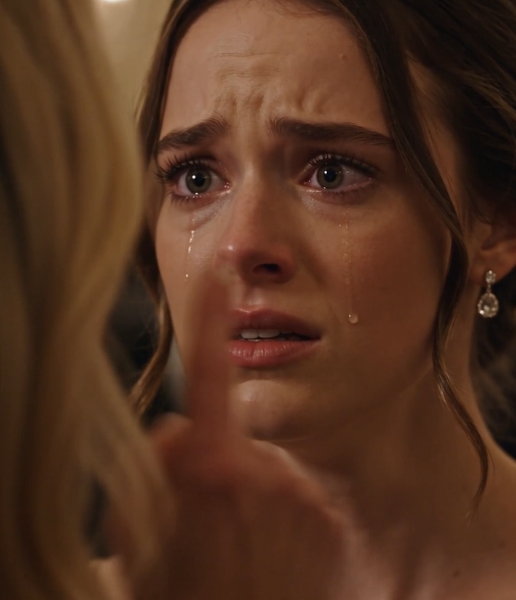
Her eyes filled. She felt it happen and could not stop it. Her throat closed, and her chin shook, and she thought, with an absurd, dizzy lightness: he knows. He knew all along. He’s going to walk across this room and I am going to say something clever, and he is going to take my hand.
She took a step towards him.
And a hand closed round her upper arm, light and cool and quite impossible to shake off.
“Well,” said a woman’s voice at her ear, delighted and silky and low. “What have we here?”









