The Daughter at the Gala
CHAPTER FIVE — An Introduction
"Ladies and gentlemen," said Charles Whitmore, "I owe you all an introduction."
He did not raise his voice. He had never needed to. He had spent forty years in boardrooms and council chambers, and he had learned that the quietest voice in a silent room is always the one that is obeyed. It rolled out across the ballroom, deep and unhurried, and four hundred people who had been murmuring into their glasses fell abruptly quiet, as if someone had turned a dial.
The quartet lowered their bows. A waiter at the back set down a tray. On the great screen above the stage, the slow-moving image of champagne flutes went on glowing, silver and serene, in the middle of a silence that was beginning to feel like weather.
Ellie stood in the circle of his arm and felt the whole room turn towards her, like a field of sunflowers.
She had never been looked at by so many people. She had spent her life, until six months ago, being quietly overlooked: in school corridors, in the staff room of the library where she worked, on the number 56 bus. She was a small, plain, careful girl who wore cardigans and kept her head down and had been told, more than once, that she had a lovely listening face. She had made a career of not being noticed.
Now four hundred people were staring at her as if she were a comet.
She could feel Charles’s hand on her shoulder. It was a big hand, warm and dry and heavy, and it was trembling very slightly, in a way that she did not think he knew. She put her own hand up and covered it. She did not decide to. It was simply where her hand went.
He turned his head and looked down at her. His eyes were wet. He gave her a tiny, crooked, astonished smile, as if she had just done something extraordinary, and then he looked up again and drew a long breath.
“Most of you know that I was married once before,” he said. “To Margaret, who died eight years ago. Most of you did not know that, long before that, when I was twenty-three and a very great fool, I was in love with another woman.”
A murmur ran round the room.
“Her name was Rose Hart. She worked in the Bodleian Library. I used to follow her up and down the stacks pretending to look for a book on Byzantine law, and she used to pretend not to notice.” His mouth twitched. “She noticed. She noticed everything. We were together for fourteen months, and they were the happiest of my life, and I was too much of a coward to tell my father. When he told me that I was to marry Margaret Ashcombe, I did. I did not say goodbye to Rose. I did not even write.”
His voice cracked. He steadied it.
“I did not know that she was expecting a child.”
The whisper rose again, louder, shocked and delighted. A woman in green gasped aloud. Somebody at the back said good God. Ellie felt her face burn. She wanted to hide. She wanted, quite suddenly and absurdly, to laugh. And she realised that the hand beneath hers had tightened, as if it were afraid she might run.
“I did not know,” said Charles, “because she did not tell me. She was twenty-two, and proud, and she had decided that her child would grow up ordinary and happy and free of everything that I came from. She did it alone. She raised her in a two-room flat in Leeds, on a librarian’s salary, and I am told that she did it superbly.” He swallowed. “Rose died in March. Her daughter wrote to me. She wrote three times, and she sent me a parcel of letters her mother had never had the courage to post. And I never received a single one of them.”
He did not look at his wife.
He did not have to. A hundred heads had already turned, slowly, in a long, rippling wave, towards the woman in black who stood alone in a clear space on the carpet, with a champagne flute in one hand and her wrist cradled in the other.
“This,” said Charles Whitmore, and his hand closed on Ellie’s shoulder, and his voice rang out clear and strong to the farthest corner of the room, “is my daughter. Her name is Eleanor Hart.”
It was the sound she would remember.
Not the words. Not even the sight of his face. It was the sound that came after: a vast, soft, rolling sigh, like a wave going out over shingle, and then, a heartbeat later, a single pair of hands, somewhere near the back, beginning to clap.
She thought at first that it must be a mistake.
But the clapping spread. It rose and swelled and ran from table to table, from the bankers in their dinner jackets to the duchess in her tiara to the white-gloved waiters standing against the wall with their trays in their hands, until the whole vast gilded ballroom was thundering with it, four hundred people on their feet beneath the blazing chandeliers. A woman in lilac was crying openly. A big red-faced man was bellowing hear, hear and thumping a table. Somebody whistled.
My mother’s name, thought Ellie, dizzily. They’re clapping for my mother’s name.
She had never said it out loud in company. In a way she had never said it at all. At the funeral, a vicar who had not known her had called her Rosemary. At the crematorium, a man from the council had asked, politely, if there was anyone else. There had been eleven people in the chapel. She had counted. She had stood at the front, in her black coat, and thought: this is what it is to have lived a quiet life. She had been so angry. She had been so tired. She had wanted somebody, anybody, to stand up in a crowded room and say that Rose Hart had mattered.
And a man she had never met had done it, in front of four hundred strangers, in a voice that shook.
She began to cry.
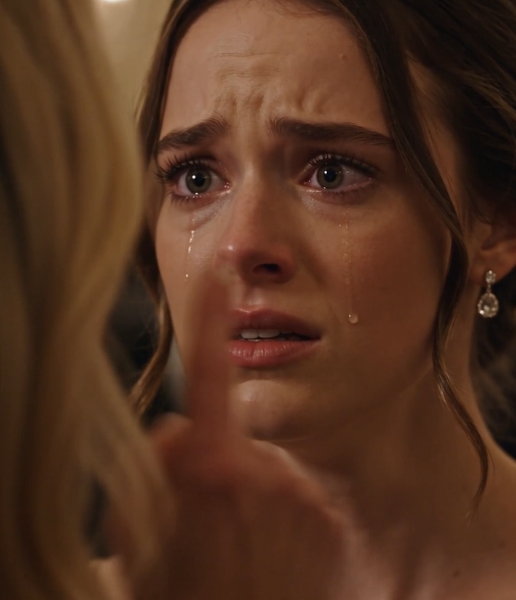
She did it without sound, without drama, in a rush, with the tears running down her face and dripping off her chin onto the satin of her mother’s dress. She did not try to stop. Beside her, Charles had taken a large white handkerchief out of his pocket and was holding it out with a look of helpless, anguished tenderness, and she took it, and laughed, and wept into it, and he put his arm round her shoulders and held her against his side, quite firmly, as though he had been doing it all her life.
“I’m sorry,” she said into the cotton. “I’m so sorry. I didn’t mean to— I only came to see you.”
“You’ve nothing to be sorry for,” said Charles, in a voice that was not entirely steady. “You’ve nothing in the world to be sorry for. If anyone is sorry, it is me, and I will go on being sorry for the rest of my life.”
“You didn’t know.”
“I should have looked.”
“You didn’t know, Charles.”
He looked down at her. She had said his name. She had not planned to. It had just come out, plain and simple, the way you say the name of someone you have been thinking about for a very long time.
He closed his eyes.
It was a little while before anybody remembered Vanessa.
It was Daniel Okonkwo who saw her first. He had been standing a few paces away, with the folder under his arm and his face composed, watching the room, with the alertness of a man trained to watch exits. He saw a flash of black at the edge of the crowd. He saw a slim figure in a halter dress, quite alone, moving towards the nearest service door in a quick, low, gliding walk, with her chin down and her eyes fixed on the floor.
He did not shout. He lifted one finger.
Four men in dark suits detached themselves from the wall.
They did not hurry. They had been briefed, three days earlier, in a quiet room at the back of the hotel, by a grave grey-haired gentleman named Mr. Briggs, the Aurelian’s head of security, who had said: You will be courteous. You will be firm. You will not touch the lady unless she touches you. They fell in around her like water closing round a stone: one in front, one behind, two at her shoulders. They did not lay a hand on her. They simply stopped.
Vanessa stopped.
She looked at the four black-suited men. She looked at the door beyond them, a dull green service door with a brass push-plate, no more than ten feet away. She looked, last of all, back over her shoulder at the great glittering ballroom, where four hundred people were slowly, one by one, ceasing to applaud, and turning to watch her.
It was a terrible thing to see, Ellie thought. She had not expected it to be. She had imagined, in the long dark months of the winter, how it would feel to watch this woman fall. She had imagined something hot and bright, like a fire. But what she felt, watching the lovely blonde head turn, slowly, helplessly, towards the room, was only a sort of slow, aching, absurd pity, like seeing a very beautiful bird in a very small cage.
“Mrs. Whitmore,” said Mr. Briggs gently, from the back. “If you would come this way.”
“Don’t touch me.”
“No, ma’am. I wouldn’t dream of it.”
“I’ll have your job for this,” said Vanessa. Her voice was thin and high and cracked. “I’ll have all your jobs. Do you know who I am? I run this foundation. I run this house. Charles—” She turned. She looked across the carpet, at the man with the white handkerchief in his hand, and for a moment Ellie saw something move in her face that was not rage, and was not calculation. It was bewilderment. It was the look of a small child who has fallen over in a playground and cannot understand where the ground has gone. “Charles, tell them. Tell them who I am.”
“I think,” said Charles slowly, “that they know.”
“I did it for us.”
“No.”
“I did it because I—” She stopped. She pressed her lips together, hard. Her eyes had filled with tears, and they ran down her face in two quick bright streaks, taking the mascara with them. “I did it because I couldn’t have— I couldn’t, Charles. I tried for four years. You know I tried. And all that time, you had a— and you never— And then a letter came, in a brown envelope, and I thought, he’ll go. He’ll leave me. He’ll go to her, and he’ll have what I couldn’t give him, and I’ll be—” She gave a harsh, sobbing, bubbling laugh. “I’ll be nothing. I’ll be a woman in a big house with a lot of dresses.”
There was a silence.
Ellie did not know what made her do it. She stepped out of the circle of Charles’s arm. She walked across a few feet of thick patterned carpet in her mother’s too-tight satin dress, with four hundred people watching, and stopped in front of the woman in black. They were of a height. They looked at each other.
“I’m not here to take anything,” said Ellie.
It was a plain, quiet, level sentence. It was what she had come to say. She had practised it in the bathroom mirror, over and over, in a dozen different voices, from defiant to wistful to dignified. She had never once imagined that she would say it like this, with her voice gentle and her face wet.
“Everyone takes something,” said Vanessa.
“I know. I’m sorry you were so frightened.”
It landed.
She saw it land. She saw the green-grey eyes widen, very slightly, and the lovely mouth tremble, and the whole elegant, shining, glacial surface of the woman begin, for one fleeting instant, to crack. Something looked out of it. It might have been the person she had been, twenty years ago, before the silk and the diamonds and the eleven-thousand-pound dresses. Someone younger. Someone poorer. Someone who had wanted, and had learned what it cost to want.
Then it was gone, and the face closed like a door.
“Get out of my way,” said Vanessa Whitmore.
Ellie stepped aside.









