The Daughter at the Gala
CHAPTER FOUR — Ninety-Nine Point Nine Eight
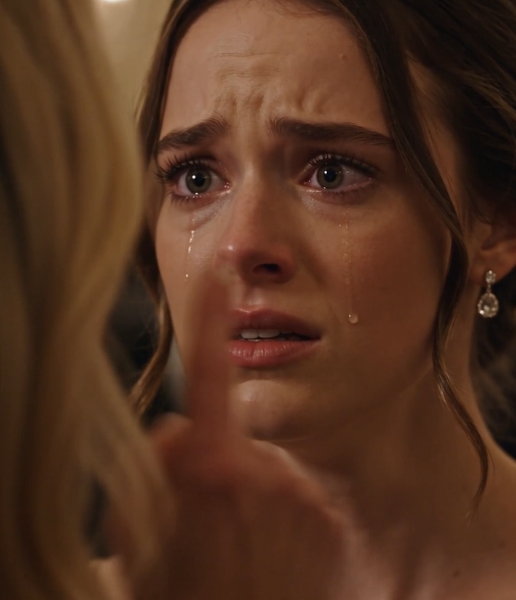
Ellie could not feel her hands.
It was a curious sensation, like standing under a very cold waterfall. She had been shaking so hard for so long that the shaking had stopped being a thing her body did and become a thing it was. She was aware, in a distant, detached, dreamlike way, of the great gilded room around her, and the faces, and the ocean-roar of whispering, and the silver-haired man who had said that’s enough, Vanessa in a voice like a closing door.
He had not looked at her.
Not once. Not since he had stepped out of the crowd and caught his wife’s wrist. He had stood between them with his broad back to Ellie, his dark shoulders blocking the light, like a wall, and she had stood behind it and breathed.
She thought: I know that back.
It was ridiculous. She had never seen it before. But there was something in the set of the shoulders, the slight stoop of the neck, the large, patient, capable hands, that made her think of a photograph that her mother had kept in a shoebox in the bottom of the wardrobe: a young man in a rumpled shirt, standing in a library window with his arms full of books, laughing at someone just out of frame.
Who’s that? she had asked, when she was seven.
Nobody, her mother had said, and put the lid back on the shoebox. A boy I used to know.
The man in front of her was talking. She tried to listen. His voice rolled over her in a low, steady, unhurried baritone. Eleven letters. In your dressing-table drawer. And somewhere, a very long way away, a woman in a black dress was saying that’s a lie, and then Charles, that’s insane, and then, rising, shrill and cracked and frightened, You can’t prove I— You can’t prove—
“Daniel,” said the silver-haired man.
The young man in the grey suit stepped forward. He opened the leather folder in his arms. He drew out a single sheet of white paper, stiff and crisp, with a pale blue letterhead at the top, and he handed it, with a small formal inclination of the head, to the man in the tuxedo.
Charles Whitmore lifted it into the light.
He did it slowly, like a man raising a flag. The white sheet caught the glow of the chandeliers, and for a moment Ellie saw only a blur of black type. Then he turned it, very slightly, towards the crowd, and she saw the heading, printed in tall plain capitals across the top.
CERTIFICATE OF PATERNITY ANALYSIS.
A gasp went round the room. It rose from four hundred throats at once, soft and sharp, like a flock of birds taking wing.
Six days ago, Ellie had sat at her mother’s kitchen table in Leeds with a notary public and a quiet man in a grey suit, and swabbed the inside of her cheek with a little white stick. She had signed four forms. She had sealed the stick in a plastic tube, and the notary had sealed it in a bag, and the man in the grey suit had said, in his low, kind, tired voice, It will be on Tuesday. She had said, It doesn’t matter what it says. And she had meant it. She had meant it with all her heart, and she had not slept since.
“This came back from the laboratory on Tuesday,” said Charles Whitmore.
His voice was perfectly steady. It was only his hand that gave him away. The paper shook, very slightly, between his fingers, like a leaf in a draught.
“That’s a forgery!”
It was Vanessa. She had thrown it at him like a stone, high and shrill and breathless, and Ellie saw the knuckles of her left hand whiten around the stem of the champagne flute. “It’s fake, Charles, she’s bought it, she’s paid somebody, she’s— For God’s sake, look at her! She’s a shop girl! She’s a nobody! She has nothing, and she wants everything, she’ll take half the estate, she’ll take the house, she’ll take the foundation—”
“She has asked me for nothing,” said Charles.
“Because she’s clever—”
“She has asked me for nothing,” he said again, a little louder, “in three letters. She has asked me for nothing in the parcel. She asked me for nothing when Daniel called her on the telephone, and told her that I wished to be certain, and she said, and I quote, he doesn’t have to be certain. He doesn’t have to do anything. I only want him to know.” He turned his head, at last, a few degrees, and the full weight of his gaze fell on his wife like a hand. “You, on the other hand, Vanessa, have asked me for a great deal. For five years. And on the day we married you signed a document, in front of three solicitors, which I did not want and you insisted upon. Daniel?”
“Clause nine,” said the young man softly. “Paragraph four.”
“Read it.”
The young man cleared his throat. He drew a second sheet from the folder, thicker, cream-coloured, folded in three. He did not look at Vanessa. He read in a clear, formal, toneless voice, like a man reading the lesson in church.
“In the event that either party shall conceal, intercept or obstruct any communication relating to the existence, welfare or paternity of a child of the other party, whether born before or after the date of this agreement, the concealing party shall forfeit all rights and entitlements under this settlement, and the remaining party shall be released from all further obligation.”
He lowered the page.
The silence that followed was so absolute that Ellie could hear the quartet’s first violinist breathe.
Vanessa Whitmore had stopped moving.
She stood in the middle of the carpet in her black dress, with the champagne flute dangling from her fingers and a long, slow trickle of the pale gold wine running down her wrist, and she did not seem to notice. She was looking at Charles. All the colour had left her. Her eyes, those cool, clear, clever eyes, had gone wide and dark and curiously young, and for the first time in the whole nightmare of the last ten minutes Ellie saw, behind the glitter, a woman who was very, very frightened.
“You wrote that,” Vanessa whispered. “You wrote that clause. Five years ago. You—”
“I asked my solicitors to,” said Charles, “on the morning of our wedding. I had a dream, the night before. I did not understand it. I only knew that there was something I had left undone, somewhere, with someone, and that if I did not provide for it, I would regret it.” He looked down at the paper in his hand. “I thought I was being sentimental.”
He lifted his eyes, and for the first time since he had walked across the room, he looked straight at Ellie.
It was like being struck by lightning.
He had very dark eyes. They were the same colour as hers. They were wet. He did not try to hide it. The tears stood on the lower lids, bright and heavy, and as she watched, one of them fell, and ran down the long lined cheek, and was lost in the silver stubble of his jaw, and he did not so much as lift a hand to wipe it away.
“Eleanor,” he said.
He said it quite quietly. It was not a speech. It was not a performance. It was the voice of a man at the end of a very long road, saying the name of a place he had thought he would never see.
“The laboratory report,” he said, “is eleven pages long. I have read it forty times since Tuesday. It says that the probability of paternity is ninety-nine point nine eight per cent.” His voice cracked. “I did not need it. I knew when I saw you standing at the top of that staircase. But I wanted you to have it in writing, so that no one, ever again, can tell you that you are not what you are.”
He held out the page.
She took it.
It was a plain white sheet of paper. It weighed nothing. It was warm from his hand. She looked down at it through a swimming blur of tears, at the neat black type, the signatures, the stamp, the long string of decimal points, and the words, in bold, at the foot of the last line, that she could not read, because her eyes would not focus, and did not need to, because she had known them all her life.
Charles Whitmore is the biological father of Eleanor Rose Hart.
A sound broke out of her. It was not a word. It was not a sob. It was somewhere between the two, a small, high, helpless, wondering sound, like a child’s first breath, and she put the paper against her chest and bent over it, and felt, from a very long way off, a large warm hand come to rest on her shoulder.









