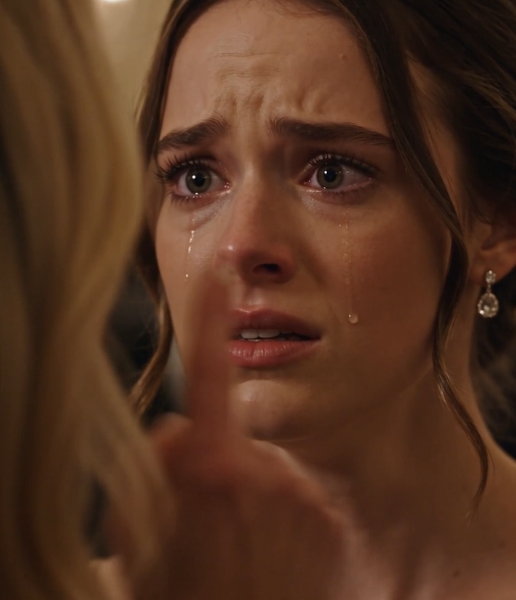
The Daughter at the Gala
CHAPTER SIX — The Open Doors
They walked her down the long length of the ballroom.
Nobody had told them to take that route. There was a service door ten feet away, and a back corridor, and a freight lift, and a discreet side entrance on Albemarle Street where a car could have been waiting. It would have been simple. It would have been kind. But Mr. Briggs, who had been a policeman for twenty years before he was head of security at the Aurelian, and who had seen a great many people leave a great many rooms, had a rule. If they came in by the front, he used to say, they go out by the front.
So they walked her, very slowly, down the full length of the carpet, through the wreckage of the gala.
The crowd parted for her. It was the strangest thing. Four hundred people stood back in silence and made a lane, as the sea parts for something that nobody quite wants to touch. A man who had kissed her hand at the hunt ball in February looked at the ceiling. A woman who had borrowed her yacht in August found something very interesting in the bottom of her glass. A banker who owed her husband a favour turned and began, quite deliberately, to talk to a waiter.
She did not look at any of them.
She walked with her chin high and her bare shoulders back and her black dress swishing against her ankles, in the sort of walk that is taught in finishing schools and cannot be broken even by catastrophe. She did not stumble. She did not hurry. She kept her eyes fixed on a point in the middle distance, where the great carved double doors of the ballroom stood closed at the end of the room, ten feet tall, in dark mahogany, with brass handles as big as a man’s forearm.
The doormen were waiting.
They were two young men in dark green livery, with white gloves, who had stood at attention beside the doors since seven o’clock without once looking at anyone. They had been told what to do. They did it, with a crisp, impersonal, perfect courtesy, as they had been trained to do it for any guest at any hour: each took a handle, and drew it back, and swung the doors wide.
The night came in.
It came in cold and dark and quiet, with a smell of rain and wet stone and distant traffic. Beyond the doors lay the hotel’s great portico, with its marble steps and its rows of white columns and its long dripping canopy of glass. A line of black cars glittered at the kerb. A uniformed doorman was holding an umbrella. Beyond that, across the road, the black trees of the park stood in the lamplight like a wall.
Vanessa Whitmore stopped on the threshold.
She stood quite still in the doorway, a slim dark shape against the dark, with the light of four hundred chandeliers behind her and the great cold night in front. She was alone. The four men in black suits had halted a pace behind her. Nobody touched her. Nobody spoke. And for a moment she did not move at all, but only stood there with her hands hanging at her sides, her blonde hair stirring in the draught, and the diamonds in her ears throwing little sparks of light across the marble steps.
She turned her head.
She looked back, down the whole length of the ballroom, across the gilded carpet and the wreckage of the tables and the fixed, silent, glittering faces. And Ellie, watching from the far end of the room, with Charles’s arm round her shoulders and his handkerchief crumpled in her fist, saw her face for the last time. It was very white. It was quite calm. The eyes were enormous. It was the face of a woman standing at the top of a staircase that goes down into the dark.
Then the doormen drew the great doors together, softly, with a sound like a long indrawn breath, and the room closed over the place where she had been.
They found a quiet corner at last, towards midnight.
It was a little glassed-in terrace at the back of the hotel, with a view of a wet garden and a stone fountain and a single lamp, and Charles had sent a waiter running for a rug and two cups of tea. They sat side by side on a wrought-iron bench, a tall old man in a black tuxedo and a small young woman in a champagne satin dress, with a tartan blanket across their knees and the steam rising from the cups.
For a long while neither of them said anything.
“I brought you something,” said Ellie at last.
She opened her clutch. She drew out, from beneath the cream invitation card, a small square photograph that had been folded and unfolded so many times that the creases had worn white. She held it out. Her hand shook only a little.
Charles took it.
It was a snapshot, faded to yellow. A young man in a rumpled white shirt stood in the window of a high stone library, with the light of a long afternoon pouring over his shoulders and his arms full of books. His hair was dark and untidy. He was laughing at somebody just out of frame, with his whole face, with his head thrown back, and there was a look in his eyes that Ellie had never seen on any grown man in her whole life: pure, uncomplicated, unguarded joy.
He stared at it for a very long time.
“Rose took this,” he said.
“She kept it in a shoebox.”
“I remember the day. It was raining. She’d said I looked like a drowned scholar.” His voice had gone rough. “She said she was going to hang it in the library of our house, one day. When we had a house. When we had a library.”
He laughed. It was a short, cracked, broken sound. He put his hand over his eyes.
Ellie put her arm round him.
It was a ridiculous thing to do. He was a head taller than she was, and twice her width, and she was perched on the edge of a wet iron bench in her mother’s dress. But he leaned into it, quite heavily, like a tree leaning into a wall, and she felt his shoulders begin to shake, and she held on.
The fountain splashed in the dark. Somewhere, a long way off, the strains of the quartet rose and fell. The rain had begun again, very gently, beating on the glass roof like a slow soft drum.
“What do I call you?” said Ellie, into his shoulder.
“Whatever you like.”
“I don’t know yet.”
“No.” He took his hand away from his eyes. They were red and tired and shining. “Nor do I. We shall have to find out.”
EPILOGUE — Seat One
It was snowing on the night of the next Whitmore Foundation gala, a year later, almost to the day.
It came down in great soft flakes over the portico of the Aurelian Hotel, and it lay along the stone balustrades and the bare black branches of the plane trees, so that the whole of Mayfair looked like something painted on a Christmas card. Cars drew up at the kerb in a steady glittering line. Guests in furs and dinner jackets climbed the marble steps, stamping the snow from their shoes, laughing and calling to each other.
At the top of the stairs, a young woman in a champagne satin dress stood and watched them come.
She had altered it again. She had taken it in at the shoulders and let down the hem, and a seamstress in Leeds had sewn a row of tiny seed pearls along the straps, one for each year of her mother’s life. She wore her hair loose. She wore, at her throat, a plain gold locket with a photograph inside of a young man in a library window. She did not look as though she were about to jump off a cliff.
She looked, said the Tatler later that month, entirely at home.
It had been a long year. There had been lawyers and journalists and a fortnight when the photographers had camped on the pavement outside her flat. There had been the settlement, which she had refused, and the house in Belgravia, which she had also refused, and the trust fund, which she had accepted on the single condition that it be used to open a children’s library in the north of England in her mother’s name.
The Rose Hart Reading Room had opened in Leeds in June. There were two thousand books and a window seat. Charles had cut the ribbon, and made a speech, and wept.
Vanessa had gone to Monaco. There had been a quiet legal process, a caution, a fine, a settlement agreed in a back room by a pair of weary solicitors, and then a long cold silence. Ellie had heard, in October, that she was living in a small flat above a perfumier’s, and that she had taken a job at a charity for women’s shelters, and that she did not go out much. She had thought about writing. She had drafted three letters. She had put them all, in the end, in a drawer.
But at the foot of the great stage that evening, on the far side of the ballroom, under the biggest of the chandeliers, the screen had been changed. It no longer showed the champagne flutes. It showed a photograph, thirty feet high, of a young woman in a high stone window with her hair pinned up and her chin on her hand, smiling at somebody out of frame. Beneath it, in silver script, ran a single line.
The Rose Hart Literacy Programme — In Memory of a Librarian.
“Eleanor,” said a voice at her elbow.
She turned.
He was in his black dinner jacket, with a snowflake still melting on his shoulder and a stiff cream card in his hand. He was grey-faced and silver-haired and very, very tired, and he was looking at her with an expression she had learned, in a year, to recognise: proud, hopeful, faintly anxious, like a man who has been given a wonderful present and is afraid of breaking it.
“They’re ready for the toast,” said Charles. “Will you come?”
“In a minute.”
He held out the card.
She looked at it. It was the same engraved cream card that she had carried in her clutch a year ago, stiff and heavy, with a number in the corner. Table 14. But the handwriting was different. It was not a number she had been given. It was written in her own round, careful, library-clerk’s hand, in blue-black ink, as she had written it herself that morning.
Seat 1, it said. And beneath, in letters that she had traced twice over to make them neat:
Eleanor Rose Hart. Daughter of the house.
She looked up.
“I didn’t think,” said Charles, with a faint trembling smile, “that you would want me to put it on the seating plan. So I left it for you.”
Ellie took it.
She turned it over in her hands, and ran her thumb across the ink, and thought of a girl at the top of a marble staircase with her mother’s dress pulled tight across her ribs. Please come, the card had said. It had been the bravest thing she had ever done, to walk down those stairs. She had not known, then, that she would never have to walk down them alone again.
“Thank you,” she said. “Dad.”
He made a small sound. It might have been a laugh.
She slid her hand into the crook of his arm, and together, under the glittering chandeliers, with the snow falling softly on the glass and the whole vast golden room rising to its feet to applaud, they walked across the carpet to the head of the table.
THE END 🕊️









