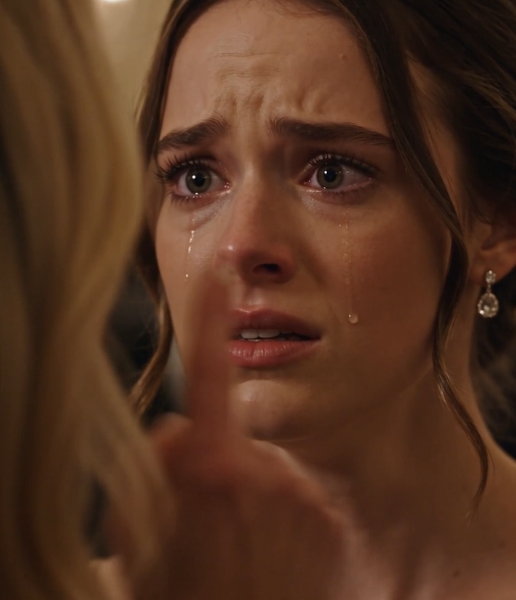
The Daughter at the Gala
CHAPTER TWO — The Woman in Black
Vanessa Whitmore had been waiting for this girl for six months, and she was going to enjoy it.
She turned Eleanor Hart round with a gentle, almost loving pressure, the way you turn a child to face the mirror, and she smiled. It was a lovely smile. It had taken years to perfect. Teeth, but not too many. Eyes, but not too wide. A smile that suggested great warmth, great breeding and a faint, indulgent amusement at the follies of lesser mortals.
She was thirty-eight years old, and she looked thirty. She wore a black halter dress that had cost eleven thousand pounds and that said, to anyone with eyes: I am the sort of woman who does not need to try. Her blonde hair fell in careful waves over one bare shoulder. At her ears hung a pair of pear-cut diamonds that Charles had given her on their third anniversary. In her right hand she held a flute of champagne, and she did not spill a drop.
“I don’t believe we’ve met,” she said.
The girl stared at her. She had very large, dark, startled eyes. She was a small, pretty, pale creature in a satin dress that was at least a size too big in the bust, and she held a little beaded clutch in front of her like a shield. Vanessa had known what she would look like, of course. There was a photograph in her desk drawer, one that the private investigator had taken from a hundred yards with a long lens, through the window of a Leeds corner shop. Dark hair. Narrow chin. A way of holding the head slightly to one side, as though she were always about to apologise.
She had her father’s eyes. That was the thing. Vanessa had sat in her study at midnight, staring at the photograph, and thought: those are his eyes.
“I’m Eleanor,” said the girl. Her voice shook. “Eleanor Hart. I— I was invited.”
“Were you?” Vanessa looked her up and down, slowly, lingeringly, from the satin hem to the cheap little earrings. “How thrilling. By whom?”
“By Mr. Whitmore.”
“Which one?” said Vanessa, brightly. “There are rather a lot of us.”
“Charles.” The girl swallowed. “Charles Whitmore. He sent me a card.”
It came out of her in a rush, and Vanessa heard, beneath the nervousness, something that she had not expected: a thread of quiet, desperate, stubborn dignity. It irritated her more than tears would have done.
Somewhere to her left a woman in lilac glanced over, curious. A man in a bow tie paused with a canapé halfway to his mouth. The ballroom, which was very good at noticing things, had begun to notice.
Good, thought Vanessa.
She leaned in until her lips were almost touching the girl’s ear, and when she spoke it was in a low, sweet, confiding murmur, like one friend sharing a secret with another.
“Sweetheart,” she said, “the staff entrance is around the back.”
The girl went white.
It was a pleasure to watch. It was like seeing a candle go out. The big dark eyes widened, and the pink drained from her cheeks, and for a moment she stood quite still with her mouth slightly open. Then, slowly, she shook her head.
“I’m not—” she began. “I’m not staff. I’m a guest. I have a card. I have—”
She fumbled in her clutch. Her fingers were shaking so badly that she dropped it, and bent to retrieve it, and came up with a small, stiff, cream-coloured rectangle held out in both hands like a communion wafer.
Vanessa did not look at it.
She knew what it said. She had seen it. A week ago, at half past nine on a Wednesday morning, she had walked into her husband’s study to ask him about the seating plan, and found a card lying face-up on his blotter, with a number written on it in his own bold hand. Table 14, Seat 1. The table beside his. The head of the table, she had thought, with a stab of disbelief. He is giving a stranger the head of the table. And on the back, in his handwriting: Please come.
She had picked it up. She had put it down again. She had gone very quietly to her own dressing room and sat on the stool in front of the mirror for ten minutes with her hands in her lap, breathing.
He had not told her.
In five years of marriage, in the whole of their long, careful, elegant, perfectly managed life together, Charles Whitmore had never once kept a secret from her. Or she had thought so. She had thought that she was the one who kept the secrets, in this house, because she was the one who knew the cost of them. She had been very good at it. She had intercepted every one of the girl’s letters at the foundation office, and the one that had come to the house in March, with the photograph of the dead woman, and the careful sloping signature. She had read them at her dressing table, with the door locked. She had learned them. She had burned the first two in the grate of the fireplace in the drawing room. The third she had not been able to bring herself to burn, and it still sat at the bottom of her jewellery case, folded small, under a pair of cufflinks.
Dear Mr. Whitmore. You don’t know me. But I believe you knew my mother.
And all the while, behind her back, in her own house, the old fool had been writing to the girl.
“May I see?” said Vanessa, and took the card out of the trembling fingers.
She held it up between two manicured nails. She turned it over. She read it with exaggerated attention, her lips moving silently, and then she looked up at the crowd that had begun to gather in a loose ring around them, an attentive circle of tuxedos and sequins, and she laughed. It was a clear, light, ringing laugh. It carried.
“Oh, darling,” she said. “I’m so sorry. This is a forgery.”
“It isn’t—”
“It’s rather a good one. But Charles never writes his t‘s like that.” She let the card fall. It fluttered to the carpet and lay face-down at the girl’s feet. “I’m afraid you’ve been rather badly misled. This isn’t a charity bake sale. It’s a private event. There are four hundred guests here, each of whom has been vetted by my office, and I’m quite certain that I would remember if your name had been on the list.”
“Please.” The girl’s voice broke. A tear spilled down her cheek, and she did not wipe it. “I’m not here for money. I never asked for money. I only wanted to see him. Just once. That’s all.”
“They always say that.”
“I’m not—”
“They always say that.” Vanessa lifted one finger and jabbed it, once, sharply, into the air an inch from the girl’s face. “Do you know how many people have written to this foundation in the past six months, claiming to be somebody’s long-lost relation? Do you know how many sad little stories we’ve had? A cousin. A half-brother. A son, last year. He had a very moving letter. He was a convicted fraudster.” She smiled. “You people are so tiresome. You read about a rich man in the newspaper, and you think: there’s a door. I’ll knock.”
“I have a letter,” said Eleanor Hart.
She said it very low. Her whole face was wet now. Her eyes were red and swollen, and her hair had come loose from its pins, and she looked about twelve years old. But she did not look away. And Vanessa, who had expected her to crumble, saw instead that the girl’s chin had come up, and that her small shaking hands had closed into fists.
“I have a letter,” she said again. “He invited me. He wrote it himself.”
“Charles,” said Vanessa, through her teeth, in a voice so low that only the girl could hear, “has never invited anyone he hasn’t met.”
But that was a lie, and they both knew it.
Something hot rose in Vanessa’s chest. It rose from the pit of her stomach and spread through her ribs and up into her throat, and it was not anger, or not only anger. It was a thing she had been carrying for five years, packed down tight beneath the silk and the diamonds and the careful smiles: a cold black coil of fear. He has had a daughter for twenty-four years. And he has never once mentioned her. She had built her whole life on the careful assumption of an empty nursery. She had given up a career for it. She had sat through eleven rounds of failed treatment for it. She had signed a prenuptial agreement, in a room full of solicitors, that granted her a generous settlement and nothing more if there were ever a rival claimant to the Whitmore estate.
She had never feared another woman. She had never feared the clever ones, or the beautiful ones, or the younger ones.
She had never imagined that she would have to fear a child.
“You,” said Vanessa, very softly, “are going to leave this room.”
“No.”
“You are going to turn round, and walk out, and never come back. And if I see you in this city again—”
“I’m not afraid of you.”
The girl said it in a small clear steady voice, with the tears still running down her face, and something in Vanessa Whitmore snapped.
She could not have said, afterwards, what she meant to do. She had never in her life struck another person. She had been brought up by a mother who believed that a lady expressed her displeasure through carefully chosen silence. But the champagne flute was in her left hand now, and her right hand was rising, rising, in a long, slow, shaking arc, with the diamonds flashing at her wrist and the crowd drawing in a single sharp breath around her, and she heard, from somewhere, someone gasp her name.
And a hand closed round her wrist, from behind, like a band of iron.









