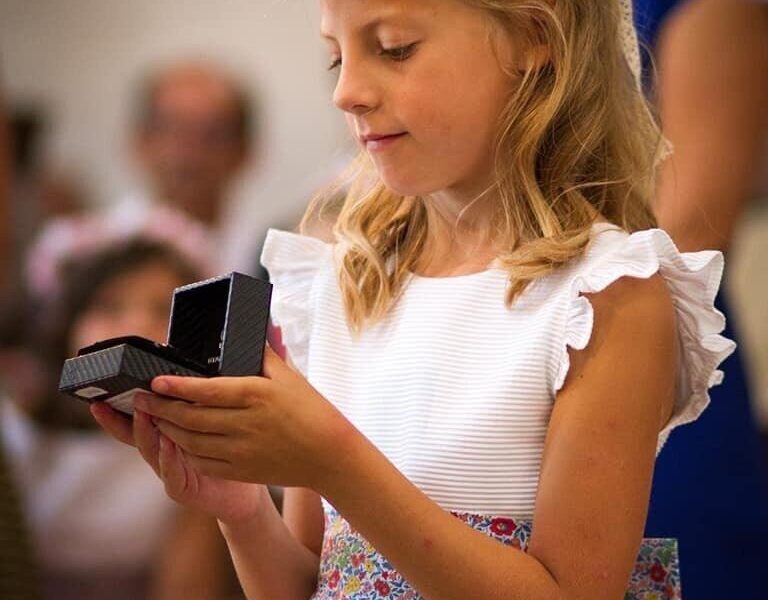
The Ring Box
CHAPTER TWO — The Wrong Ring
There are moments in a life that divide it, cleanly and permanently, into before and after.
Isabelle Hartwell would later think that she had known this one was coming. Not the details, not the shape of it, but the weight, the way you know a storm is coming from a change in the pressure of the air. All morning she had felt it: a tightness behind her ribs, a faint, high singing in her ears. She had put it down to nerves. Brides are supposed to have nerves.
But she had thought, standing at the top of the aisle with the crowd turning towards her and the string quartet swelling into the opening bars of Pachelbel, Dad should be here.
She had thought it a hundred times in the last two years, and every time the sentence arrived with the same small, familiar shock, as though she had stepped off a kerb she hadn’t known was there.
Edmund Hartwell had built ships for forty years. He had built them with his own hands and his own temper and his own rough, tender, brilliant, impossible mind, and he had named every one of them after a woman he loved: Marguerite, Isabelle, Penelope, Poppy. He had wanted to walk his eldest daughter down this aisle more than he had ever wanted anything. He had told her so. He had told her, at twenty-two, with a glass of whisky in his hand, I’ll be there, Izzy. I’ll be there if I have to crawl.
He had died on a Tuesday afternoon in the second week of March, in his office at the shipyard, of a heart that his doctors had called strong as an ox a month earlier.
She had walked down the aisle alone.
It had been her own choice. Aunt Cordelia had offered, tearful and elegant in her mauve silk, and Uncle Thomas, and a dozen others. But Izzy had wanted it this way: just her, one foot after another, in her father’s pearl earrings, with the whole room rising to its feet. She had thought it would be unbearable. She had been surprised by the strange and gentle lightness of it. The pearls had been cool against her neck. And as she reached the end of the white carpet, with the roses and chandeliers swimming through her tears, she had seen Julian’s face, and the whole thing had suddenly felt less like a funeral and more like a homecoming.
I’m marrying him, she had thought. I’m actually doing it.
Julian Ashby had come into her life twenty months ago, at the worst moment of it. He had stood at the back of the church at her father’s funeral, tall and quiet and rather awkward in a dark coat that did not quite fit, and afterwards he had come up to her in the rain and said, in a low, serious voice, I’m so sorry. I was with him when he— I’m so sorry. He had been the head of the firm that had agreed to buy the shipyard in Edmund’s last week. He had every reason to be a cold, practical stranger. Instead he had held her father’s umbrella over her head, in the churchyard, for forty minutes, without saying another word.
He had saved the yard. That was the thing nobody else could say. When the board wanted to break the company up and sell it for parts, Julian had stood in the boardroom and refused. When four hundred jobs were on the line, Julian had personally guaranteed the payroll. He had come to her door with sandwiches. He had sat with her in her father’s study and listened, for hours, while she talked about the man she missed.
Somewhere in those months, without either of them noticing, the grief had turned into something else.
And now here he was, in a black tuxedo with a white rose in his lapel, looking at her as if she were the only person in the room, and she could not stop smiling.
“You look,” he murmured, as she reached the altar, “like every good thing that has ever happened to me.”
“Stop it,” she whispered back. “You’ll make me cry before the vows.”
“That’s the plan.”
He took her hand. His palm was warm and slightly damp. She noticed it, the way you notice a stray note in a piece of music, and then forgot.
The minister smiled at them and said a few words about love and patience and the strange, stubborn courage of two people choosing each other in front of the world. Izzy barely heard. She was looking at the little figure coming down the aisle towards them, in a dress the colour of the inside of a seashell, carrying a navy velvet box as if it contained the crown jewels.
Poppy.
Her baby sister. The best and bravest thing her father had ever made. Eight years old, and born so late in Edmund’s life that people had assumed she was Izzy’s own child, and Izzy had never once corrected them. When their stepmother Marguerite died of a fever, five years ago, it was Izzy who had learned how to plait a small girl’s hair. When their father followed, three years later, it was Izzy who had sat on the edge of a narrow bed in the dark and promised, I’m not going anywhere. I’m here. I’m always going to be here.
Poppy had been so quiet in the two years since. Thin and watchful and strangely dignified, with eyes too old for her face. She did not cry anymore. She did not ask questions. Izzy had begun to wonder, in the sleepless hours of the night, what kind of silence it was.
But today, in the blush-coloured tulle, with the chandeliers throwing glitter across her hair, Poppy was smiling. A real smile. The first real one in months.
Izzy felt her throat close.
“I didn’t drop it,” whispered Poppy, drawing level, lifting the box on both hands. “Not even once.”
“You were perfect, Poppy,” Izzy whispered, and she laughed and wiped her eye with the back of her glove. “Absolutely perfect.”
Beside her, Julian crouched to the girl’s height, with his white rose bobbing. “Best ring bearer in the history of weddings,” he said.
She loved him. In that moment she loved him so much that her ribs ached.
She reached out and lifted the lid of the box.
A small, soft, dark gleam of velvet. A pillow of white satin. And on the satin, instead of two bands of gold, something that did not belong.
It took her several seconds to understand what she was looking at.
It was a phone.
An old one, with a cracked top corner and a faded sticker of a sailing ship on the back. It lay face-up on the pillow, and as she stared, the screen woke up on its own, with a small chime that nobody else could possibly have heard. A soft red-and-blue glow rose up out of it, flushing her gloves, her wrists, the underside of her chin.
“Where are the rings?” she said, in an odd, high voice. “Poppy, sweetheart, where—”
She broke off.
The smile was still on her face. She could feel it, stiff and silly and left over, like something painted onto a wall. Her eyes had caught on the back of the phone: on the cracked corner, the faded sticker, the little scratch near the camera lens that she herself had put there when she was fifteen and had borrowed it to take a photograph of a seagull.
That’s Dad’s phone.
The thought was so enormous that it did not feel like a thought. It felt like a sound. It rang through her head like a bell struck underwater.
That’s Dad’s second phone. The one he said he lost. The one the police never found.
And on the screen, in clean white letters against the glowing field of red and blue, a line of text slowly appeared, as though somebody were typing it, patiently, from a great distance:
For Izzy. Play me at the altar.
The string quartet played on. Three hundred people breathed softly in the warm, rose-scented air. Somebody coughed. Somewhere a child laughed, and was shushed.
“It says,” Izzy whispered. She could hardly hear her own voice. “It says, play me at the altar.”
A sound broke the hush: a sharp, wet, strangled gasp, from somewhere in the front row. Izzy’s head jerked up.
In the first pew, in a mauve silk dress that matched her pearl-pink lipstick, sat her father’s sister. Aunt Cordelia. Elegant, silver-haired, immaculate Aunt Cordelia, who had run the shipyard’s accounts for thirty years and who had held Izzy’s hand at the funeral. Her hand was clamped over her mouth. Her eyes above it were enormous and fixed, not on Izzy, but on the glowing phone, and Izzy saw something there that she had never seen on that gentle, careful face.
It was not surprise.
It was terror.
“Oh, my God,” breathed Cordelia, through her fingers. “Oh, my God.”
The whole room had begun to murmur. Heads were turning. Chairs creaked. In the hush Izzy heard a hundred fragments: what is it— what’s wrong— is it a prank— is she all right? She felt dizzy. She turned to Julian, to share the impossible thing with him, to say look, look, it’s Dad’s, because he was the one person who would understand.
And Julian was not looking at the phone at all.
He was looking at her.
His face had gone strange. Not shocked, not confused, not curious. It was shut. The warm, open face of an hour ago had closed up like a door, and behind it she could see something moving: fast, tight, intensely focused, the way a man looks when he is doing sums in his head and the sums are bad. His knuckles had gone white where he gripped the edge of his jacket.
He didn’t say what is that. He didn’t say whose phone.
He leaned very slightly towards her, and in a voice so quiet that it was barely a breath, he said:
“Izzy. Don’t press play.”









