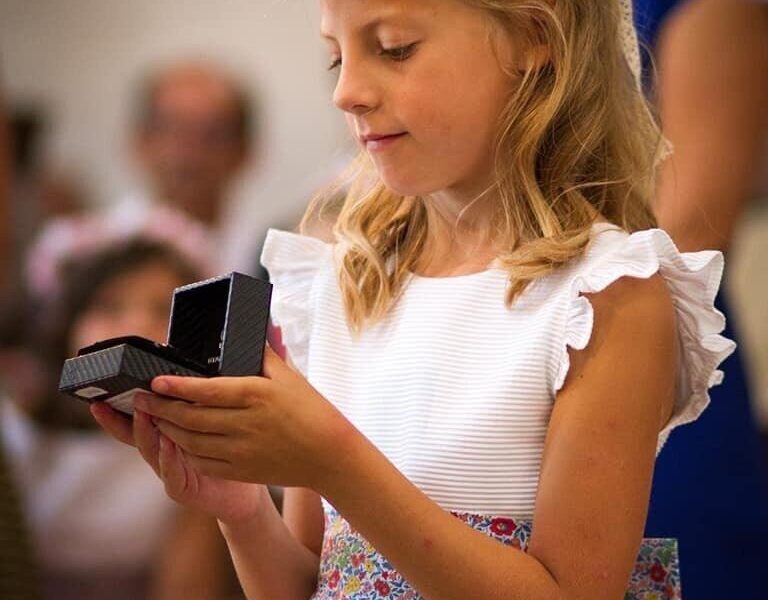
The Ring Box
CHAPTER SIX — Play
It is a strange fact about catastrophes that they rarely arrive with a noise.
There is no thunder. No crash. A great quiet falls instead, a silence so complete that you can hear a heartbeat in it, and you realise, a long moment too late, that the thing has already happened, and that it has been happening for some time.
Cordelia Hartwell Pryce stood in that silence, in her mauve silk and her mother’s pearls, and looked from Izzy’s face to Julian’s, from Julian’s to the child’s, from the child’s to the glowing phone on its white satin pillow. And Izzy watched her, with a sick, strange, slow-dawning clarity, make up her mind.
“This is absurd,” said Cordelia.
Her voice was perfectly calm. It was even faintly amused. She lifted her chin and looked out over the ballroom with the weary, kindly, indulgent air of a woman rescuing her family from a scene.
“Ladies and gentlemen, I am so sorry for this unfortunate interruption. My niece is under a great deal of strain. My brother was ill for a long time before he died, and in his last months he wrote some very unkind things about the people who loved him. It is a tragedy. It’s a symptom of the disease. I think we should all go in to the reception and give the family a moment.”
Nobody moved.
In the third row, somebody’s grandmother whispered, loud and clear and quavering, “But she hasn’t said it isn’t true.”
A murmur ran along the pews. A chair scraped. A small, hard, ugly sound began to gather in the air, the sound of a crowd beginning to understand.
Cordelia heard it. Izzy saw her hear it. And in that moment the silver mask slipped, just for one heartbeat, like a stage flat swaying in a draught, and Izzy glimpsed what lay behind it. It was not grief. It was not rage. It was only a bare, bright, hungry, frightened intelligence, calculating exits.
The aisle. The side doors. The three hundred guests.
Her eyes dropped to the ring box.
And Izzy, who had spent her whole life studying how ships were put together, who had learned from a man who could tell by the sound of a rivet whether a hull would hold, knew in the same instant what the woman was going to do.
“Poppy,” she said sharply. “Poppy!”
Cordelia moved.
She was quicker than anyone would have believed. One white-gloved hand lashed out at the box, going for the phone, the way a bird goes for a seed. Izzy flung up her arm. The velvet case tumbled, and for one long, terrible half-second the old cracked telephone hung in the air above the white carpet, turning over and over, its screen flashing red and blue, red and blue.
A small hand shot out and caught it.
It was a very small hand. It was the hand of an eight-year-old in a blush-coloured dress, and it closed around the phone with a grip like a vice, and with the other hand, in a single smooth movement that she had clearly practised a hundred times in a bedroom at night, Poppy Hartwell stepped backwards, out of reach, and tucked it against her chest.
“No,” said Poppy.
It was the quietest word in the room, and the loudest.
Cordelia froze, one gloved hand outstretched, her face a foot from the child’s. The two of them regarded each other across a gulf of forty years. Then the child said, in a small, clear, singing voice that carried to every corner of the vaulted ballroom:
“Daddy said you’d try to take it.”
A sound went through the room. It was not a gasp. It was something older and lower, a kind of groan, like a hull flexing in a heavy sea.
Cordelia’s hand dropped.
Poppy did not run. She turned, quite slowly, her blush skirts rustling, and held out the phone to her sister with both small hands, and a look of such grave, trusting, heart-stopping seriousness that Izzy felt something inside her rib cage give way.
“Daddy told me to carry it,” Poppy said. “He said not to tell. He said it would be heavy, but I’d be able to do it, because I’m the bravest of us.” Her voice wavered. “I didn’t tell, Izzy. Not even you. Not even once.”
Izzy took the phone.
It was warm from the child’s body. The screen lit up in her palm, and the white letters came again: For Izzy. Play me at the altar. And beneath them, newly risen, a single blue triangle, pulsing softly, patiently, like something with a heartbeat.
“Isabelle,” said Cordelia, in a different voice now, low and urgent and quick, “darling, please—”
Izzy pressed play.
There was a click. A rustle. The soft buzz of a speaker coming to life.
Then the phone, in the hush of that enormous ballroom, in front of three hundred guests, in front of a minister and a quartet and a roomful of white roses, began to speak with the dry, gravelly, tired, tender voice of a dead man.
“Hello, Izzy.”
A stifled cry from somewhere in the room. Izzy did not hear it. She was looking at the screen, where, in the grainy, warm light of a desk lamp, a face had swum up out of the dark. Broad. Weatherbeaten. Heavy-browed. The thick white eyebrows and the creased, kind, tired eyes of a man who had spent forty years squinting into salt wind. He sat in the old leather chair in the study, with the brass globe over his shoulder, in his shirtsleeves, with a glass of whisky at his elbow and a sprig of grey hair standing up at the crown of his head, as it always did.
He looked, she thought, with a pang so sharp that it was almost a delight, exactly like himself.
“If this is playing,” said Edmund Hartwell, “then you are standing at an altar, and you are beautiful, and I am very sorry that I am not there. I hope you are wearing the pearls. I hope your sister is in pink. Pop, if you can hear me, you did splendidly.”
Beside her, very quietly, the little girl began to cry.
“I have a few things to say, and a short time to say them,” said the dead man on the screen. “First, to my sister Cordelia, who I suspect is in the front row.”
The whole room turned.
Cordelia stood in the aisle with her hands pressed flat against her skirts and her face quite white. She did not run. She did not scream. She stood there with her chin up, as straight as a rod, and Izzy saw that the pearl-pink mouth was moving, though no sound came out. It might have been a prayer. It might have been a curse.
“Cordelia,” said Edmund, “I loved you. I want that said first, and plainly. I loved you when you were seven, and you hid in the boatshed from the thunder. I loved you when Mother died. I would have given you every penny I own, if you’d asked. You did not need to steal it.”
A click. A crackle. And then, from somewhere in the speaker, a second voice, thin and tinny and unmistakable, a woman’s voice, trembling with fury:
“You can’t prove a thing, Edmund. The books are mine. Nine years. Nine years I’ve kept them. Who do you think the auditors trust? Who do you think the bank trusts? Not you. Not your temper, and your drinking, and your sentimental old yard. They’ll say you’re a sick old man who lost his mind. They’ll say you’re making accusations because you can’t bear the thought of retirement—”
The tape stopped. Edmund’s face came back, grave and sad.
“That was Monday evening,” he said. “In my study. I had the recorder running in the globe. I am not proud of it. But I am a shipbuilder, Izzy. I check a hull before I trust it to the sea.”
A ripple went round the ballroom. Then a sob, a long sharp inhalation, a sound of dismay from three hundred throats. Cordelia gave a small, strangled cry and put out a hand, as though she could stop the sound with her palm.
Then she turned, and she ran.
She ran like a girl, silk skirts bunched in both fists, her silver hair flying, her heels hammering on the marble. She ran straight up the white carpet towards the great double doors at the back of the ballroom, past the open-mouthed guests, past the toppled chairs, past a waiter with a tray of champagne. She was fast. She was nearly there. She had almost reached the handle, when the doors swung open from the other side and Theo Ashby, who had slipped out of the second row at the first words of the recording, stepped through them with his arms spread wide and two large, silent, black-suited security men at his back.
Cordelia stopped dead.
Slowly, as if turning in her sleep, she lifted her face. And Izzy, watching from the altar, heard the soft, collective, appalled sigh of a roomful of people watching a woman of sixty-two lose, in a single breath, every single thing she had ever pretended to be.
Behind her, on the phone in Izzy’s hand, her brother was still speaking.
“Izzy,” said Edmund, “there is one last thing, and it is the hardest. I’ve saved it till now, because I want you to hear it while you are holding the hand of the man in question.”
Her breath caught.
“Julian Ashby is not the man who hurt me,” said the old man on the screen. “I want that understood. But I think he may have done something he’s ashamed of, if I know my sister, and if I know what she will have said to him. I think he waited when he should have acted. I think it has been eating him alive.”
Julian made a small broken sound.
“Forgive him, if you can. But before you do, Izzy—ask him about the four minutes.”
The phone fell silent.
Izzy slowly, slowly turned her head.
Julian stood beside her with his hands at his sides, and tears running down his face, and he did not look away. He looked at her with open, naked, unguarded grief. He did not say a word. He did not need to.
“Four minutes,” said Izzy.
She had heard it earlier, on his lips: I did nothing for four minutes. She had not understood. She understood now. A long, slow, cold understanding came over her, from her scalp to her heels, like water rising in a hold.
She understood that there was still a piece of the puzzle missing, and that the man she was about to marry was the only one who held it.
She understood that her father had planned everything with such cold precision, such stubborn, loving cruelty, that there could not possibly be only one message.
And as she thought it, in her hand, the screen of the old phone flickered. The video blinked out. The blue triangle faded. In its place, in white letters on black, a new line of text rose slowly out of the dark, and beneath it a small digital clock began to tick.
Message 2 of 2. For the man who lied.
Unlocking in 00:59… 00:58… 00:57…
Poppy, still sniffling, tugged at Izzy’s lace sleeve. She looked up with enormous wet eyes, and she said in a hoarse, hushed, solemn little whisper that went through the silent room like a knife:
“Daddy said this one’s for Julian. And Daddy said…” She gulped. “Daddy said, when it’s over, you’ll know whether to say yes.”
The numbers kept falling.
Julian stared at the screen. His lips had gone the colour of ash. Across the vast white room, three hundred silent faces turned, as one, towards the altar, and in the front row a seat was empty, and at the back doors a silver-haired woman stood trapped between two guards, with her hands over her face.
00:31… 00:30… 00:29…
To be continued in Part 2 — follow my profile. 👇









