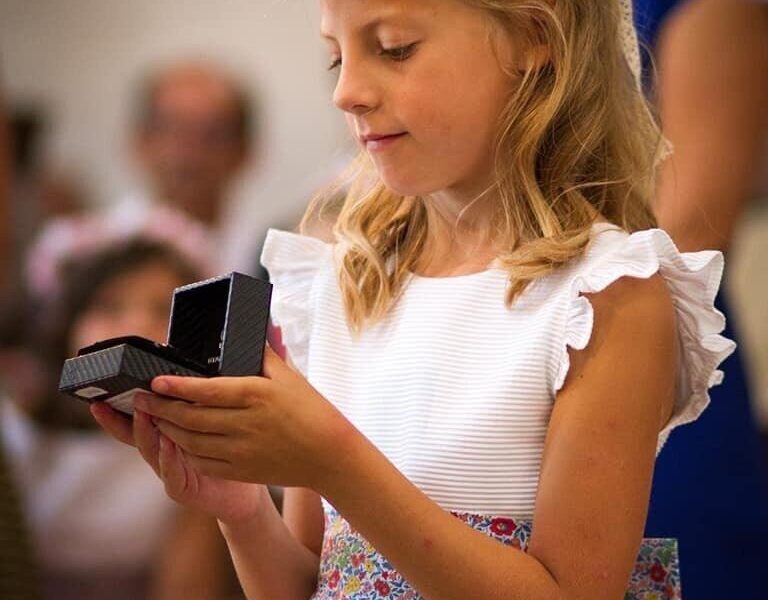
The Ring Box
CHAPTER FIVE — The Seal
It was only an envelope.
That was what Izzy kept telling herself, in the long, slow, stretched-out second after Julian held it out. It was a plain, heavy, cream-coloured envelope, a little crumpled at one corner, a little yellowed at the edges, of the kind that her father had bought by the box from a stationer on Fenchurch Street for the past forty years. She had licked a hundred of its brothers in her childhood. She had addressed Christmas cards on its siblings at the kitchen table, with her tongue between her teeth, while the old man leaned over her shoulder and said, Slower, Izzy. Slower. A good hand is never in a hurry.
She knew the paper. She knew the weight of it.
And she knew the seal.
It sat in the centre of the flap, a fat round blob of deep blue wax, pressed with a brass stamp into a small, crisp, perfect design: an anchor, with a letter H wound through its flukes like a rope. The Hartwell crest. Her father’s signet ring had made it, the great square thing that he wore on his right hand and that had been buried with him, and no one else on earth had ever possessed another.
It was unbroken.
“That’s his seal,” Izzy whispered.
She was surprised at the sound of her own voice. It was far away and small. It might have belonged to a girl of nine, standing at a study door, watching her father at his desk in the lamplight.
“He gave it to me the night he died,” said Julian. “Quarter past eight. He told me to hold it, and to give it to you on your wedding day. I put it in my jacket, and I didn’t think about it again until—” He drew a ragged breath. “I have not opened it, Izzy. I swear that on anything you want. It’s been in my safe, my desk, my car. I’ve never so much as lifted the flap.”
“Twenty months,” said Izzy.
“Twenty months.”
“My wedding day.”
“Yes.”
“You knew it was for today.”
“I knew it was for someday,” said Julian miserably. “And then I fell in love with you, and every day that passed it got harder to hand it over, because I was so afraid—” He stopped, and his voice dropped to a whisper. “I was so afraid it would end us. I’m sorry. I’m so sorry. I’m the worst kind of coward there is. The kind who thinks he’s being kind.”
The envelope trembled in his hands. She saw that he was not offering it so much as surrendering it, with his arms stretched out and his palms upturned, the way a man hands over a weapon.
She turned it over.
On the front, in blue-black ink, in the tall, narrow, slanting, impatient hand that she would have known anywhere, that she had seen scrawled across a thousand birthday cards and shipyard memos and apologetic notes left on kitchen tables, were seven words.
Izzy — read me before you say yes.
The ballroom went away.
It did not fade. It simply stopped, with no more sound or consequence than a dropped curtain, and the whole bright, enormous, glittering room, with its crystal and its three hundred faces and its drifting scent of roses, was gone, and there was only the paper in her hand and a voice she had not heard in two years.
A good hand is never in a hurry.
Her vision swam. She blinked, and a tear fell, hot and quick, and made a small round dark mark on the cream.
“Isabelle.”
The voice came from very near, and it was no longer warm.
Cordelia had left the aisle. She had walked the eight paces up the white carpet in complete silence, with her mauve silk whispering round her ankles, and she stood now at Izzy’s elbow, a tall slim shape in the corner of her eye. A faint scent of lily of the valley drifted from her. Izzy had loved that scent all her life. It was the smell of her aunt’s kitchen, of Sunday afternoons, of a hand on her hair.
“Give me that,” said Cordelia.
It was not a request.
“Isabelle, listen to your aunt. Whatever that man has told you, whatever he’s dug up, you are standing in front of three hundred people, and you are not yourself. Your father was a sick old man at the end. He wrote all sorts of foolish things. Give me that paper, and we will go and read it together, in private, as a family—”
A white-gloved hand, long and elegant, closed on Izzy’s wrist.
It was a very strong hand.
“No,” said Izzy.
She tried to pull away. The fingers tightened. For one mad second she and her aunt stood locked together at the altar, a bride and a woman in mauve silk, tugging a piece of paper between them like children over a toy, while the guests looked on in stunned horror and somebody’s phone began to ring and was hastily silenced.
“Isabelle. Let go.”
“Let go of her, Cordelia,” said Julian.
He had not raised his voice. He had stepped forward, quite slowly, until his shoulder was between the two women, and he laid one hand lightly, very lightly, on the silver-haired woman’s wrist. There was nothing threatening in it. But Cordelia looked down at that hand, and then up at his face, and Izzy saw something pass between them, a flash, quick and cold and utterly private, like a lamp swung across a dark room. It lasted perhaps half a second. In it, Izzy saw two people who had been circling each other in silence for twenty months.
Cordelia’s fingers opened.
She stepped back. She smoothed her skirts with both hands. She even smiled, a faint, hard, glittering smile that did not reach her eyes.
“Very well,” she said lightly. “Read it. Humour him. But when you’ve done, darling, you’ll remember that I was the one who sat by your father’s bed.”
“You weren’t there,” said Izzy slowly. “He died at the yard. You told me—”
She stopped.
A small, cool, clear thought had slipped into her head, like a coin into a slot. If he died at nine-fifteen at night, why did she tell me he was alone? And if he was alone, why was Cordelia Pryce, who lived forty minutes away, in his office with a tray of tea?
She had not even known that Cordelia had been there. Julian had not said so. She had not said so.
The thought was so quiet that nobody else could have heard it. But the woman in the mauve dress went white.
It was only for an instant: a flicker beneath the powder, a tightening of the nostrils. And then the face smoothed itself, and the pearl-pink mouth said, in its warm, patient, perfect voice: “Darling, what are you talking about?”
But Izzy was already breaking the seal.
She did it with her thumbnail, in one clean movement, before she could stop to think. The blue wax cracked across the middle of the anchor with a small dry snap like a snapped twig, and fell in two crumbling halves to the white carpet, and a faint, forgotten smell drifted up from the open flap: pipe tobacco, and machine oil, and the cedarwood of her father’s desk.
She closed her eyes.
Then she opened them, and drew out a single sheet of cream paper folded in three, and unfolded it with fingers that no longer felt like her own.
The handwriting rushed up at her out of the page like a face out of water.
My dear Izzy,
If you are reading this, then two things are true. The first is that I am dead, and I am sorry for it, because I wanted so badly to see you in white. The second is that Julian Ashby has kept his word, and delivered this to you on the day you marry. Which means I was right about him.
Her lips parted.
Forgive him whatever he has done. He has done it out of kindness, or fear, which in a decent man look so much alike. I have known him for three months, and in forty years he is the only man who has ever wept at my kitchen table when I told him how many families depend on a shipyard.
A sound came out of Izzy that she did not recognise. Something between a sob and a laugh.
I am going to tell you something now that I should have told you years ago, and I do not have the nerve to say it to your face. I will hide behind paper instead. You know that Hartwell Marine has been losing money. You have been told it was the market, the steel prices, the new shipping rules. It was none of those. For nine years, my darling, someone has been taking money from the company. Eleven million pounds, so far as I can count. Not all at once. A little at a time, patiently, through accounts that I trusted, in a handwriting I know as well as my own.
Izzy read the line twice, three times. The words would not hold still.
I found out on Sunday. I confronted her on Monday. She wept, and begged, and swore it was for a debt, and that she would put it right. I gave her until the end of Tuesday to go to the board herself and confess. I did not want to ruin her. She is my sister, and she held our mother’s hand at the end.
The paper shook. The ballroom had gone absolutely silent: three hundred people holding their breath. At her elbow, Izzy could hear the slow, steady, soft rasp of someone breathing through her nose.
But I am an old man and not a fool. If I am dead by Wednesday morning, then I did not die of my heart, no matter what the doctors write. I have told Julian none of this, because I am not sure that I trust his courage yet, and I would not put it to the test with your life. I have told Poppy nothing, because she is a child.
But I have not been idle. I have left you a recording. It will find you on a day when you are happy and safe and surrounded by people. It will tell you who she is.
If you are reading this on your wedding day, my love, then my sister is sitting in the front row.
Izzy lifted her head.
She did it very slowly. She was aware of the chandeliers, each tiny hanging drop shivering in the warm air. She was aware of the roses and the minister and the silent, enormous, wide-eyed room. She was aware of her sister, a small blush-coloured figure at the edge of the carpet, standing absolutely still, with her hands folded behind her back and her chin raised, looking at her with eyes that were much too old.
She was aware of Julian. She was aware of the blood draining out of her own face, so that her lips felt cold, and her cheeks felt cold, and the pearls at her ears felt like drops of ice.
And she was aware, most of all, of the silver-haired woman in mauve silk who had held her hand at the grave, who had braided her hair, who had taught her to bake lemon cake, and who now stood at her side with her gloved hands folded and her pearl-pink mouth quite still, looking at the paper in her hand as a rabbit looks at the shadow of a hawk.
“Aunt Cordelia,” said Izzy.
Her voice did not break. It was thin and clear and terrible.
“Dad wrote me a letter.”









