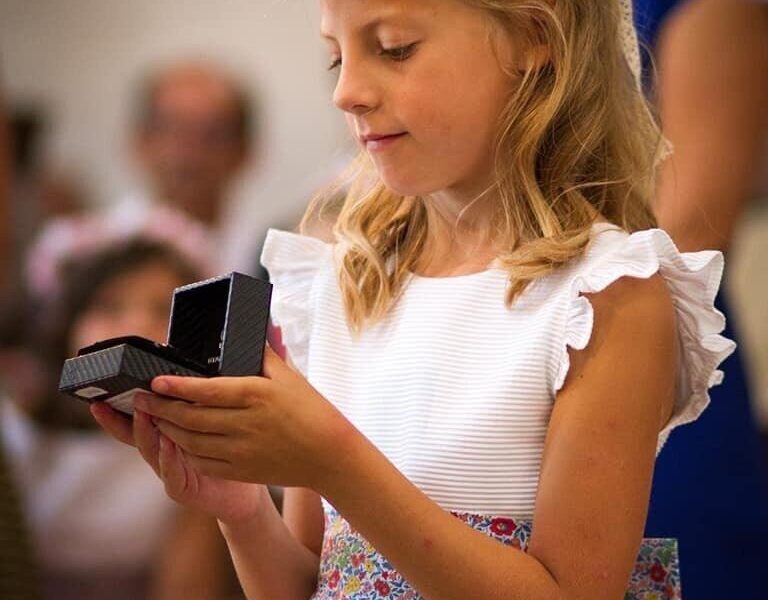
The Ring Box
CHAPTER FOUR — Don't Press Play
She did not move.
For a long moment Isabelle stood quite still with the ring box in her hands and the sentence ringing in her ears, and the whole elegant, flower-drenched ballroom seemed to slide away from her at a great speed, like a stage being pulled into the wings. She saw it all with an odd, glassy clarity. The ivory roses. The crystal drops of the chandeliers, trembling in a draught. The minister, a kind-faced man with a shock of white hair, gaping at the pair of them with his Bible half raised. The string quartet frozen mid-bow, a cellist staring at her bow as though it had betrayed her.
And Poppy, standing at the edge of the carpet in her blush tulle dress, with her small pale face turned up.
Izzy turned her head slowly. Julian’s eyes were close to hers, grey-green and bright and horribly, unmistakably afraid.
“Don’t press play?” she said.
Her voice sounded perfectly normal. That was the strangest thing. It was a quiet, level voice, the kind she used in boardrooms, the kind she had learned from her father. It carried across the silence like a coin dropped on a marble floor.
“Why on earth,” said Izzy, “would you say that?”
“Izzy—”
“You didn’t ask what it was. You didn’t ask whose phone. Everyone in this room is looking at this box and wondering what it is, Julian, and you looked at it and said don’t. As if you knew.”
“Please. Let me—”
“As if you knew.”
She heard her own voice rise a fraction on the last word, and she heard, in the front row, the sharp rustle of Aunt Cordelia rising to her feet.
“Isabelle, darling.” Cordelia’s voice was high, bright, perfectly pitched to carry. It had the slightly breathless warmth of a hostess attempting to smooth over a small disaster at dinner. “Darling, you mustn’t be upset. Someone is playing a very cruel joke on you. That’s all this is. Some dreadful, tasteless prank. Julian, take that thing away at once, will you? Take it away from her.”
Julian’s head snapped round.
He did not look at the phone. He did not look at Izzy. He looked at Cordelia, and Izzy saw something go across his face, a flicker, a tiny involuntary tightening around the mouth, that she would remember for a very long time. It was not the look of a man receiving help.
It was the look of a man who has just seen a knife in someone’s hand.
“No,” said Julian quietly.
“Julian, for heaven’s sake—”
“I said no, Cordelia.”
The name came out of him like a stone from a sling. A gasp passed through the guests, small and collective, a breath drawn through three hundred teeth. Izzy felt the hair on her arms stand up. In two years she had never heard Julian use that tone with her aunt. In two years he had called her Mrs. Pryce, with a faint, wary courtesy that Izzy had put down to shyness.
She looked from one to the other.
The silver-haired woman stood in the first pew in her mauve silk, with one manicured hand pressed flat against her breast, and her eyes on Julian’s face were like two small flat coins. All the warmth had gone out of them. In its place was a bright, hard, wary calculation that Izzy had never in her life seen there, and that made her suddenly, bone-deep cold.
What is going on?
The thought came with a lurch, like missing a step in the dark.
She turned back to her fiancé. His hand had gone to the lapel of his jacket, the left one, high on the chest, and his fingers had closed on it. He was holding himself like a man bracing against a wind.
“There’s something,” said Julian, and his voice cracked, “that I should have told you before today. Before I ever asked you to marry me. Before I ever—” He stopped. He swallowed. “I was going to tell you tonight. I swear to God I was. I had it all written down. I thought if I could just get you alone, get you somewhere quiet—”
“Told me what?”
“Izzy, I—”
“Told me what, Julian?”
A sound, from somewhere to her left. A small, cracked, hiccuping breath. She glanced round and saw that the minister had lowered his Bible entirely and was staring at the carpet with the look of a man wishing very hard to be a hundred miles away. Beyond him, in the second row, Julian’s brother Theo, the best man, had half risen, his hands spread in a wordless question. Three hundred guests had gone absolutely rigid, every one of them holding the same breath.
Somewhere at the back a baby began to wail, thin and lost.
Izzy was shaking now. She could feel it beginning in her knees, in the lace of her sleeves, in the crystal-heavy bodice against her ribs. Not fear, not yet. Something colder, something that came before fear: the plain, stunned recognition of a floor giving way.
“Twenty months,” she said. “Twenty months ago you stood in the rain and held an umbrella over my head for forty minutes.”
“I know.”
“You sat with me in his study. You held my hand at the grave.”
“I know. I know.” His eyes were wet. “And every single minute of it, Izzy, was real. I need you to believe that. Whatever you hear, whatever you think of me afterwards. I never lied to you about how I feel.”
“But you lied about something.”
He closed his eyes.
It was the most terrible thing she had ever seen: a strong, grown man in a tuxedo, flinching at a single sentence, like a boy waiting for a slap. Then he opened them again, and there was a kind of broken steadiness in them, as though some great load he had been holding for so long that he had forgotten its weight had suddenly been set down.
“I was in the room,” he said.
The silence thickened.
“The night your father died. I wasn’t just a man who was in the building. I was in the room with him when he collapsed. We’d been working on the contract for hours. He was fine. He was fine, Izzy, he was joking about the legal fees. And then he wasn’t.”
“They told me it happened in the afternoon.” Her voice had gone thin. “They said four-fifty. They told me he was alone.”
“It was nine-fifteen at night,” said Julian. “And he wasn’t alone.”
Far off, in the quiet, one single, delicate crystal tinkled in a chandelier, like a tiny bell.
Izzy felt something shift under her feet. A small, slow, enormous movement, like the hull of a ship leaving its slip. Everything she had ever believed about the last night of her father’s life, every comfort she had made out of it, at least he went quickly, at least he never knew, began to slide away down some long dark slope.
“Julian,” she said. “What did you do?”
“I did nothing.” It came out a ragged whisper. “That’s the whole of it. That’s what I’ve been carrying. I did nothing, Izzy, for four minutes, when I should have done something, and—”
“Isabelle.”
Cordelia’s voice, again, sharp as a bell. She had stepped out into the aisle, a slim silvery figure in the aisle’s white light, one hand lifted. “Isabelle, darling, you are overwrought. He is saying things in his panic. You must not listen to him. Come with me. Come, now. We’ll go somewhere quiet and—”
“Stay where you are, Aunt Cordelia.”
Izzy had not meant to say it. It had come out of her mouth quite on its own, calm and flat, in her father’s voice. The silver-haired woman halted as though she had walked into glass.
Izzy did not look at her. She was looking at Julian’s hand.
It had slipped inside his jacket. Slowly, with the careful reluctance of someone drawing a splinter, he was reaching into the left breast pocket, the pocket that had been hand-sewn last Thursday, the pocket that had sat so stiffly and strangely against his ribs all through the ceremony. His fingers were trembling so badly that she could see them shake.
“Izzy,” he whispered. “I’m so sorry. I was supposed to give you this two years ago.”
And in the hush of the great white ballroom, with the chandeliers glittering overhead like a thousand held breaths, he drew out something flat and pale and rectangular, and slowly, as though it weighed a hundred pounds, held it out to her in both hands.









