A Storm Knocked Down the Biggest Tree During the Worst Drought — What It Revealed Changed Everything
The Price of Water
The first rain came on the eleventh of October.
It fell on a Sunday afternoon, and it fell for eleven hours. When it stopped, the drought had broken on its one hundred and fourth day. Florinda, Nolan, and Opal stood in the cabin door and watched the water pooling in the cracked earth beyond the green zone, wetting the bones of the grass everyone had thought was dead. The spring kept running, three and a half gallons a minute, indifferent to the rain, as deep springs mostly are.
By December, Florinda had a hundred and twenty-seven dollars in the tin on the high shelf. Ten cents a bucket had added up. Yarbrough himself had paid three dollars and forty cents by the end of September, carrying the coins up the track himself, laying them on the cabin threshold without a word, and walking back down.
Florinda counted the money each night and marked it in the oilcloth log the same way she marked every other customer. She did not mention it to the children, because there was nothing to mention. A debt paid is a door closed. You do not stand at a closed door and talk about what used to be on the other side.
In January, Florinda rode the stage to Jefferson City with Ransom’s homestead paperwork and Grandmother Ione’s notebook in a flour sack on her lap, and Nolan’s hand securely in hers. The clerk at the land office read the file, read the oilcloth log, asked two questions, and signed the patent on the spot.
Forty acres. Florinda Crenshaw. Her name. Her signature.
The land was hers the way her hands were hers. The way her children were hers. Not because someone had generously given them to her, but because she had fought for them, bled for them, and earned them. And everyone who mattered knew it. The clerk let Nolan press the heavy county seal onto the hot wax himself. It was a small thing, but Nolan would remember it for seventy years. He would remember the weight of the seal in his hand, the heat of the wax, and the sound it made when the metal pressed in. A soft, firm sound. The sound of something finally being finished.
In the spring after the drought, Cordelia Whittaker walked up the track to Florinda’s cabin with a shawl she had knitted over the winter—cream-colored wool with a beautiful cable pattern at the border. She stood on the threshold and held it out, and did not come inside.
“Florinda. I am not asking forgiveness because I do not deserve it. I just want you to know that I am deeply ashamed.”
Florinda looked at the shawl. She looked at Cordelia. She looked at the deep lines on Cordelia’s face and the way the older woman was holding the shawl with both hands, offering it the way you offer something when you know the offering might be refused, and you have already decided to accept the refusal without argument.
“Come in, Cordelia.”
They sat beside the spring basin in the morning sun and drank water from tin cups and did not say much. The silence between them was not the kind Nolan had taught Florinda about—the silence that is full. It was a different kind. It was the silence of two women who have been through something separately that they should have gone through together, and who are sitting in the same place now not because everything is magically repaired, but because the sitting is the beginning of the repair.
When Cordelia stood to leave, Florinda said, “Cordelia. You were frightened. Everyone was frightened. What matters is that you are here now.”
Cordelia cried on the walk home. By summer, she was helping Florinda sell water to the farms west of the ridge, keeping a ledger of her own, collecting dimes in a coffee tin, arriving each morning with a fierce determination that had something penitent in it, and something tremendously proud.
Seven of Florinda’s neighbors bought back the farms Yarbrough had purchased cheap the previous summer. Florinda lent each of them the down payment from her water money, at the exact same plain interest the First Bank of Mills Creek would have charged. Not one of them was ever late.
Yarbrough did not lose his farm in the first year. His speculation business collapsed in the second year. Too many predatory loans extended against land that was no longer worth what he had paid for it. He and Lovisa, the baby, and Nerissa moved in disgrace to St. Louis. He sent Florinda a letter the Christmas after the move. Three lines on plain paper. No letterhead, no gold embossing.
Mrs. Crenshaw. Our son is doing well. My wife sends her regards. I am not the man I was that July, and I owe you the life of my child. — Burly Yarbrough.
Florinda put the letter in the front of Grandmother Ione’s notebook, between the leather cover and the first page. She never showed it to anyone. She read it twice a year for the rest of her life—once at Christmas when it arrived in memory, and once in July when the anniversary of the storm came around. Each time she read it, she thought the same thing: That three lines from a man who had tried to take everything from her weighed vastly more than three hundred pages from a man who had never tried at all. Because the weight of words is not in how many there are, but in what it cost the person to write them.
In the fifth year after the drought, Florinda stood at the Mills Creek Grange on a chilly February evening and was asked to say a few words about her famous hillside.
She had not expected to be asked. She wore a new wool dress. Opal had braided her hair beautifully. She had not prepared a speech because she did not know she was the kind of woman who gave speeches. The discovery that she was happened at the same time as the speech itself, which is how most true discoveries work.
“The biggest tree in a dry land is drinking from somewhere deep,” she said, her voice carrying over the crowd. “That is what my grandmother taught me in Tennessee when I was a little girl. The tree is not the problem. The tree is the map. Look for the tallest, the oldest, the greenest tree on a hillside where nothing else grows, and I can promise you that tree has its roots in water you cannot see. And what that tree is drinking, you can drink, too. If you know how to ask the land.”
She paused. The large room was pin-drop quiet. Forty people. Farmers, their wives, the reverend, the storekeeper. People who had watched her from a safe distance for five years and were now hearing her voice for the first time in a room where she was not asking for anything, and not defending anything, but simply saying what she knew to be true.
“And the second thing I would say is this,” Florinda continued. “What people call worthless is often only hidden. You do not always have to build a thing. Sometimes you have to uncover it. Sometimes the ground will open itself to you, and all that you are asked to do is have the wit to notice.”
The Grange printed both sentences in the newsletter that spring. By autumn, they had traveled to the granges of four adjoining counties. By the tenth year after the drought, men Florinda had never met in Arkansas and Kentucky were quoting them as old country wisdom, passed down from generation to generation.
And Florinda, when she heard this, did not correct anyone. She did not need to. The words had done what words do when they are true. They had let go of the person who said them and become the property of everyone who needed to hear them.
Nolan was thirteen the year of the Grange talk. By eighteen, he was teaching younger farmers how to read a hillside for water. How to watch where the green stays green when everything else goes brown. How to listen to the land the way his grandmother had listened, and his mother had listened, and he had learned to listen on a night when he was eight years old and working by moonlight with bleeding hands.
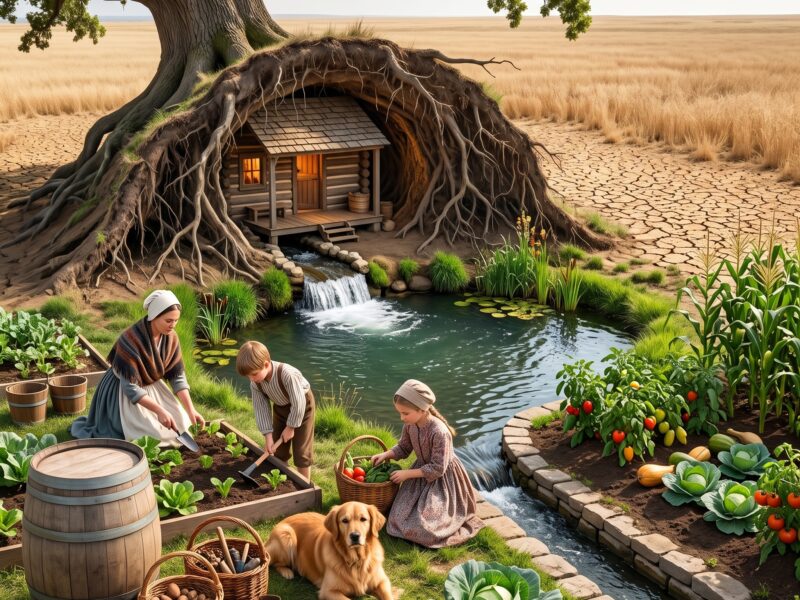
Opal was fifteen the year she became engaged to Garfield Vandiver from the neighboring hollow. The two of them built their first cabin on the adjoining slope on exactly the pattern of Florinda’s. The back wall was the upturned root ball of a storm-felled elm. There was a small spring in the crater. A stone channel ran down to their garden. When their first daughter was born, they named her Ione.
Florinda held the baby on the porch of the new cabin and looked out at the two hillsides. Hers and Opal’s. The two channels running. The two green lines stitching themselves across the land. And she thought that this is what inheritance actually looks like when it works. Not money, not property, not paper in a clerk’s office. A way of seeing. A way of reading what the land is telling you. Passed from hand to hand like a tin cup of cold water.
Florinda never remarried. She did not want to. Ransom had been her husband. Grandmother Ione had been her teacher. Her children were her children. The oak on the hillside was her oak.
The cabin inside the root cavity stood for as long as Florinda did, which was another forty-one years. Velvet moss grew on the root wall. Ferns grew out of the earth, their fronds uncurling each spring from between the massive roots, delicate green against dark earth. By the end, the wall was indistinguishable from the hillside it had come out of. It had gone back to being the ground. The ground had taken it happily home.
When Florinda was a very old woman, she went to market in Mills Creek on a crisp September morning. The square was busy. There were wagons and horses and children running between the stalls, and the rich smell of apples and woodsmoke and new leather.
At the feed store, a young farmer was talking to the man beside him, leaning against the wooden counter with his hat pushed back, speaking in the easy, confident tone of a man sharing something he believes to be ancient and settled and beyond dispute.
“My daddy says the biggest tree in a dry land is drinking from somewhere deep.”
The young man did not know who she was. He did not look at her. She was just an old woman buying flour, and old women buying flour are invisible in feed stores. Which suited Florinda perfectly fine. Because she had never been interested in being seen. She had been interested in being useful, and those are not the same thing. The difference between them is the difference between a man who builds a grand monument to himself, and a woman who builds a stone channel that carries water to a garden that feeds her children.
“Where did your daddy learn that, son?” she asked, her voice like dry leaves. “Old country saying, ma’am. My daddy’s daddy used to say it.”
Florinda paid for her flour. She smiled at the young man. A small, private smile. The smile of a woman who knows something the entire room does not know, and has decided that this is exactly as it should be.
She walked out into the bright afternoon. She crossed the bustling square. She went home to her hillside, and to the oak, and to the spring, which was still running at three and a half gallons a minute. Which is the speed of patience. Which is the speed of the earth remembering what it promised.
She sat down on the threshold of the cabin. The wood was warm from the sun. The root wall behind her was cool and smelled of moss and deep stone. She could hear the spring. She could hear the channel. She could hear, faintly, a bird in the crown of a young sycamore that had grown up beside the fallen oak. A new tree drinking from the same water. A new cup on the same table.
She opened Grandmother Ione’s notebook. She turned to the last blank page—the page where she had written to Ione in the dark of day nine, the page where she had written to Ransom on the morning Nolan was hurt.
Below those entries, in a hand that was steady and spare and unhurried—the hand of a woman who had run out of time for decoration, and wanted only to get the truth down—she wrote one final line in graphite:
A grandmother in Tennessee, a tree in a storm, and a daughter who finally learned to read what was already there.
She closed the notebook. She set it on her lap. She looked out at the hillside, at the green line of the channel, at the sprawling garden, at the long, magnificent body of the oak returning slowly to the earth it came from. The sun was warm. The spring was running. The brass button was still in the pocket of her dress, over her heart, where it had been since the morning Nolan polished it and told her to take Papa with her.
She had taken him. She had taken all of them. Ione and Ransom and Nolan and Opal and Cordelia and even Yarbrough. Even the man who had tried to take everything. Because you cannot build a life without including the people who tried to tear it down. They are part of the architecture. They are the structural weight the walls were built to hold.
Florinda Crenshaw sat on the threshold of her cabin on her hillside in Missouri, and watched the afternoon light move across forty acres that belonged unequivocally to her. And the spring ran, and the channel carried, and the garden grew. And somewhere in Arkansas, a man she had never met was telling his son an old country saying that was not old, and was not country, and was not a saying at all.
It was a woman. It was a grandmother. It was a storm. It was a tin cup of water offered to a man who did not deserve it, at a price that was fair, on a hillside where the biggest tree had fallen and the water had come up to meet the sun









