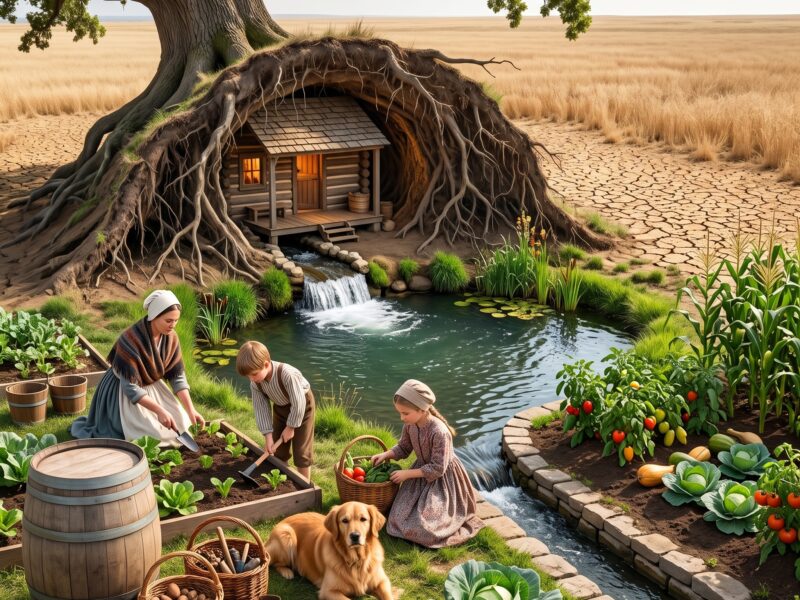
A Storm Knocked Down the Biggest Tree During the Worst Drought — What It Revealed Changed Everything
The Verdict of the Soil
He did not go home. He went to the farm he had been holding three miles east, the one with forty head of cattle and a sulfur creek that the cattle had stopped drinking from two weeks ago because the water had gone toxic in the heat.
His wife, Lovisa, and their three-month-old son had been living there with Nerissa, and the house had been getting quieter every day in the way that houses get quiet when the people inside them are running out of options and energy and hope. Ansel met him at the gate.
Seventeen cattle had lain down in the pasture that morning. Nine had not gotten back up. The rest stood in clusters in whatever pathetic shade they could find, their heads low, their sides working, breathing the way things breathe when breathing is the last effort they are willing to make.
Lovisa was on the porch with the baby in her arms. The baby’s tiny face was dangerously red. Its mouth was dry as paper. It had not passed water since sunrise. It was making a sound that was not crying exactly, but something smaller and much more frightening. A thin, reedy whimper that came and went. The sound of a tiny body that was trying to conserve what little it had left.
Yarbrough went into his kitchen. He sat at his table. He put his head in his hands.
Nerissa stood in the doorway and watched her son. She did not speak. She had said everything she had to say on the night Ansel brought his report about the green line on Florinda’s hillside, and the words had landed where they landed. Repeating them would not make them land any differently now.
He came at dusk.
He walked, because the sorrel could no longer carry a grown man two miles in this heat. He walked beside the buggy because the buggy horse could still pull the empty trap, but not a heavy man sitting in it. And Lovisa was on the buggy seat with the baby. The baby was breathing in shallow, rapid pulls, and it had not made any sound for an hour, and the terrifying silence was worse than the whimpering because at least the whimpering meant there was something left to spend.
Florinda saw them on the track from the cabin door. Two figures in the failing purple light. One walking beside a horse. One on the buggy seat holding a small shape tightly against her chest.
Nolan saw them a moment later. He stood up. His good hand went to the doorframe. “That is him, Mama.” “I see him, sugar.” “Do not open that door, Mama. He tried to take our home. He called you ignorant in front of everyone in the county. I was there. I heard what he said. Do not open that door for him.”
Opal came and stood between them. Five years old, the tin cup already in her hand because she was the one who carried water in this house, and she had understood before either of them what was happening on the track below. She had seen what Florinda had not yet named and what Nolan was refusing to name. A woman holding a baby who was not moving enough. A wealthy man walking because his horse could not carry him. The brutal arithmetic of what that meant.
“But, Mama,” Opal said, and her voice was small. “Mrs. Yarbrough is crying. And the baby is hot.”
Florinda stood in the doorway for a long second. She was not hesitating. She was not deciding. She was remembering.
She was remembering Ransom, who would have carried water to anyone. Who would have given the shirt off his back to a man who had stolen his horse, because Ransom believed that what you do for people who have wronged you says infinitely more about you than what you do for people who have not.
She was remembering Grandmother Ione in a Tennessee kitchen when Florinda was eleven. A man at the door who had cheated them on a land deal two years earlier, his hat in his hands asking for bread, and Ione reaching for the bread box and saying: Show them who you are, sugar. Not who they made you.
She was remembering the splint on Nolan’s arm. The tin cup in Opal’s hand. Eighty-seven days of drought. Thirty dollars resting on the pine table. A silver pen she did not touch.
Lovisa’s voice reached her from the dusty track, ragged, stripped of all pride and pretense. “Mrs. Crenshaw. My mother-in-law told me that someday I would need a woman like you to be kind to me. She was right. Please. The baby is very weak.”
Florinda walked down the hill.
Yarbrough was standing at the edge of the property line. His arrogant face was the color of ash. There was a day of beard on his jaw, and his collar was open, and his thick neck was sunburned and cracked. When he saw Florinda coming down the slope, he stopped walking. He put out a hand to the side of the buggy to steady himself, and his hand was shaking, and he did not try to hide it.
“Mrs. Crenshaw. I am asking five dollars a bucket. I do not care what you charge. Five dollars for my boy. For Lovisa. You can set any price you wish.”
Florinda walked past him without answering. She went to the channel. She knelt in the grass beside the last section—the twelve feet she had finished on the day Opal told her Papa would be proud. She dipped the cedar bucket into the rushing flow. The water was cold and perfectly clear.
She lifted the bucket, carried it up to the buggy, and passed it up to Lovisa.
“Wet a cloth and lay it on his face first. Not his mouth. Small sips after. His body will take the water faster if the skin learns it is coming.”
Lovisa took the bucket with both hands and began to weep so violently she could not hold it steady. Florinda reached up and held it for her. Standing on the dry ground beside the buggy wheel with her arms extended, holding the weight of the water and the weight of everything the water meant, while Lovisa tried to breathe.
Florinda untied her apron—the exact apron she had been wearing on the morning in July when Yarbrough set his pen on her table—and she tore a strip from the hem. She dipped it in the water, reached up, and laid it across the baby’s forehead herself. The cloth darkened with the water. The baby’s skin was hot enough that Florinda could feel the heat radiating through the wet fabric. She held the cloth in place and waited.
One minute. The baby’s translucent eyelids fluttered. Its mouth moved. Two minutes. Its eyes opened.
Florinda stepped back from the buggy. She turned to Yarbrough.
“Ten cents a bucket, Mr. Yarbrough. Same as everyone else who has come to this hillside in the last three weeks. Same price the widow Heenan pays who lost her husband in the spring. Same price Reverend Gilstrap pays for his wife’s garden. Same price for you.”
She met his eyes. She held them with the force of a branding iron.
“You do not owe me five dollars. I will not take ten cents today. Next week, every week for as long as the drought lasts, take as many buckets tonight as your buggy will carry.”
Yarbrough stared at her. His mouth opened. It closed. Something profound was happening behind his face. Something structural. A wall coming down. A heavy load being redistributed. The kind of internal rearrangement that happens when a man who has spent his whole life believing he understands the categories of people—the strong and the weak, the winners and the losers, the sensible and the ignorant—discovers that the categories are entirely false.
That the woman he filed three malicious petitions against is standing in front of him holding a bucket of life. She has no obligation to give him. Charging him the same price she charges everyone. Not less out of pity, and not more out of revenge. And he does not know which column to put that in, because he has never built a column for grace.
“I do not have ten cents with me today, Mrs. Crenshaw. I rode without my wallet.” “Then pay me Friday, Mr. Yarbrough. Take the buckets. Go home. Your wife needs to lay that child down somewhere cool before the sun finishes setting.”
He nodded. He could not speak. He took two buckets to the buggy himself, filling them at the channel with his own hands, kneeling on the wet stones in his charcoal coat with the dust on the hem. He carried two more when he walked back beside Lovisa in the failing light.
He did not look at Florinda until he reached the track. Then he turned once. He was not wearing a hat; he had come without one. He bowed his head. A slow, deep bow. The kind a man makes only in church before God. Florinda understood that this was the first honest thing she had ever seen Burly Yarbrough do. Not calculated. Not performed. Not weighed against what it would cost or what it would earn. Just a broken man bowing his head to a woman who had given him something he did not deserve, and had not charged him more for the not deserving.
Florinda went back up the hill.
Nolan was standing at the cabin door. His good hand was at his side. His splinted arm was held against his chest. His face was working—the muscles around his jaw and his eyes fighting each other, trying to decide whether what had just happened was something to be angry about, or something else. Something he did not have a name for yet.
“Mama, why did you help him?”
Florinda sat down on the cabin threshold. She pulled Nolan into her lap, splint and all, and she looked out at the oak, the long green body of it stretched across her land, and the channel running down from the root wall, and the green line of grass where the water ran to the garden in the last light.
“Because we are not the people he thought we were, Nolan. And I will not let his wickedness make us into them.” “Is that what Grandmother Ione meant?” “That is exactly what Grandmother Ione meant.”
Opal came and leaned against Florinda’s other side. Three of them in the doorway, watching the last light leave the hillside. The spring murmured below them. The garden was invisible now in the dusk, but they could smell it. The green, wet smell of things growing. The smell of corn and tomatoes and turned earth and cold water. And the smell was the smell of the next day, and the day after that, and all the days that followed. Which is what a future smells like when you have built it with your own bloody hands.
“Mama,” Opal said, almost asleep against Florinda’s arm. “Yes, sugar.” “Mrs. Yarbrough said, ‘God help us.’ Will God help them?”
Florinda put her cheek on the top of Opal’s head.
“God already did, baby. He sent a storm in July.”









