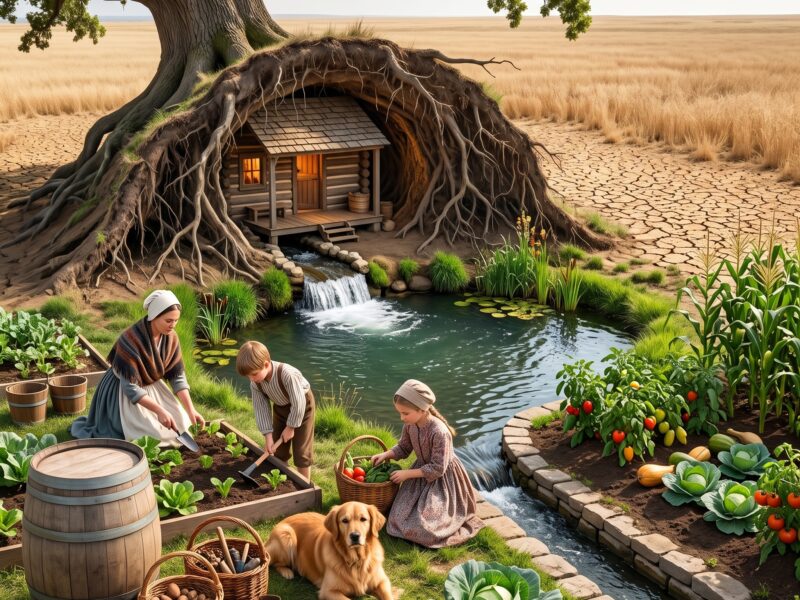
A Storm Knocked Down the Biggest Tree During the Worst Drought — What It Revealed Changed Everything
The Weight of Stones
Day fourteen. Opal found the green first.
She came running up the hillside with her cheeks flushed, her voice arriving ahead of her body. A small, vibrant figure against the dead brown landscape, shouting words that did not make sense until she was close enough to be heard.
“Mama! The dead grass is coming back!”
Florinda walked down. Along both sides of the stone channel, a thin, hesitant line of green had stitched itself into the baked brown earth. Four feet wide on each side, give or take, where moisture from the channel had wicked sideways through the soil. The dormant prairie grass had decided that spring had miraculously come again.
It is capillary action, Grandmother Ione had written in the notebook. The natural pull of moisture through loamy soil, three to six feet out from any constant water source. The soil wicks it sideways the way a lamp wick pulls oil upward.
It was just arithmetic. But watching Opal chase a dizzy grasshopper through that four-foot band of green—a grasshopper that had no business being alive on the eighty-seventh day of a historic drought—Florinda thought that arithmetic is also its own kind of miracle when the numbers finally come out right.
The next day, a rider appeared on the high ridge road. Not Yarbrough. A younger man, thick in the shoulders, hat pulled low over his eyes. Ansel Brashear. Yarbrough’s brutal foreman. The man who did the things Yarbrough did not want to be seen doing in daylight.
Ansel rode the boundary of the property slowly, his horse picking its way along the ridge. From up there, the fallen oak looked exactly like what it had looked like to Treadwell a week earlier: a hundred and twenty feet of useless ruin. The new cabin door faced south, deep inside the root cavity, which meant it was entirely invisible from the ridge road. The channel ran down the north-facing slope and could not be seen from above. The green line was four feet wide in a landscape where brown went to the horizon, but it was below the sightline.
He sat his horse for a long time. Then he turned and rode back east at an unhurried trot.
Florinda and the children did not move from the shadows of the root cavity until the sound of hooves was gone from the ridge. Then Florinda exhaled, and she realized she had been holding her breath for five minutes.
Day sixteen. The cabin was finished enough to sleep in. Florinda lit the small iron stove for the first time. The chimney pipe went straight up through the new cedar shake roof, and the draw was excellent. The massive earthen root wall behind the cabin acted as a cold mass, pulling the heat out of the air and the smoke up and out. The interior temperature at sunset was a perfect sixty-eight degrees. Outside, it was still ninety-four.
Nolan put his hand on the earthen root wall. “It feels like a cool hand,” he said in wonder. Opal put her hand on the same spot. “It smells like dirt and wet rope.” “Home is where there is butter,” Nolan said. “This is where there is wet rope. She is a goose, Mama.” “Your sister is right,” Florinda said softly. “It does smell like rope. But it is still home.”
Florinda listened to them bicker, lying on the straw-tick mattress she had dragged into the new cabin that afternoon. She stared at the underside of the cedar shake roof and listened to her children argue about nothing—about the smell of dirt and the definition of home. And she thought: This is the first time in two years I have heard my children fight the way children are supposed to fight. Not scared, not hungry, not worried about what comes next. Just disagreeing about whether a house smells like wet rope.
She fell asleep to the sound of it. She slept harder than she had slept in six months.
She should not have.
She woke sometime after midnight. Moonlight came through the small, south-facing window and laid a square of silver on the cabin floor. The children’s mattress was in the corner. Nolan’s shape was visible under the blanket, but the shape was wrong. It was too small. It was only Opal.
Florinda got up. She went to the door. She opened it and looked down the hillside in the pale moonlight, and she saw her son.
Nolan was at the channel. One hand held the flat cedar splint she had not yet needed to use on anything. The other hand was lifting stones. Small, flat ones, fitting them into the channel wall where gaps remained. He was working by moonlight. He was working with one hand because the other held the splint he was using as a lever. His movements were incredibly slow and deliberate—the movements of a boy who was trying very hard not to drop anything, because dropping something would make noise, and noise would wake his mother, and his mother would make him stop.
Florinda opened her mouth to call him in. She closed it. She watched him for five agonizing minutes. She watched him place seven stones. She watched him pause after each one, flex his aching hand, and then reach for the next.
She went back inside. She lay down. She did not sleep.
In the morning, she saw that the channel was three feet longer than she had left it the night before, and the stones were set with a precision she could not have matched herself. She looked at Nolan across the breakfast of cold cornbread and the last scraping of molasses. He looked back at her and then looked away quickly, the way a person looks away when they do not want to be thanked for something because the thanking would make their sacrifice smaller. She did not ask.
Two nights later, Opal padded out of bed at midnight looking for Florinda. She did not find her mother. She found her brother. She stood beside him in the wet channel in her nightdress and tugged his muddy sleeve.
“Nolan, your hand hurts.” “Mama is not sleeping enough, Opal. If I do extra at night, she can stop earlier tomorrow.”
Opal sat down beside him in the mud. She picked up the smallest stone she could find—the ones her five-year-old fingers could wrap around—and she placed them where Nolan pointed. They worked together in silence until the moon went behind the ridge.
Florinda found the heartbreaking evidence in the morning. Stones too small for her own hands, placed with the uneven care of a child who was doing her absolute best.
Day eighteen. Florinda woke before dawn and knew something was terribly wrong. You know something is wrong when a sound you have become accustomed to suddenly stops. She had grown used to the murmur of the spring, the quiet, constant voice of water moving over stone. And now the voice was thin. Barely there.
She went outside with the lantern. The channel was nearly dry. A pathetic trickle no wider than her palm wound through the stones and disappeared. The basin had dropped two inches below the rim. She knelt with the pocket watch in the bucket. Counted. One and a fifth gallons a minute. Less than half of what it had been on day twelve.
“Mama.” Nolan, standing in the doorway in his nightshirt, bare feet. Opal wrapped tightly around his leg, because where Nolan went, Opal was already going. “Go back to bed, sugar.” “What is wrong with the water?” “I do not know yet.”
He came down the hill. He should not have. The stones around the basin were slick with overnight dew, and his hand was already weakened from two nights of secret work, the tendons overused, the grip unreliable. He reached out to brace himself against the basin wall. His tired fingers could not hold. He dislodged a flat stone at the rim.
The stone did not fall far. Six inches. It fell directly onto his left forearm.
Nolan did not cry out. He made a small, compressed sound—the sound a creature makes when it has been hurt and does not want to attract the attention of anything larger.
Opal screamed.
That was how Florinda knew how bad it was. Opal was five years old, and she had been trained by drought and grief not to scream. She had learned that screaming brought nothing and cost energy. For Opal to scream meant that what she was seeing was vastly worse than what she had learned to endure.
Florinda was across the stones in two strides. She lifted the heavy fallen rock off the arm. The skin had split in a two-inch line. The bone beneath, when she pressed it carefully with her thumb, was cracked but not completely broken through. A horrifying bruise rose under the skin like something dark coming up from deep water.
She carried him up the hill herself, all sixty pounds of him, laid him on the straw mattress, and cleaned the wound with spring water. The water was cold enough to slow the swelling before it started. She tore a strip four inches wide from the hem of her only petticoat, split a flat piece of cedar shake for a splint, and wrapped the arm tightly from elbow to wrist.
Nolan did not make a sound the whole time. He did not weep until she was done. And then he wept quietly into her neck, the way a boy weeps when he is ashamed of the weeping and deeply grateful for the neck.
Florinda rocked him. She said nothing for a long time. Then she said very quietly into his dusty hair: “You have been working at night. I know. Your hand was already tired. That is why you slipped.”
Nolan went stiff against her.
“This is not your fault, baby. But it is not your job. You are eight years old. You are not supposed to save us. That is my work. Papa would have done it. Papa did do it every day for two years, and it was too much for him, too. The work did not kill him, but it took everything he had, and when the sickness came, there was nothing left.” She squeezed him tighter. “I will not let this land take you.”
She held him until he slept. Then she laid him down carefully, his splinted arm across his chest, and she went back to the dying basin.
The notebook gave her no immediate answers. Three entries on springs; none about flow dropping drastically after twelve days. She turned to the last page and wrote in the space below her earlier entry. Not to Ione this time. To Ransom.
Ransom, you should be here. Your son is doing your work, and it is breaking him slowly, and I do not know how much longer I can watch it happen.
Then she made herself think. The storm had disturbed the ground. The massive tree had torn free. That had opened the spring, but the violent storm had also churned fine silt into every underground passage the water traveled through. The initial flow had been the clean rush, the first explosive release. Now the silt was finding the narrower channels and beginning to clog them. The flow was not dying. It was being choked.
The fix was in the notebook after all, just not where she had looked. Two pages earlier, under a heading that read: For a well gone muddy. Ione had written: Lay a bed of pebble the size of a baby’s fist at the inlet, and the silt will catch there, and the water will learn to find its way through as through a sieve. A gravel filter. Not at the surface. At the inlet—the place where water actually entered the basin from below.
Day nineteen. Florinda emptied the basin stone by stone, bucketed out the muddy water, and by late afternoon found what she was looking for. Four inches below the original earth, a spot where water bubbled up through a visible funnel of choking clay. She reached her arm in past the elbow, cleared the silt with her bare fingers, and packed a six-inch bed of pea gravel she had collected from Mills Creek.
Day twenty. The flow returned. Three and a fifth gallons a minute. Day twenty-three. It stabilized at three and a half. Stronger than it had ever been.
Day twenty-four. Opal filled a tin cup at the channel, carried it up the hill with both hands, and held it out to Florinda, who was sitting in the open cabin door with Nolan asleep against her shoulder, his splinted arm resting on her lap.
“Papa would be proud, Mama.”
Florinda took the cup. She drank half of it. She set it on the threshold. She put her face into her free hand, the hand that was not holding her injured son, and she cried for ten minutes without making a single sound. The tears ran between her filthy fingers and fell on the threshold and dried instantly in the heat. And when they were gone, she stood up, laid Nolan down gently on the straw, kissed the top of Opal’s head, and walked back down the hill to finish the last twelve feet of channel.









