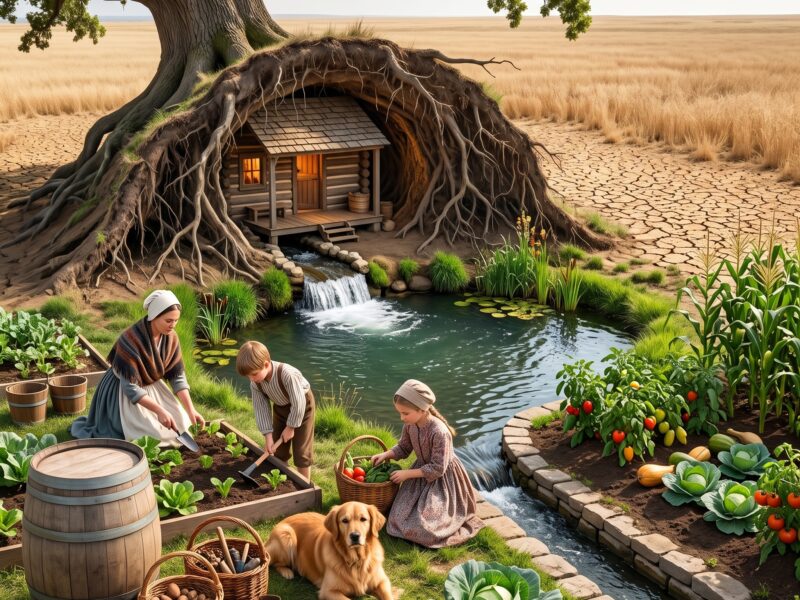
A Storm Knocked Down the Biggest Tree During the Worst Drought — What It Revealed Changed Everything
The Mathematics of Dust
Florinda knew the horse before she saw it. Burly Yarbrough’s sorrel. A big chestnut mare that was fat and sleek and glossy in a season when every other horse in three counties was showing ribs like piano keys. The thud of its hooves outside the cabin door was the sound of a man who did not worry about tomorrow because he owned a piece of it—owned the piece and rented the rest to people who could not afford to say no.
The knock was three short raps. Polite. Polite the way a thing with teeth is polite to a thing without them.
“Mrs. Crenshaw. A word.”
Florinda wiped her hands on her apron, touched the top of Opal’s head once, and opened the door. Burly Yarbrough stood on her porch in a charcoal frock coat, already beaded with trail dust along the hem. His gold watch chain caught the harsh sunlight and threw a sliver of it across Florinda’s floor like a knife laid down casually on a table. Under one arm, he carried a leather portfolio that snapped shut with a brass clasp.
His eyes moved across her kitchen in the half-second the open door gave him, and she watched him count what she had. She watched him add up the limp flour sack, the empty salt pork hook, the pathetic potato bin, and the two buckets of creek water. She watched him arrive at a number, and she watched him be satisfied with that number because it was the exact number he had come here to find.
He came in without waiting for an invitation. He set the portfolio on the pine table Ransom had built their first winter, laid the clasp open with one finger, and placed a fountain pen beside it. The pen was a silver Parker with a mother-of-pearl inlay along the cap. Florinda had seen one like it once in the desk drawer of the stationmaster. They cost eight dollars. More than she had in the tin.
Yarbrough set the pen on her table the way a gambler sets down aces—slowly, with the face showing, so you understood that the game was already decided and the rest was just manners.
“Thirty dollars for the whole forty acres. I’ll have the deed drawn up by Friday. You and the children can be east of the river by Sunday evening.”
Florinda stood very still. Nolan had moved behind her, close enough that she could feel his breath on her arm. Opal had drifted to the edge of the table and was looking at the pen the way a child looks at a snake that has not decided yet whether to strike.
“My husband filed a homestead claim on this land, Mr. Yarbrough. Two years completed of five.”
“And then he died, Mrs. Crenshaw,” Yarbrough’s voice carried the tone of a man delivering bad news he had rehearsed. “Which I was sorry to hear. Truly. A widow may complete her husband’s claim under the statute, as you know. But completion requires improvements.” He held up one finger. “It requires crops.” A second finger. “And it requires water.”
His eyes went to the window, to the brown, cracked square that had been her garden in the spring, and then further to the hillside that stretched out behind the cabin like a promise someone had broken and walked away from.
Opal had gotten close to the table. Yarbrough looked down at her, and he smiled at the child with a particular kind of smile. The kind a man uses on a small person whose hunger he is counting on. It was a smile that calculated. A smile that measured.
Opal did not smile back. She looked at him with that stubborn set to her face, the one she had been born with, and then she turned away, picked up her corn-husk doll, and held it to her chest. Five years old, and she knew. She knew the way animals know when the air changes before a storm. She knew that smile was not for her.
“My offer closes in three days, ma’am. After that, I have other widows to visit.” He said it the way a man reads a train schedule. “Tuesday, the Crenshaw place. Wednesday, the Heenan widow on the South Fork. Thursday, the Dawson claim.” A route. A business. “The county will take this for back taxes in October, and you will get nothing at all.”
Florinda did not touch the pen.
“Three days, Mrs. Crenshaw.”
He rose from the table, tucked the portfolio under his arm, and tipped his hat in the doorway. His body blocked the light for a moment, and in that moment the cabin went dark. Florinda understood that this was what he was actually selling. This feeling. This shadow. The terrible knowledge that a man could stand in your door and make the sun go away.
“A sensible woman,” he said softly, “will have signed by supper tonight.”
She stood in the open door after he rode out, watching the dust of his horse settle on the track. She did not close the door, because closing it felt like agreeing that she was trapped inside.
Twenty minutes later, Jovita Pennywit’s wagon came along the track from the east. Jovita had sold her place to Yarbrough two weeks back. Her wagon was piled high with furniture, bedding, a crate of miserable chickens, and the iron stove her husband had left behind when he walked off the claim in June and never returned.
Jovita reined up, squinting through the glare. She was thirty-five, sun-cracked, with hands that looked like they had been fighting the ground for a decade and losing.
“You sign yet, Florinda?” “Not yet, Jovita.” “Sign, honey. There is nothing out here worth dying for. Not a stone, not a tree, not a memory. Take his thirty dollars and get those babies to your people before the cold comes and finds you empty.”
The wagon rolled on east. Florinda watched until it became a dark smudge on the white road, and then she watched the place where it had been, and then she closed the door.
That afternoon, Cordelia Whittaker came walking up the track from the neighboring hollow. Cordelia was sixty, widowed three years, thin as a fence post and just as upright, with gray hair kept in a bun so tight it pulled her eyebrows into a permanent expression of mild surprise. She had known Grandmother Ione in Tennessee. She had sat in Ione’s kitchen, drunk Ione’s coffee, and listened to Ione’s stories about water and trees and the things the earth told you if you had the sense to shut your mouth and listen.
Cordelia brought a jar of pickled cucumbers and a piece of advice.
“Ione would have told you to fight back, Florinda,” she said, setting the jar on the table exactly where Yarbrough’s pen had been. “But Ione also died in Tennessee. Not here. Not in this.”
Florinda looked at the old woman. “Do you think I should sign, Cordelia?”
Cordelia was quiet a long time. The silence had weight to it—the weight of a woman who had been through her own drought and her own grief, and had come out the other side with opinions she did not want to impose but could not entirely keep to herself.
“I think you should live,” Cordelia said finally. “How you do that is your business.”
Cordelia left. Florinda stood in the kitchen and felt lonelier than she had before the old woman arrived. The counsel of someone who refuses to choose for you weighs infinitely more than the threats of an enemy. An enemy, at least, tells you where he stands. A friend who will not take sides leaves you standing in the middle of the road with traffic coming from both directions.









