A Storm Knocked Down the Biggest Tree During the Worst Drought — What It Revealed Changed Everything
The Thirty-Day War
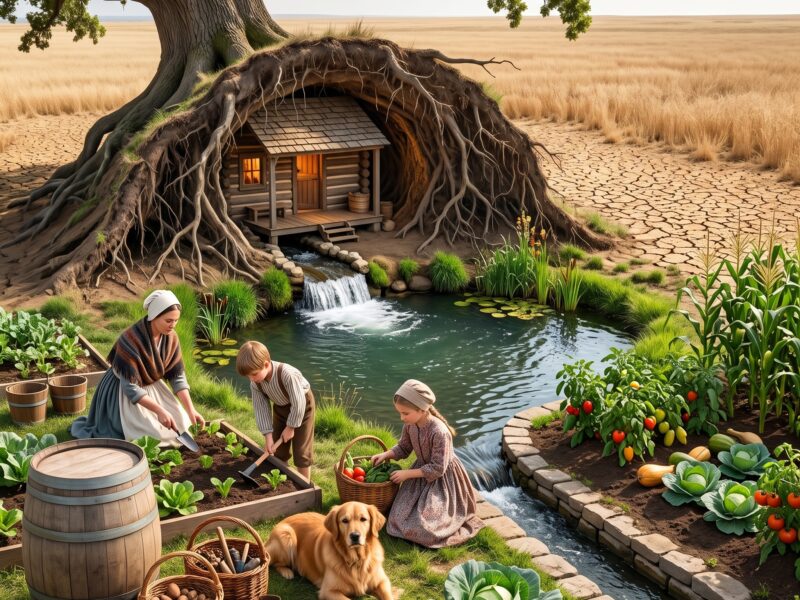
Day seven. Florinda began setting the first course of the spring basin. Flat stones placed in a perfect ring three feet across, each stone fitted to its neighbor without mortar. Grandmother Ione’s notebook had said: Never dam a spring. Cradle it. Florinda understood what that meant now. You did not trap the water. You did not force it. You built it a beautiful place to rest, and then you let it decide whether to stay.
Day eight was the channel. Florinda cut the earth with the heavy spade. Nolan followed behind with a wooden scoop Ransom had made for winnowing grain, and lifted the loosened soil out of the cut. Opal walked the line with a string stretched between two wooden pegs to make sure they were not wandering off course. The five-year-old took this job with the deadly seriousness of a surveyor. She corrected her mother twice—once when Florinda drifted three inches east, and once when the channel began to curve where it should have run perfectly straight. Florinda did not argue either time. The foreman had spoken.
Day nine. Florinda sawed planks from the downed trunk. Fourteen planks. Each seven feet long, five inches wide, and an inch and a quarter thick. The handsaw dulled on her twice. She sharpened it with a metal file her grandfather had given Ransom at their wedding—a gift that had seemed odd at the time and now seemed beautifully prophetic.
Sitting cross-legged in the dirt, drawing the file screaming along the teeth, she realized she had not cried once in nine days. And this was not because she had stopped missing Ransom. It was because the missing had dramatically changed direction. For six months, it had been a heavy hand on her chest pushing her backward, pushing her down. Now it was a firm hand on her back, pulling her forward, pulling her through.
That night, after the children were asleep in the new space inside the root cavity—not yet a cabin, but something closer to a secure den—Florinda sat alone beside a single candle and opened Grandmother Ione’s notebook to the last page, the blank page.
She took the pencil stub she kept in her apron pocket and she wrote: Mama, I do not know if this will hold. I am doing what you told me. If it does not hold, I need you to know I tried. Forgive me for not being enough.
She closed the notebook. She put her head down on her arms and slept there at the table. She did not dream, and she did not wake until a small, warm hand touched the back of her neck and a small, clear voice said, “Mama, your candle went out.”
Opal. Standing beside her in the dark, barefoot on the packed earth, her hand resting on Florinda’s neck the way you rest your hand on a fallen bird to see if it is still alive.
Florinda sat up. She remembered why she was still here on the ninth day of thirty. She kept going.
The basin held on day twelve.
Florinda removed the temporary diverter stone a little after ten o’clock in the morning with both children watching. Their dirty faces were so still and so focused that they looked like small statues someone had placed on the hillside to mark a sacred spot.
Water rose through the fine gravel bed in thirty seconds. It found the level of the lip. It found the overflow notch she had carefully cut into the eastern stone. It began to run. Clear and cold and without hesitation down the stone-lined channel toward the flat ground where the garden would be.
She timed it with Ransom’s pocket watch in a cedar bucket. Fifteen seconds. Three and a quarter gallons. More than three gallons a minute of cold, clean water coming up out of the earth as if it had been waiting to be asked.
Nolan whooped. It was a true boy’s whoop. High and wild and uncontained. The sound of someone who has been holding his breath for twelve days and has finally been given cosmic permission to exhale.
Opal ran to the channel and plunged both hands into the rushing flow, and then put her wet hands directly onto her mother’s exhausted face. The water on Florinda’s cheeks was cold enough to shock, and it felt like waking from a long nightmare.
“Mama! It is cold!” “Fifty-four degrees, sugar. Year-round. The springs here run at the temperature of the deep stone they come through. That is colder than our cabin. That is colder than anything you have touched in a month.”
Opal grinned. It was the first full, unshadowed grin Florinda had seen on her daughter’s face since Ransom’s funeral.
The next morning, Florinda rode the bony mule down to Mills Creek for salt. She needed it for preserving whatever the garden would miraculously produce, and salt was one of the things the drought had not made expensive because salt does not need water, and therefore salt does not care about the weather.
At Treadwell’s Mercantile, she met Cordelia Whittaker at the counter. Cordelia was buying a half-sack of flour. Treadwell was behind the counter with his ledger book, making notes in the margins the way he always did. Small annotations that were less about bookkeeping and more about surveillance. Who bought what. Who could not afford to buy what. Who had credit and who had used it up. In a drought, information about other people’s desperation was its own potent form of currency, and Treadwell traded in it with the same attention to margin that he gave to nails and lamp oil.
“Mrs. Crenshaw,” Treadwell said without looking up from the ledger. “You have not signed for Yarbrough yet.” He was asking.
Before Florinda could answer, Cordelia spoke. Her voice was thin. Her voice trembled. But the words were clear.
“Florinda is still there, Mr. Treadwell. She has not signed.”
The words hit the wooden counter like dropped coins. Treadwell looked up. His bushy eyebrows rose. His pencil stopped moving. Florinda could see the information entering his mental ledger even though he did not write it down. Could see it traveling from this counter to Yarbrough’s ear by nightfall, carried on the invisible current of small-town gossip that moved faster than water and was twice as hard to stop.
Cordelia would not meet Florinda’s eyes.
Outside, in the white, blinding glare of the street, Florinda took Cordelia by the hand. The old woman’s fingers were shaking like dry leaves.
“Cordelia. Why?”
Cordelia began to cry. The tears came without sound, running down the deep creases of her face the way water runs down a dry creek bed, finding the old, familiar channels.
“Yarbrough told me if I did not confirm who had not signed, he would reassess the water tax on my well. I have no money, Florinda. I am sixty years old, and I live alone, and I am frightened of what happens if I lose my water. I am so sorry. I am so sorry.”
Florinda let go of Cordelia’s hand. She did not let go because she was angry. She let go because she understood, and understanding was heavier than anger, and she needed both hands free to carry it. She understood that Cordelia was not a traitor. Cordelia was a good woman trapped in a system designed by greedy men to break good women. And the system had found the hairline crack in her and pressed on it, and the crack had given way.
Florinda did not blame her. She could not afford to blame her. Blame was an emotional luxury that required energy, and energy was something Florinda was measuring out in tablespoons now. Rationing it the way she rationed flour. Giving each task only what it needed, and saving the rest for the next task, and the next.
But she felt something terrifyingly new as she walked back to the mule. A loneliness she had not felt before. Not the loneliness of grief, which she knew well. Not the loneliness of hard physical work, which she had made her peace with. This was the dark loneliness of knowing that even the people who love you can be turned against you. That kindness has a breaking point, and that the breaking point is lower than you want to believe.
She rode home with the salt in her saddlebag, and the cold knowledge that Yarbrough now knew she was still fighting on the land. He would come sooner than she expected. She had less time than she thought.









